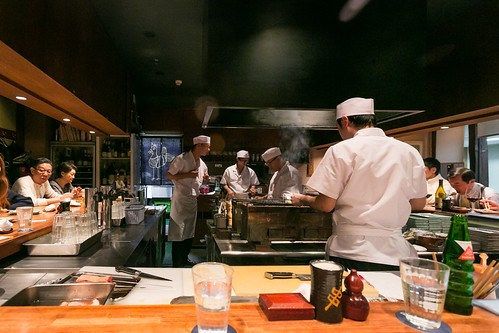


The difficult part is choosing somewhere that does not make the invitation sound larger—or smaller—than intended. A celebrated restaurant gives it a scale. A reservation made well in advance suggests that the evening has been considered; a good room lends the occasion some composure. There will be a table. Dinner will have a beginning and an end.
For a particular kind of visit, this is a relief. The person coming may usually know your life through brief, practical accounts: work, a journey, whether you have been eating properly. Now they are here, and the choice of restaurant seems to carry an unreasonable amount of information. You would like them to see that things are going well. You would also like, perhaps, to stop reporting on how things are going.
An expensive dinner is a perfectly sensible place to start. It can be pleasurable in exactly the ways anticipated. The mistake would be to choose it chiefly because its reputation requires so little explanation, then expect the other person to provide the feeling the occasion lacks.
There is another complication. You may be inviting someone who once chose all the places for you. They knew what you ate, how far you could walk, when it was time to go home. Now you have a city to show them, and considerable freedom to get the details wrong.
© MonasteryInwang · Source · CC BY-SA 4.0 · Resized, uncropped.
Twenty-four floors up
The Lounge at Park Hyatt Seoul gives an invitation an immediately legible setting: the twenty-fourth floor, above Teheran-ro, with Korean cooking, traditional teas and an afternoon tea service. It is an address to choose without embarrassment when this is the kind of afternoon the guest would enjoy. The window and the menu are substantial parts of the offer. [1]
The height has a practical consequence. It allows a city to be looked at without requiring the visitor to keep moving through it. That may be especially welcome at the end of a journey, or when the host is keen to show a great deal and the guest has the energy for rather less. A seated view leaves room for unequal appetites for sightseeing.
The room also permits an invitation in daylight. The hotel now opens The Lounge at nine in the morning, and its afternoon tea runs on a separate schedule. There is no obligation to turn a meeting into the evening’s principal event. An afternoon can be given its own shape, with other hours still available afterwards. [1]
Taking responsibility for the booking, the timing and the bill can be a straightforward pleasure. This need not conceal a grander emotional intention. Sometimes the invitation means precisely what it appears to mean: you are going to sit down, and somebody else has arranged lunch. Getting the details right is work, even when the result looks effortless.
The food and service still have to justify their price. A view cannot establish how well a kitchen cooks, and a hotel name cannot tell you whether the room will suit a conversation. The Lounge’s published offering makes it a credible choice for Korean food or tea above the city; it does not establish the atmosphere of a particular table on a particular afternoon. A window seat, menu terms and any time limit belong in the booking enquiry, not in promises made to the guest. [1]
There is, in any case, nothing discreditable about wanting the view to impress. Pleasure in a city’s scale can be shared. The difficulty comes when the host begins to check whether it is having the required effect: whether the phone has been raised for a photograph, whether the right comparison has been made, whether the occasion looks sufficiently like an occasion.
An invitation can survive a more ordinary response. Someone may be interested in the tea. They may want to talk about the journey. They may be pleased simply to find you sitting opposite them without having to leave for work. A table chosen with care should be able to accommodate all of this, rather than compete with it.
Lunch in a former home
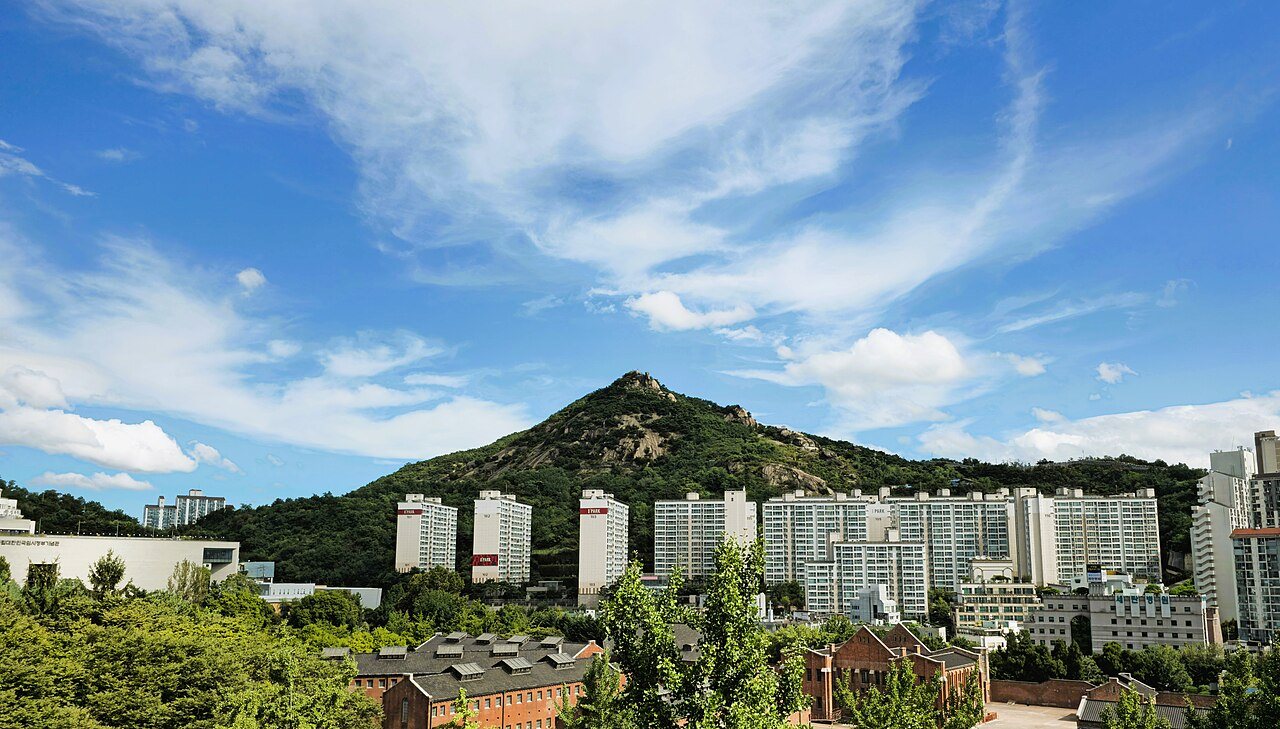
At Jaha Son Mandu, in Buam-dong, the mountain has a different relation to the meal. Michelin’s account places Inwangsan beyond the main dining room. There is no need to climb it to make it part of lunch. [3]
The restaurant began in 1993, when Park Hye-kyung and her sister-in-law put three parasols outside the family home. In a 2020 interview with Michelin, Park described how the business spread through the house: first a room was cleared, then more of it, until the family moved out. The restaurant’s domestic beginnings are a matter of record, not a mood inferred from its furniture. [2]
It is a telling history because it involves a change of use. The home did not remain intact around a few fortunate guests. It became a place where other people could eat. That is enough of a story; there is no need to add an imaginary welcome at the door or turn the family into guardians of an unchanging past.
The most direct order is mandutguk: dumplings filled with pork, tofu and vegetables, served in beef broth with house-made soy sauce. The current published menu lists it at ₩20,000. A dumpling hotpot for two is ₩58,000. These are proper restaurant prices, and the meal deserves to be considered without the flattering fog that sometimes gathers around an old family recipe. [3], [4]
Park’s account of the soy sauce gives the bowl a more precise history. The practice came through her mother and grandmother; in the interview, she described never having bought soy sauce for the restaurant. A familiar condiment is therefore one of the things that makes this particular kitchen worth seeking out. It offers a better starting point for curiosity than the vague assurance that a meal will be traditional. [2]
A bowl also establishes a manageable scale for an invitation. It can be lunch, rather than a procession of dishes ordered to demonstrate that nothing has been withheld. Someone who is hungry can eat. Someone with a modest appetite need not participate in a long performance of appreciation. The host can stop adding to the order.
This can be welcome when a visit has already acquired a full programme. The pressure to account for a city is considerable: something old, something new, an address the visitor might recognise, another they could not have found alone. Lunch is allowed to interrupt that programme. The mountain is already there, in the restaurant’s setting; it does not have to become the next task.
There are practical reasons to keep the plan small. Buam-dong is not a flat extension of a subway platform. The public-transport approach involves a bus and a walk, and step-free access to the restaurant has not been established for this feature. A taxi may be the simpler arrival; the restaurant should be asked directly about stairs and seating. [5]
Nor does a former house imply a quiet table. Go for the dumplings, the documented history of the kitchen and the outlook. A meal worth taking someone to does not have to withstand the additional requirement of being empty around them.
Lunch can remain the whole appointment. The walk afterwards can be decided afterwards.
© Korea.net / Korean Culture and Information Service (Jeon Han) · Source · CC BY-SA 2.0 · Resized, uncropped.
The crossing is part of it
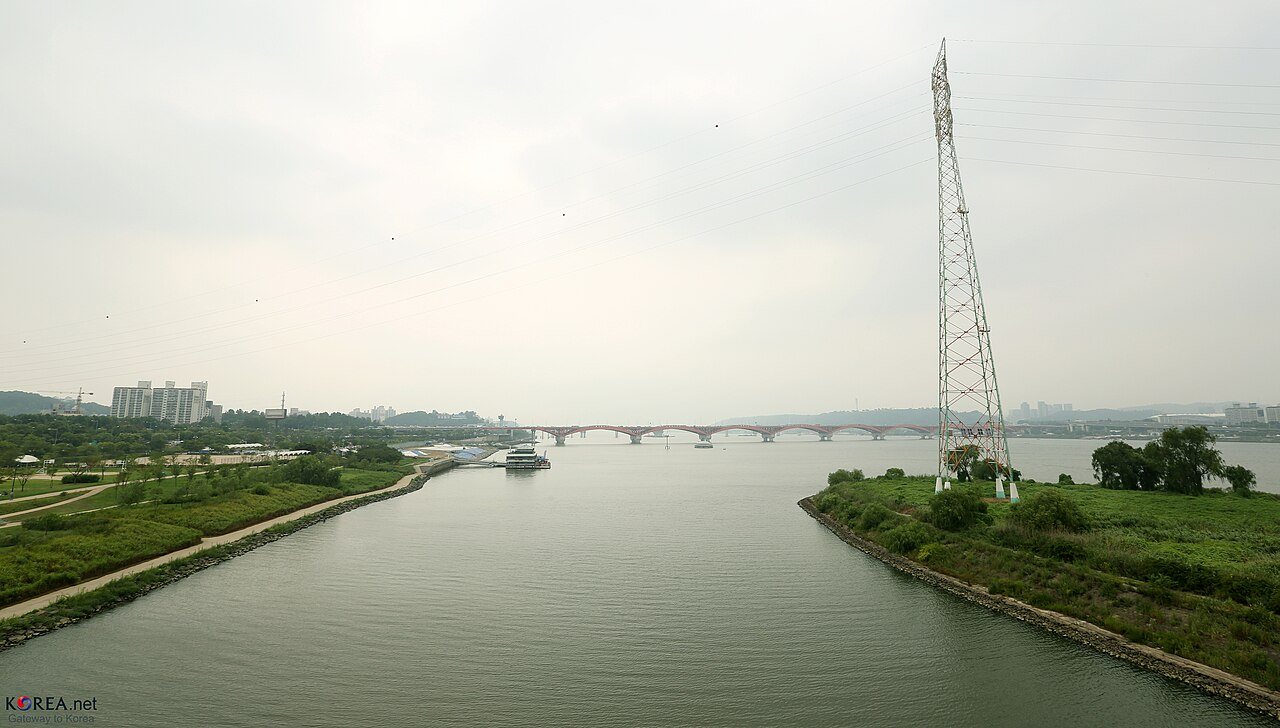
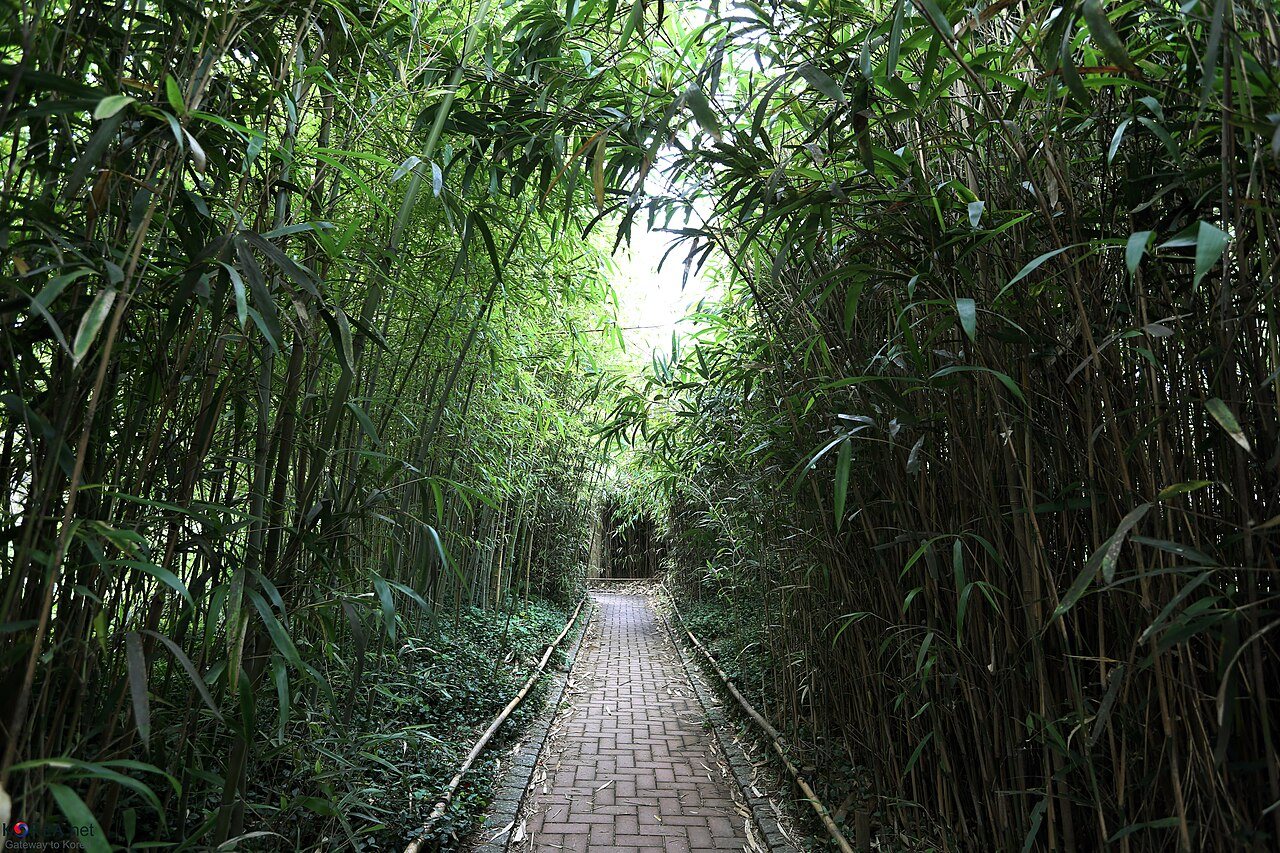
For Seonyudo Park, start on the southern riverbank at Yanghwa Hangang Park and approach across the pedestrian Seonyugyo. The sequence matters. Reaching the island across water gives the visit an interval that would be missing from a direct arrival at its gate. The city’s own walking route connects the park, the bridge and the southern riverbank. [6]
A crossing supplies a simple piece of shared business. There is a direction to follow and something ahead. Two people can look the same way without having to explain why they are not looking at each other. Conversation need not occupy the whole passage.
The crossing has to suit both visitors. The bridge is exposed, and a visit to the island carries the obligation to get back. The approach should be chosen for someone who likes walking, in conditions that make walking agreeable. The broad river view does not cancel cold, fatigue or a dislike of heights.
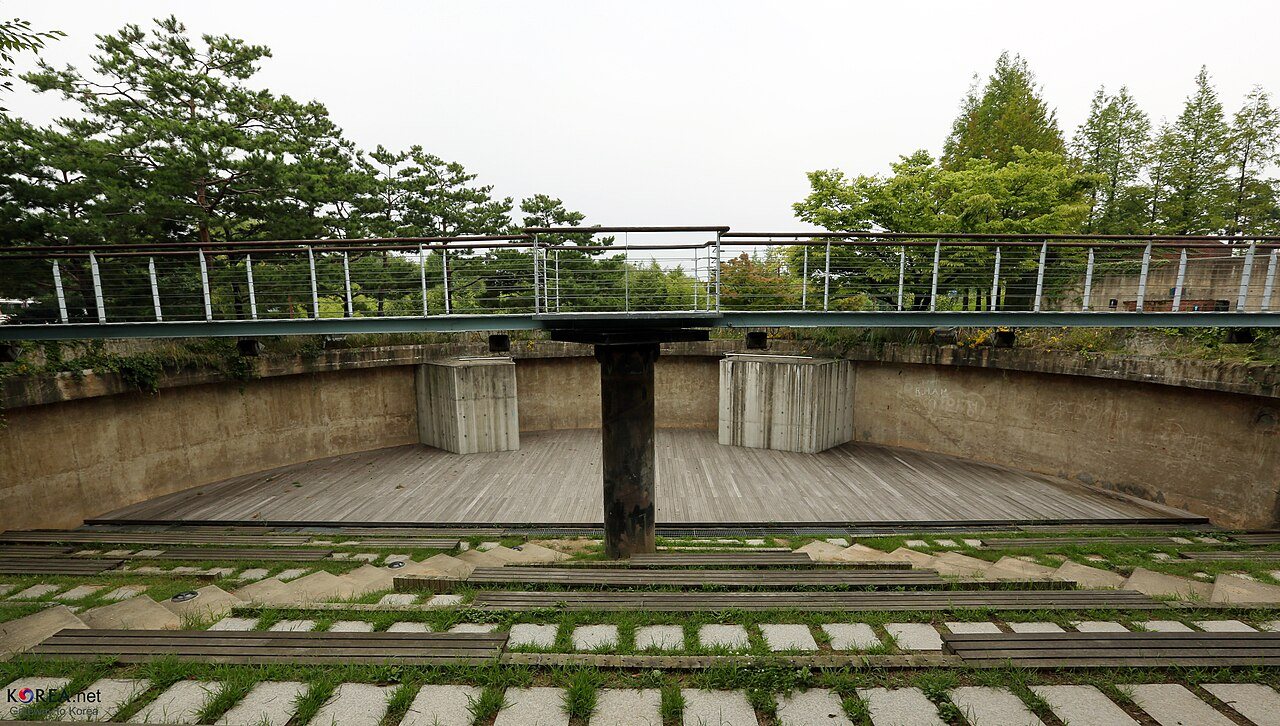
Inside the park, the scale changes. Seonyudo opened in April 2002, reusing a water-treatment plant rather than removing every trace of it. The retained structures divide the landscape into smaller areas, with planting occupying spaces once devoted to the work of supplying water. [6], [7]
In the Green Pillar Garden, the roof slabs of a former reservoir were taken away while its columns remained. KBS’s reporting describes the resulting rows of supports in a recessed garden. The roof is absent, but the spacing still belongs to a structure built to carry one. [8]
That is a reason to come even under an undistinguished sky. The park is not waiting for a sunset to make sense. Its interest is in relationships that can be examined at ordinary speed: an edge, a change in level, a piece of concrete whose earlier purpose is no longer its only use.
© Korea.net / Korean Culture and Information Service (Jeon Han) · Source · CC BY-SA 2.0 · Resized, uncropped.
For someone interested in design, there is plenty to discuss. For someone who would rather just look, the history does not have to be delivered in full. The conversion is visible enough to allow curiosity to begin with a question. What was this part for? Why was that left standing? The host is allowed not to know every answer.
A conversation conducted entirely through updates has a limited repertoire. Work, family, the next journey: there may be a great deal to catch up on and very little that has happened to both of you. The park supplies other material. You have at least looked at the same object. It is possible to disagree about it, to find it ugly, to wonder why it was kept. There is no requirement that the discussion move on to anything more consequential.
Seonyudo’s earlier purpose also prevents a simple reading of the island as a retreat from urban life. The waterworks served the city. Its remains belong to the same urban history as the roads and housing beyond the river. The garden offers a different way of occupying that history, not a clean separation from it. [8]
It remains a public park. The photographs in this feature record its paths and structures at particular moments, not a promise about the number of other visitors. A weekday in daylight is the more cautious choice for an unhurried walk; there may still be groups, events and people with quite different plans for the same space. There is no entitlement to a quiet island.
The official sample route runs to about 2.3 kilometres, without accounting for the journey from and back to transport. That is enough walking to deserve an honest description before setting out. A shorter visit is entirely possible; the point is to leave some energy for the return. Seoul’s accessible-tourism information also identifies level changes, so a route that suits one walker should not be assumed to suit every visitor. [6], [9]
Bring water, know the way back, and let the park occupy the time available. There is no need to wait for the light to improve. Crossing back with some afternoon left can be a satisfactory ending of its own.
© Korea.net / Korean Culture and Information Service (Jeon Han) · Source · CC BY-SA 2.0 · Resized, uncropped.
At the end of Ogin-gil
At Suseongdong Valley, the important decision comes near the beginning. It is possible to see the valley without going on to climb Inwangsan. The lower public area is a destination, not an inadequate version of the summit. [10], [12]
The approach places it firmly in Seoul. Ogin-gil runs up through Seochon towards the eastern foot of the mountain; alternatively, the Jongno 09 local bus ends its route close to the valley. Official visitor directions put the final walk from the terminus at roughly 140 metres. A hillside landscape begins within reach of a neighbourhood bus. [12], [13]
That is a different proposition from leaving the city behind. It allows a visit to remain small. The bus has done much of the uphill work; the street is still part of the return. Someone can agree to come without committing to a mountain route whose remaining distance they cannot judge.
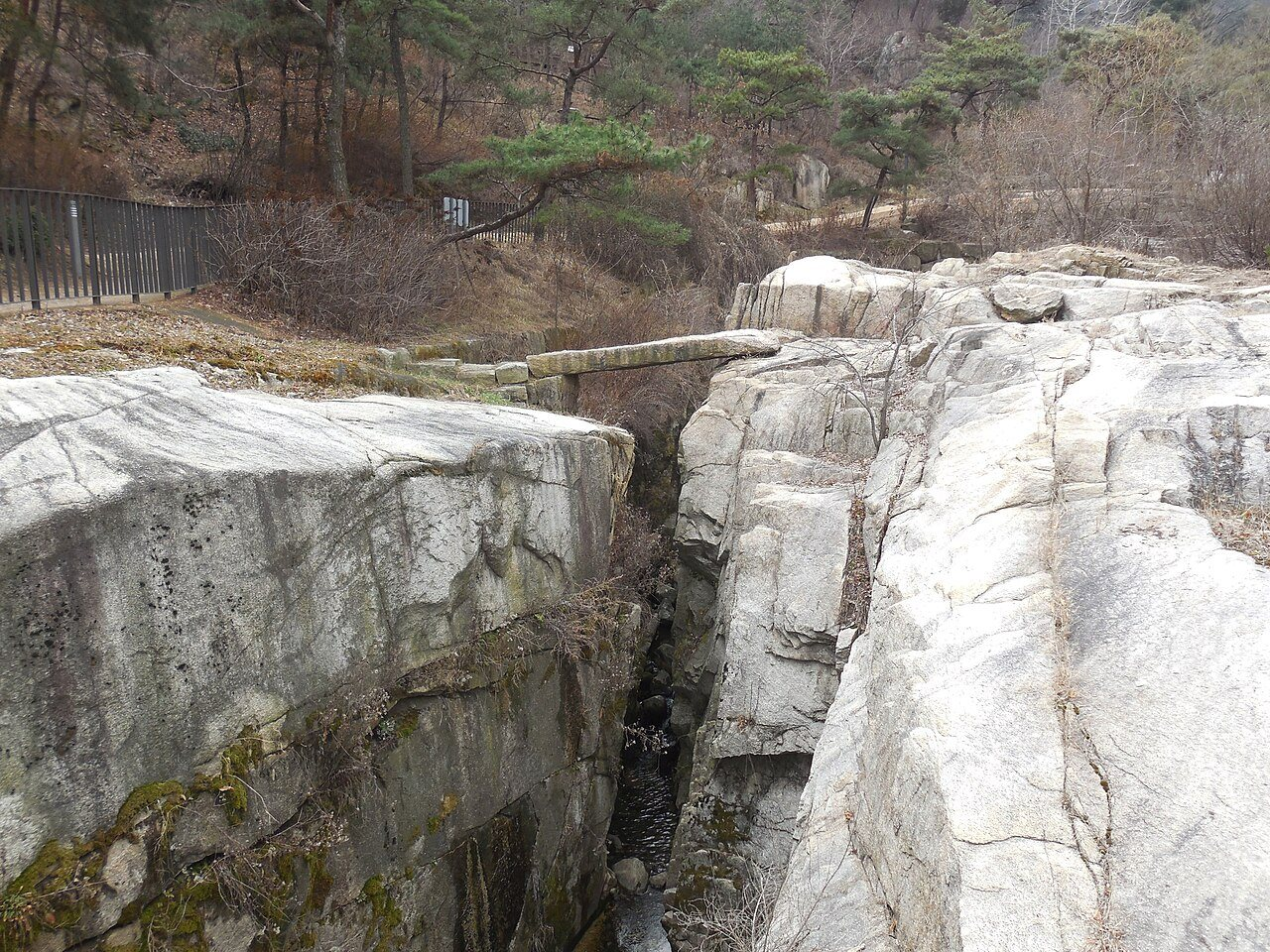
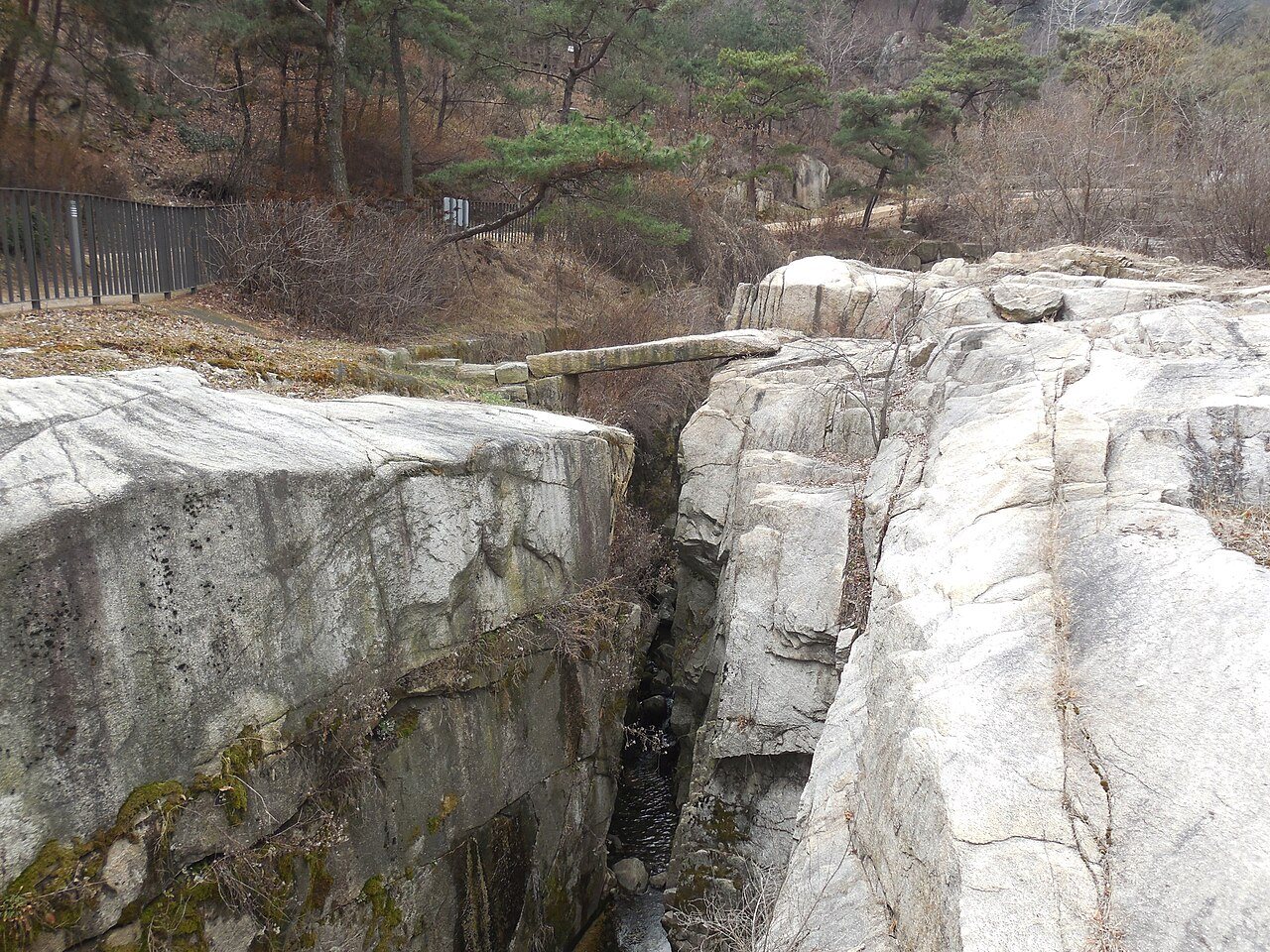
The physical detail worth looking for is Giringyo, the stone bridge across the lower valley. In the archival photograph reproduced here, its narrow span sits among broad areas of exposed rock. It gives the eye a measure: against the irregular bedrock, a crossing made to the scale of a person. The bridge is also present in Jeong Seon’s eighteenth-century depiction of Suseongdong. [10], [11]
© 오모군 · Source · CC BY 3.0 · Resized, uncropped.
There is a temptation to let the painting settle the meaning of the place. A historic bridge, granite, a mountain: it would be easy to describe the valley as a piece of old Seoul preserved outside the demands of the modern city. Its actual history is less tidy.
Nine Ogin apartment blocks, built in 1971, occupied the site before their removal during the restoration project. The landscape opened to the public again in July 2012. The city’s announcement was explicit about the role of Jeong Seon’s painting in the work: the intention was to recover the rock formations and a setting recognisable from the earlier view. [11], [14]
Restoration involved choices about what to reveal, remove and plant. The result can be valued without pretending that the intervening decades did not happen. The apartments were once homes. Their presence complicates the view, even when the buildings themselves are no longer in it.
At Seonyudo, the conversion kept much of the concrete. Here, recovering an earlier landscape required buildings to come down. Both places can appear to offer relief from the built city, although each is the result of a decision about it. The painting matters; so does the period when the address belonged to apartment residents. The view holds both histories uneasily. [7], [11], [14]
The water offers a smaller correction to expectation. Suseongdong’s name refers to its sound, but the Academy of Korean Studies notes that there is often little flow outside rainy conditions. There may be more exposed bedrock than running stream. A visit arranged around the sound of rushing water could therefore fail before either person had done anything wrong. [10]
The rock still gives the valley its form. It need not be made to impersonate the wettest photograph of itself. In dry weather, the crossing and the bed of the stream can be considered without the water becoming the principal event; in heavy rain, the sensible decision may be to stay away.
Downstream, this water belongs to the network feeding Cheonggyecheon. The Academy’s account describes the lower course covered as the neighbourhood developed. The valley and the streets below are connected physically, not just by a pleasant walk between them. Part of what appears to end at the edge of the landscape continues out of sight. [10]
At the entrance, there is a more immediate provision. Seoul’s walking guide identifies benches in the plaza as somewhere to pause before hiking. The restoration announcement also records seating around the viewing area. The visit need not proceed beyond that pause. [11], [12]
The benches present a small embarrassment for an over-prepared host. There is nothing else to unveil. The afternoon is no longer supported by a confirmation email or a menu describing what will follow. It might be over in half an hour; it might last considerably longer. This is difficult to advertise in advance without making it sound as though very little has been arranged.
There is also a limit to what the arrangement can decide. The guest might be interested in the bridge, the route on a map, the question of what to eat later. They might have no interest in the painting at all. An afternoon can go well without producing agreement about its most important part.
A public seat helps in an unglamorous way. Provided one is available, sitting does not require another order, another course or an explanation for staying. It also does not require staying. The way back is still there.
None of this makes the entrance a private room. Other people use it, and organised events can change its character. The case for coming rests on the modest scale of the visit and the possibility of pausing, not on the prospect of possessing a piece of Seoul undisturbed.
Perhaps this is someone who has travelled to see where you live. Much of the time together will inevitably concern arrangements: how long they can stay, when to leave for the airport, whether the suitcase is ready. Between those conversations, it is reasonable to want to show them something that has not been selected only because it is famous.
A bench may be free. There may be time before the practical conversations have to begin again. And the person you brought may have a story that has nothing to do with Seoul, a story you have not heard because the telephone calls have always been so short.
Later, there will be the choice of walking down Ogin-gil or returning to the bus stop.
For now, there is somewhere to sit.
Before you go
Choose one, rather than make a circuit. Gangnam, the western riverfront and the Inwangsan neighbourhoods are separate outings. Jaha Son Mandu and Suseongdong have different approaches to the mountain; they should not be treated as adjoining stops.
Published information checked 9 October 2026. This is a desk-researched feature, not a firsthand restaurant review or an accessibility audit. Confirm hours, bookings and weather-related access before departure.
The Lounge, Park Hyatt Seoul
파크 하얏트 서울 더 라운지
606 Teheran-ro, Gangnam-gu, 24F. Choose a seated meal or tea when an indoor visit is preferable. Published hours: daily 09:00–22:00; breakfast 09:00–11:00. Afternoon tea: weekdays 14:00–17:00, weekends 12:00–17:00. Reserve directly on +82 2 2016 1235. It is paid dining: request the current price of the specific menu or tea service; no unverified per-person total is quoted here. [1]
Limitations: confirm window seating, table duration and the appropriate arrival route when step-free access is required. A quiet table is not guaranteed. This is the indoor choice within this selection, not a nearby rain shelter for the other three places. Checked 9 October 2026.
Jaha Son Mandu
자하손만두
12 Baekseokdong-gil, Jongno-gu, Buam-dong. Published hours: Tuesday–Sunday 11:00–21:00, closed Monday. Lunch keeps the appointment modest. Call +82 2 379 2648 for booking, waiting arrangements and last orders. Published prices: mandutguk ₩20,000; dumpling hotpot for two ₩58,000. The signature soup contains pork and beef, as well as tofu and vegetables. [3], [4], [5]
Arrival and limits: the official approach uses buses 7022, 1020 or 7212 from the Gyeongbokgung area to Buam-dong Office, followed by a walk. A taxi to the address can simplify the arrival. Step-free entry and internal seating access were not verified; ask about stairs before booking. Plan the return separately rather than adding a mountain walk by default. Checked 9 October 2026. [5]
Seonyudo Park
선유도공원
343 Seonyu-ro, Yeongdeungpo-gu. Standard hours: daily 06:00–24:00; ordinary admission is free, with no reservation. For the approach in this feature, navigate first to Yanghwa Hangang Park, then cross Seonyugyo. Seonyudo Station, Line 9, is one starting point, not a park-door arrival. Allow extra time for the station approach; the municipal sample park-and-riverbank route alone is approximately 2.3 km. [6], [7]
When and limits: daylight, preferably a weekday when schedules permit; no solitude is promised. The bridge is exposed and paths change level. Consult the Seoul Danurim access information for wheelchair planning rather than assuming a uniformly step-free circuit. Bring water, check same-day park and Hangang notices, and retrace a known route before dark. Shorten the visit rather than depending on an unverified café opening or a particular empty seat. Checked 9 October 2026. [9]
Inwangsan Suseongdong Valley
인왕산 수성동 계곡
185-3 Ogin-dong, Jongno-gu; the entrance is at the upper end of Ogin-gil. Standard public access is listed as 24 hours, free, without a reservation. Choose dry daylight nonetheless. From the Gyeongbokgung Station area, use local bus Jongno 09 to the Suseongdong terminus, then approximately 140 metres on foot. Return towards the Gyeongbokgung area on the same local route; check the actual stop and next service before setting out. [12], [13], [15]
Physical demands and limits: the bus avoids much of the uphill street approach. This recommendation is for the lower valley and entrance plaza, not a summit hike. Benches are public and first come, first served; a complete step-free valley route and continuous lighting were not verified. The stream may carry little water in dry weather. Avoid slippery or icy conditions. Checked 9 October 2026. [10], [12]
October planning note: Visit Seoul advertises a performance at the valley entrance on 17 October 2026, 16:00–17:30. Expect a different use of the entrance area around that time. The concert’s ₩30,000 ticket is separate from ordinary free public access; consult the event notice for changes. [16]