



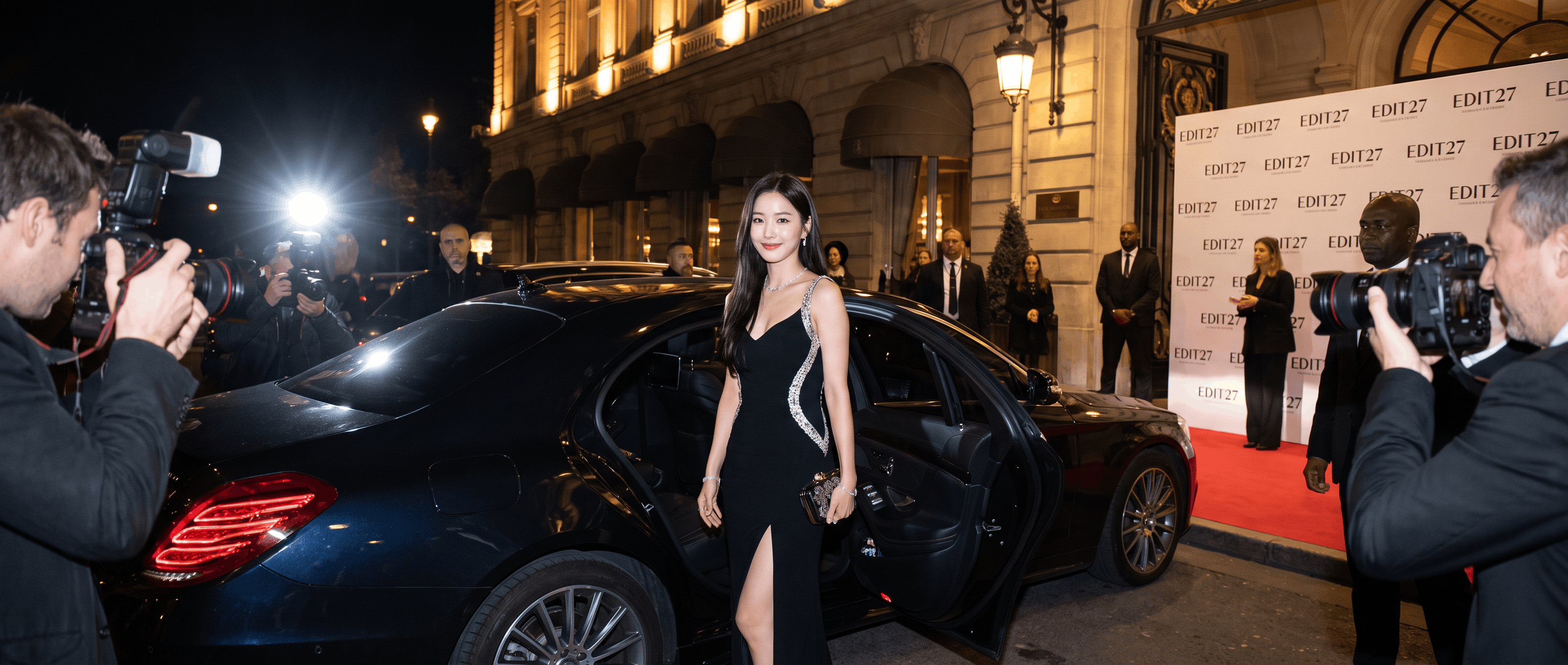
Before Rihanna stepped onto the Met Gala carpet in 2015, there was a problem with the seating.
She was wearing Guo Pei, and getting the outfit into and out of a car required planning. Recalling the evening in a 2020 interview with Access Hollywood, she described the questions: “Who sits at the door? Where does the coat go? Where do I sit?” She also remembered circling three times before making her entrance, concerned that she had gone too far. [1]
The garment was The Yellow Queen. Hong Kong’s M+ museum describes it as weighing twenty-five kilograms, with a four-metre train. Those measurements help explain the practical difficulty, although they cannot quite account for the pleasure of looking at it: the extraordinary breadth of yellow, the embroidery, the way the train gives the wearer an expanse of space that belongs, for a moment, entirely to her. [2]
An arrival photograph has little room for the discussion about where to put the coat. Its business is the finished appearance. We see the person who has emerged, suitably arranged, and are tempted to imagine that this was how she felt throughout.
The preparation suggests a more interesting understanding of confidence. Someone can hesitate in the car and still make an entrance worth remembering. The hesitation need not cancel the achievement; nor does the achievement make the hesitation imaginary.
Guo Pei deserves to remain central to that achievement. Calling the garment “Rihanna’s yellow dress” is convenient, but it makes the designer sound like a supplier to an occasion rather than the author of a substantial work. M+ subsequently included The Yellow Queen in its exhibition devoted to Guo’s practice, placing the piece within a career rather than a single evening’s celebrity coverage. [2]
That is one reason to look carefully at arrivals. They bring several kinds of work into unusually close contact. Clothing meets a body, then a pavement, a staircase, a camera. A design that has been considered in a workroom must contend with a door that opens only so far. A person who has spent hours getting ready has to decide where to look.
The results can be glorious. They can also be awkward, overmanaged or simply dull. An expensive outfit and an important invitation do not settle the matter.
What gives a good entrance its appeal is the small interval in which everything is still possible. The guest has arrived, but the evening has not yet made its demands. There has been no disappointing conversation, no speech that outlasts the room’s patience, no discovery that the table looked better before everyone sat down. The picture can hold the evening at this promising stage indefinitely.
The people attending have to keep moving.
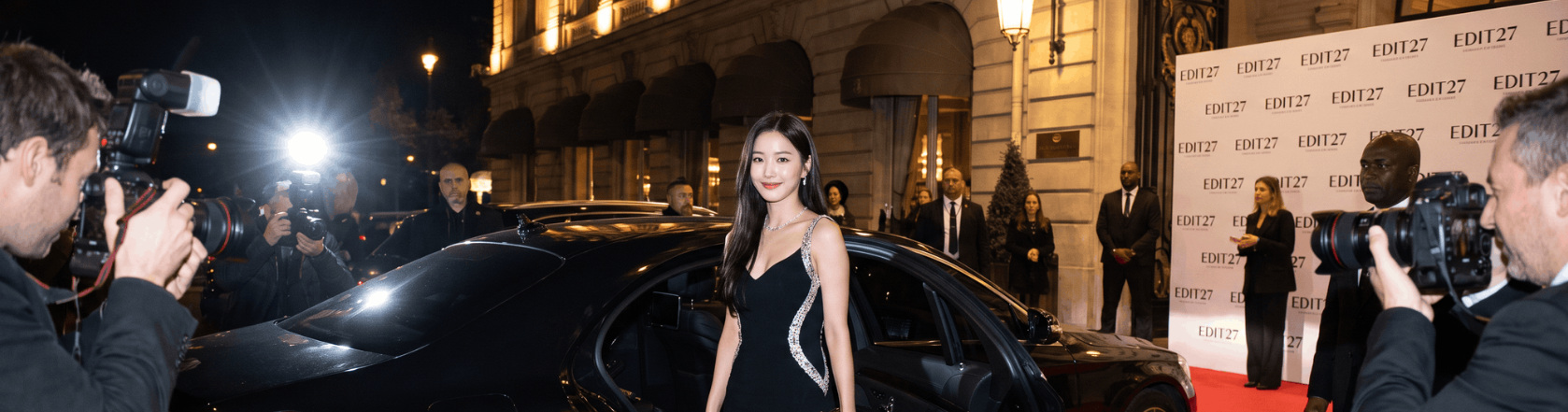
A little space around the person
In a red-carpet photograph, pay attention to the unoccupied ground.
The space beside a guest allows a dress to be read in full. It separates an outline from the next person’s clothes and gives a photographer a chance to make a portrait rather than a record of congestion. What looks like an individual commanding attention may owe something to a publicist making sure nobody walks into the frame.
Writing for Backstage, publicist Rick Krusky describes a properly managed carpet as a paced sequence, with a gap between arrivals. A publicist or assigned handler introduces the guest to photographers and guides them along. In his account, photographers come before the line of reporters. The route has an order, however busy it appears from outside. [3]
This should make us cautious about reading too much social meaning into every isolated figure. An empty section of carpet can be an impressive-looking consequence of competent scheduling. Someone else is waiting just beyond the photograph.
The waiting matters to the photographer, too. In interviews for Shutterstock, Presley Ann described the frustration of losing a subject’s eye contact to someone calling from farther down the line. Brian Friedman emphasised the importance of a photographer’s own demeanour in securing a useful moment with the person being photographed. Hunter Abrams advocated a warm approach rather than shouting. [4]
These are accounts of people trying to do a job. The noise of an arrival can obscure the delicacy of the exchange: an invitation to look, a response, enough time to register an expression, then attention passed to someone else.
A guest who understands this can cooperate without becoming rigid. There is a difference between giving a photographer a moment and arranging oneself as though any movement might ruin the evening. The most appealing pictures often leave us with a sense that the person could resume walking.
Photographers also make decisions that a finished image conceals. Ann has described using a flash modifier for a softer effect, while Friedman prepares for difficult lighting with spare equipment. Their accounts offer a useful corrective to the idea that a red-carpet image is merely whatever happened when somebody pressed a button. [4]
The flash may be part of the visual excitement, but excitement alone does not make a good picture. There must still be a face, a gesture, a relationship between the figure and the surroundings. A wall crowded with logos can tell us exactly which event someone attended while giving us very little else to enjoy.
Nor should every photographer near a celebrity be described as paparazzi. In Michael Schulman’s 2022 profile for The New Yorker, Kevin Mazur drew the distinction himself: “I’m the guy that’s invited.” He spoke about trust as the basis of access, and Schulman observed him working close to subjects while other photographers remained in the press pen. [5]
The distinction changes how we should look at the resulting photograph. An invited portrait, an agency arrival shot and an unsolicited picture taken outside a restaurant may share a subject, but they do not arise from the same relationship.
Permission does not make an image artistically uninteresting. A willing subject can offer a photographer much more than a defensively lowered face. Equally, a picture that appears relaxed should not automatically be treated as an unguarded revelation. Ease can be collaborative. There is no need to mistake it for an accident in order to enjoy it.
When the entrance is the performance
Lady Gaga’s arrival at the 2019 Met Gala made unusually good use of all this organisation.
Over roughly fifteen minutes, she presented four Brandon Maxwell looks, beginning with a vast pink cape dress and moving through black and pink dresses before the final crystal-covered underwear. The entrance had a sequence, a pace and several reveals. It rewarded watching rather than merely checking what she wore. [6]
Vogue’s behind-the-scenes reporting described months of preparation and rehearsals that took place while the clothes were still being completed. The hair and make-up team became part of the performance, appearing for a staged touch-up. Work usually kept outside the final image was brought into it deliberately. [7]
The touch-up was a particularly good idea. It gave the audience something recognisable within the extravagance: the business of getting a person ready to be looked at. A small act of maintenance became another way to hold attention.
There was also a reason for the scale. Gaga was a co-chair of the benefit celebrating Camp: Notes on Fashion, an exhibition concerned with, among other things, artifice, theatricality and exaggeration. Her entrance belonged to the occasion. [8]
That relationship is more important than the number of outfits. An entrance becomes tedious when its only argument is that it should be longer or larger than the one before it. Here, the changes created anticipation. Each look altered the meaning of the previous one. The audience was allowed to understand the trick and still enjoy the reveal.
There is considerable pleasure in this kind of excess. It gives fashion a chance to do something that ordinary clothes, quite reasonably, are not asked to do. Nobody needs four outfits to reach the front door. Need would be an unhelpful criterion for judging the performance.
Yet copying its dimensions would miss the point. Fifteen minutes can be excellent theatre in one setting and appalling behaviour in another. The invitation matters. So does the purpose of the room beyond the carpet.
The Met identifies its Costume Institute Benefit as a primary source of funding for the department’s exhibitions, publications, acquisitions and operations. The clothes outside and the work inside have an institutional connection, even when an individual photograph does not explain it. [9]
A film premiere has another centre of gravity. Its cast may be dressed magnificently, but there is a film to see. At a fashion presentation, the arriving audience should eventually surrender its attention to the collection. A private dinner can reasonably ask its guests to contribute conversation rather than a visual event.
An entrance has to understand which of these occasions it is entering. It can be witty, beautiful or deliberately disruptive, but it should have some relationship to what everyone has assembled to do.
This is where the idea of simply “making an entrance” becomes insufficient. Getting noticed is a modest ambition. Giving people something worth noticing takes rather more thought.
The clothes have an evening to get through
The body is the part of an arrival that cannot be retouched into permanent cooperation.
At the London premiere of Dune: Part Two in February 2024, Zendaya wore the chrome-and-Plexiglass robot suit from Thierry Mugler’s 1995 couture presentation, sourced by her stylist Law Roach. Vogue traced the original design to Mugler’s collaboration with Jean-Pierre Delcros, a specialist in aircraft bodywork, and the influence of illustrator Hajime Sorayama. [10]
The object carried its own history into the premiere. Its association with science fiction was immediately legible, but it did not depend on reproducing an outfit from the film. It offered a separate, persuasive vision of a body in the future.
There was an important change from the original runway presentation: Zendaya wore it without the headpiece. Her face remained visible above the suit’s metallic structure. The Associated Press documented the archival look and Roach’s styling at the premiere. [11]
That exposed face makes the appearance compelling. The expression belongs to a person; the torso appears engineered. The contrast gives the eye somewhere to return after it has taken in the construction.
Wearing it was another matter. In her subsequent Vogue Life in Looks interview, reported by InStyle, Zendaya recalled becoming lightheaded within ten minutes or less while trying it on. She described the heat and the bodysuit underneath, and explained that wearing the piece had been her own suggestion. She changed into a black dress after the appearance. [12]
Her account allows admiration without pretending the outfit was effortless. It also preserves her agency. An ambitious fashion decision can be voluntary and physically difficult at the same time.
It would be equally unhelpful to insist that every extraordinary garment should behave like something chosen for a comfortable dinner. Some clothes are made for a brief, exacting appearance. The useful question is whether the person wearing them understands that bargain and has a workable way out of it.
A photograph cannot answer that question. It records the shape of the suit, not the temperature inside it.
For less theatrical eveningwear, movement deserves to be part of the judgment from the beginning. A jacket should still make sense once its wearer sits down. An elaborate sleeve has to coexist with a glass. A train needs somewhere to go when its owner turns a corner. These are not minor technicalities to be forgiven once a dress looks good from the front. They influence the way a person carries herself throughout the evening.
A garment that allows someone to greet a friend, take a seat and forget about the position of a fastening offers a different kind of accomplishment from a piece requiring continuous assistance. Both can be interesting. They should not be assessed as though they were designed for the same task.
The surroundings complicate matters further. Reporting on Cannes in 2024, British Vogue’s Alice Newbold described styling discussions that considered how clothes would photograph against the red carpet and the blue of the sea and sky. The staircase was another practical consideration. A look prepared in a hotel room still had to work outside it. [13]
It is worth resisting the habit of judging eveningwear as an image cut free from its setting. Colour has neighbours. A silhouette has a background. The same outfit may become much more intelligible when there is space around it, or less interesting when the staging competes with every detail.
Even reaching that staging can demand patience. Newbold reported that journeys from Cannes’s nearby hotels could involve upwards of an hour in traffic, despite the short distance, while red-carpet slots were tightly timed. Proximity on a map did not translate into an uncomplicated arrival. [13]
This is the part of the evening that a fashion credit cannot convey. “In Mugler” identifies a designer. It says nothing about the fitting, the waiting, the journey or the change of clothes afterwards. A useful account of fashion should occasionally make room for those things, especially when they help explain why an appearance succeeded.
The time belongs to other people, too
At Cannes, the arrival eventually has to deliver an audience into a cinema.
That requirement became particularly visible in May 2025, when the festival made its dress policy more explicit. Alongside its prohibition on nudity, it specified that voluminous outfits, particularly large trains, were not permitted when they obstructed the movement of guests or made seating difficult. The Associated Press reported the clarification on the eve of the festival. [14]
The reference to seating is revealing. A train can be magnificent on a staircase and inconvenient in a row of occupied chairs. The photograph and the screening make different demands on the same piece of clothing.
There is a reasonable argument for keeping a route clear. Everyone behind a guest also has somewhere to go. An arrival that consumes more space or time has consequences for people whose names may never appear in the coverage.
But a host who wants extraordinary fashion should give its makers usable information. “Voluminous” is a description, not a measurement. Applied at a door, it leaves considerable room for interpretation.
In Vogue Business’s reporting on the 2025 change, stylist Rose Forde said she learned about it through social media. She acknowledged the logic of keeping attention on the films while defending fashion as a form of artistic expression. Other contributors raised concerns about the late notice and the difficulty of judging what, precisely, would be unacceptable. [15]
The uncertainty is a failure of planning before it becomes a question of taste. A clearly communicated restriction can be worked with. An ambiguous one, discovered after clothes have been made and transported, transfers the difficulty to the person standing at the entrance.
The opening night did not resolve the ambiguity. AP documented substantial trains on the carpet, including Heidi Klum’s, while jury member Halle Berry said she had changed her intended look to comply with the policy. The report noted that enforcement remained unclear. [16]
It would be too easy to treat this as proof that every rule is simply negotiable for the right person. The reporting does not establish the explanation for each decision. It does establish a gap between a published instruction and what an observer could see.
For an event that depends so heavily on appearances, that gap matters. The entrance communicates the character of the host as well as that of the guest.
Good direction can be firm without making someone feel foolish. A person should know where to stop, which way to move and whether there is time for another photograph. A guest bringing a complicated garment should understand its demands; an organiser inviting that guest should make those demands part of the plan.
The same principle applies to less public occasions. There is little elegance in an arrival that requires an invited person to argue about a name at the door. Nor is there much charm in being admitted successfully and then left to work out what happens next.
An invitation creates obligations on both sides. The guest owes the occasion some attention to its purpose and timing. The host owes the guest a comprehensible welcome.
None of this requires an evening to become cautious or visually restrained. A well-planned setting can accommodate extravagance more generously than a confused one. Clarity gives people room to enjoy what they are wearing.
After the photograph
The most useful distinction may be between an entrance worth watching and an evening worth attending.
They can coexist very happily. There is no reason a party with excellent photographs should have disappointing food, or a dinner with interesting guests should be visually indifferent. The trouble begins when the first achievement is accepted as evidence of the second.
An arrivals picture establishes that someone was there, dressed in a particular way, at a particular moment. It cannot establish whether the host remembered an introduction, whether the room made conversation possible or whether anybody was enjoying themselves once the posing stopped.
Those details deserve their own attention. They are also where the ordinary business of hospitality reasserts itself.
After a tightly directed entrance, it should be possible to stop thinking about one’s placement. Someone ought to know where coats are going, where an accompanying guest should wait and how to help a person who needs a moment before joining the room. The transition need not be another performance.
A photograph can make assistance look incidental. For the wearer of a substantial train, it may be essential. The people who have been looking after the clothes should not have to improvise their own exit from the scene while everyone else proceeds to dinner. An organiser who has planned the image carefully should be capable of planning what happens around it.
There is a useful lesson here for anyone getting dressed for an evening that will never appear in a magazine. Consider the whole invitation. A standing reception, a seated dinner and a night involving dancing ask different things of clothes. The most extravagant choice may be exactly right, but it is worth knowing what it will require after the first ten minutes.
Then allow the preparation to end.
That is harder to prescribe than a dress code. Having made an effort, it is natural to want the effort noticed. There is pleasure in being seen well, in having a friend appreciate the cut of a jacket or recognise the audacity of a dress. Such pleasures do not need to be dismissed as vanity before a conversation can begin.
They do, however, need somewhere to lead.
Rihanna’s questions about the car are appealing because they are so concrete. Even an appearance of extraordinary scale begins with the body of a person and the problem of where to put it. The work becomes more impressive when we remember those circumstances, rather than imagining that glamour exempts anyone from them.
The best arrivals leave us wanting to see what happens next. The clothes give us something to look at; the person gives us a reason to remain interested. A host then has the opportunity to turn that interest into an evening.
After all the attention paid to the entrance, there should be a table at which the guest can sit comfortably and someone beside them worth talking to. By the time they leave, the conversation might be what they remember.
.png)





.png)