



.png)
EDIT27 · SEOUL · FOOD & ARCHITECTURE
The Hanok Table
A relocated pavilion, a house altered by glass, a newly built room beside a palace wall. Eight Seoul restaurants reveal what happens when an architectural inheritance has to earn its living—and how much of dinner a tiled roof can reasonably be expected to provide.
© el_ave / Wikimedia Commons · CC BY 2.0 · Source & rights. Uncropped; web-sized and JPEG-optimised on preparation.
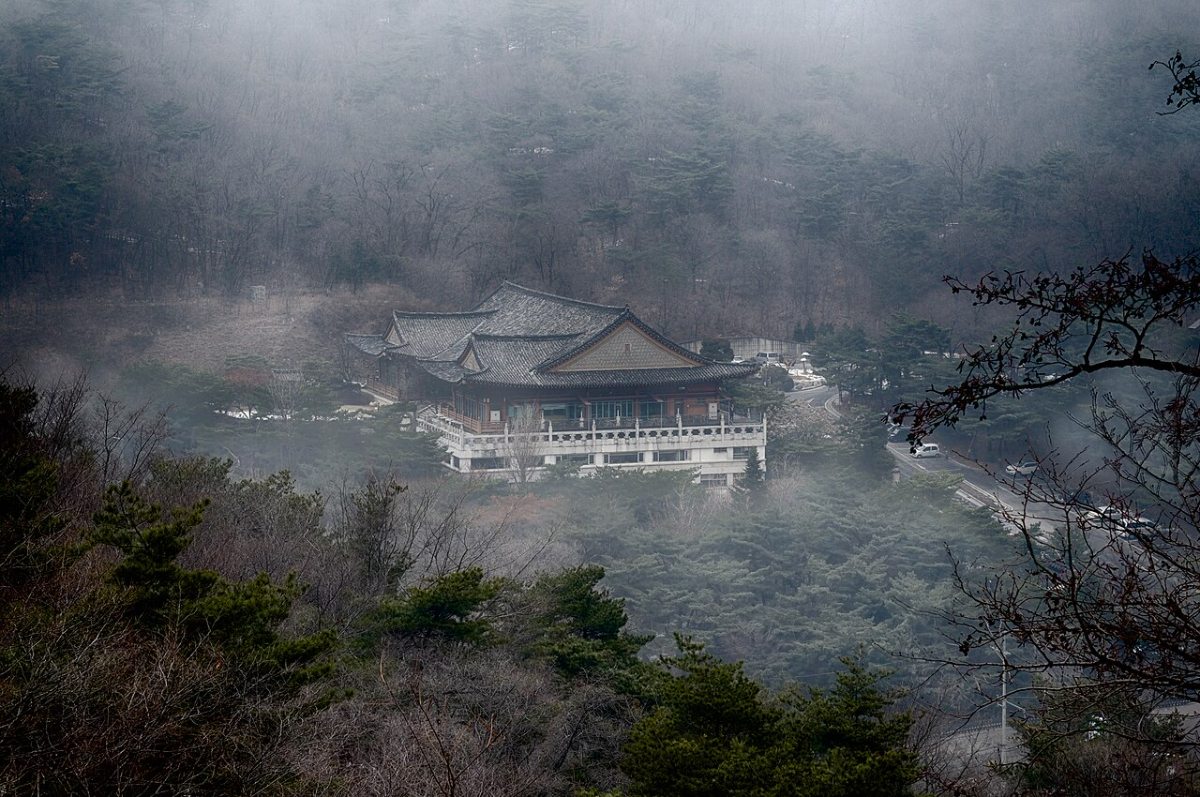
At Dugahun, the chairs are part of the argument. When architect Choi Wook adapted the house in 2004, diners were no longer asked to sit on the floor. Paper-screened openings gave way to glass. The tiled roof remained, but the posture of the people beneath it changed. A familiar outline concealed a fairly decisive revision to the way the house was occupied. 1
It is a useful place to begin, because the chair does what a photograph of the roof cannot. It makes preservation a question about use.
Much of the appeal of a Seoul hanok restaurant arrives before the meal: the low entrance, the first glimpse of a courtyard, the prospect of sitting somewhere that was not originally arranged for strangers. Architecture has already supplied a reason to choose the address. The kitchen is then presented with an advantage that can become an alibi. A disappointing course may be forgiven because the room is pleasant; an unremarkable menu acquires significance through its setting.
There is nothing wrong with paying for a room. Restaurants sell the conditions of a meal as well as the food. The difficulty begins when the quality of those conditions is inferred from a building’s apparent age. Timber does not provide a construction date. A courtyard does not establish privacy. An old house can be an excellent place to eat, or an obstinate collection of rooms through which hot food travels badly.
The historical distinction is no simpler. Some Seoul hanok restaurants occupy inherited buildings; others incorporate structures moved from elsewhere. Some were designed as commercial or institutional premises, while a few are new buildings whose forms are older than their materials. These differences run through the addresses that follow. Calling them all “historic houses” would remove much of what is interesting about them.
Bukchon itself complicates the romance of architectural survival. Seoul’s account of the neighbourhood describes housing companies subdividing larger holdings in the 1930s and building groups of smaller urban hanok. The type was being adjusted to a property market. Glass and metal additions could enter a building vocabulary that visitors now tend to imagine as fixed. Commerce did not arrive only when the first restaurant opened. 2
This does not excuse every conversion. It does make a ban on change a peculiar form of respect. A house that was once an answer to contemporary demand cannot be understood entirely through the parts of it that appear untouched.
The more exact question concerns the plan. A madang, the courtyard or yard, could accommodate domestic work while admitting light and air. A maru, a wooden-floored hall or platform, helped connect enclosed rooms and open space. Together with rooms warmed by ondol, underfloor heating, these areas offered different conditions for different activities and seasons. The house worked through their relationship. 3
A restaurant may keep that relationship legible. It may also retain every recognisable material while turning the courtyard into a display. The distinction becomes apparent in ordinary things: whether a door can still be opened, whether guests can see another room without hearing every word spoken in it, whether staff must interrupt a table whenever they cross a threshold. These are less marketable details than weathered timber. They are also closer to the reason a building is worth inhabiting.
© 오모군 / Wikimedia Commons · CC BY 3.0 · Source & rights. Uncropped; web-sized and JPEG-optimised on preparation.
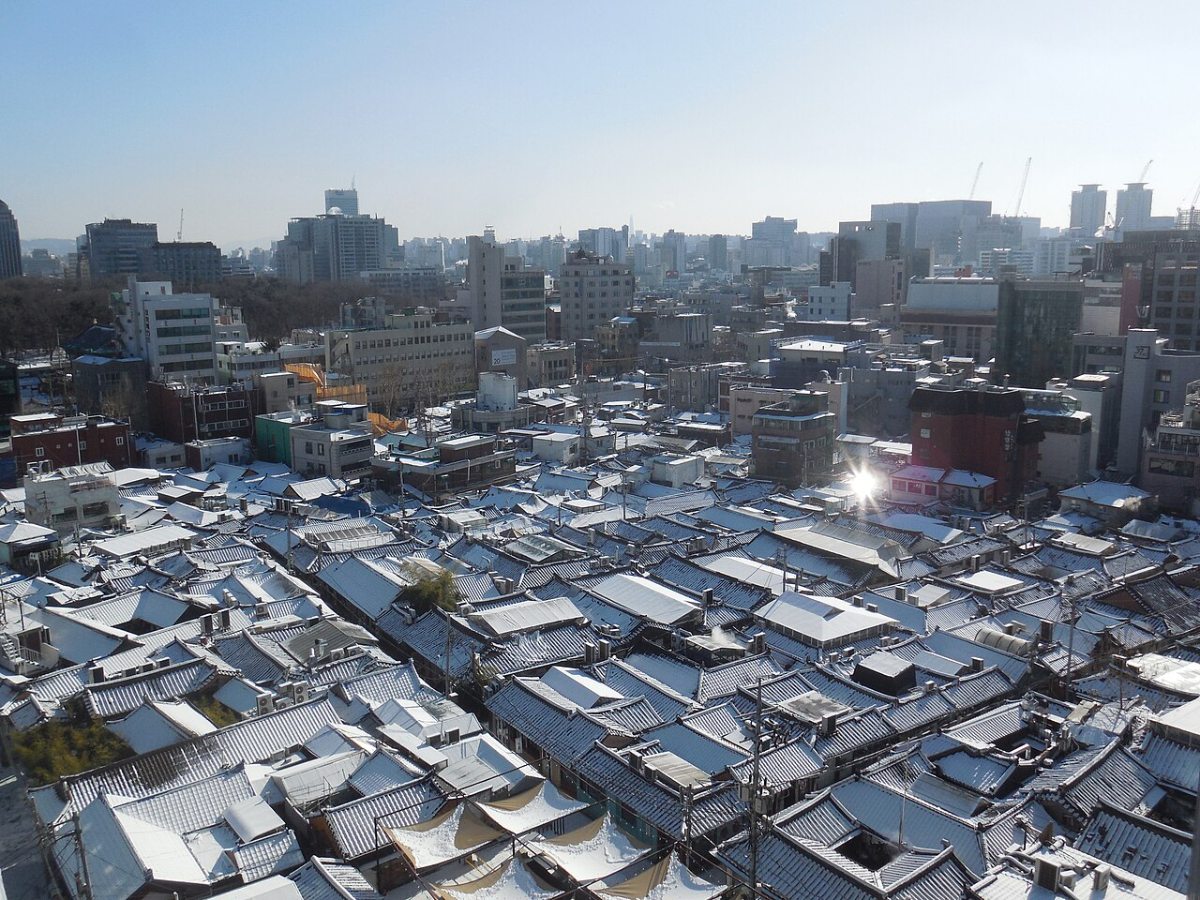
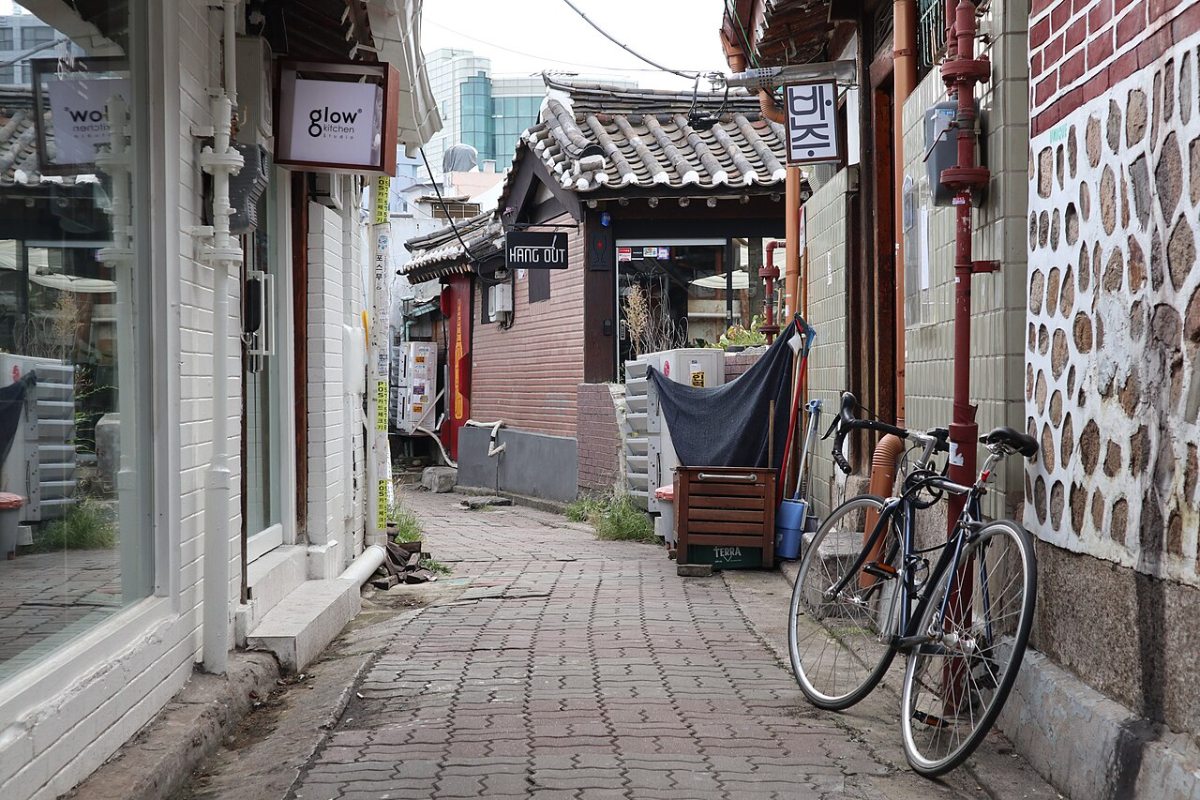
The neighbourhood matters as much as the individual house. Ikseon-dong’s commercial revival followed years in which redevelopment expectations had discouraged maintenance. In a 2015 essay, Robert Fouser described the awkward economics: deteriorating houses needed investment, while commercial tenants could support rents that residents could not. Condemning cafés alone would not repair the roofs. Equally, a street of repaired roofs could cease to function as a residential street. 4
Seochon has a different reminder of what preservation can involve. At Hong Geon-ik House in Pilun-dong, a mid-1930s residence acquired by the city was restored and given a public cultural use. It did not need a tasting menu to remain accessible. The building is a useful corrective to the flattering suggestion that restaurant conversion is the only alternative to neglect. 5
Still, restaurants can do something valuable. They admit people who would never receive an invitation to a private house. They make continued occupation financially possible. They allow a room to acquire new associations rather than live permanently under the description of its previous owner.
That access has limits. An empty courtyard occupies space that could hold tables. A generous interval between seats is lost capacity. The owner who leaves a room unfilled is making an operating decision as well as an architectural one. An inherited plan becomes convincing hospitality when those decisions feel deliberate, rather than when discomfort is presented as evidence of character.
The same scrutiny belongs at the table. Formal Korean course dining need not be dismissed because it accommodates family occasions or business hospitality. Nor does a menu become culturally serious through an expensive protein and a historical name. Rice, vegetables and fermented seasonings may provide a more specific account of a kitchen’s priorities than a procession of premium ingredients.
An Italian restaurant can also be a perfectly reasonable occupant. The house need not police the nationality of dinner. What matters is whether the new use understands the scale of the rooms, the location and the occasion being offered.
The following selection is therefore deliberately uneven in its endorsements. There are reservations with a substantial food proposition, places best understood through formal hospitality, and one commercial courtyard whose design deserves more attention than its claim to culinary distinction. They have not been arranged as a ranking. A newly built hanok and a relocated historic hall require different questions before either reaches the kitchen.
Seokparang 석파랑
The history belongs to a particular building.
© Lawinc82 / Wikimedia Commons · CC BY-SA 4.0 · Source & rights. Uncropped; web-sized and JPEG-optimised on preparation.
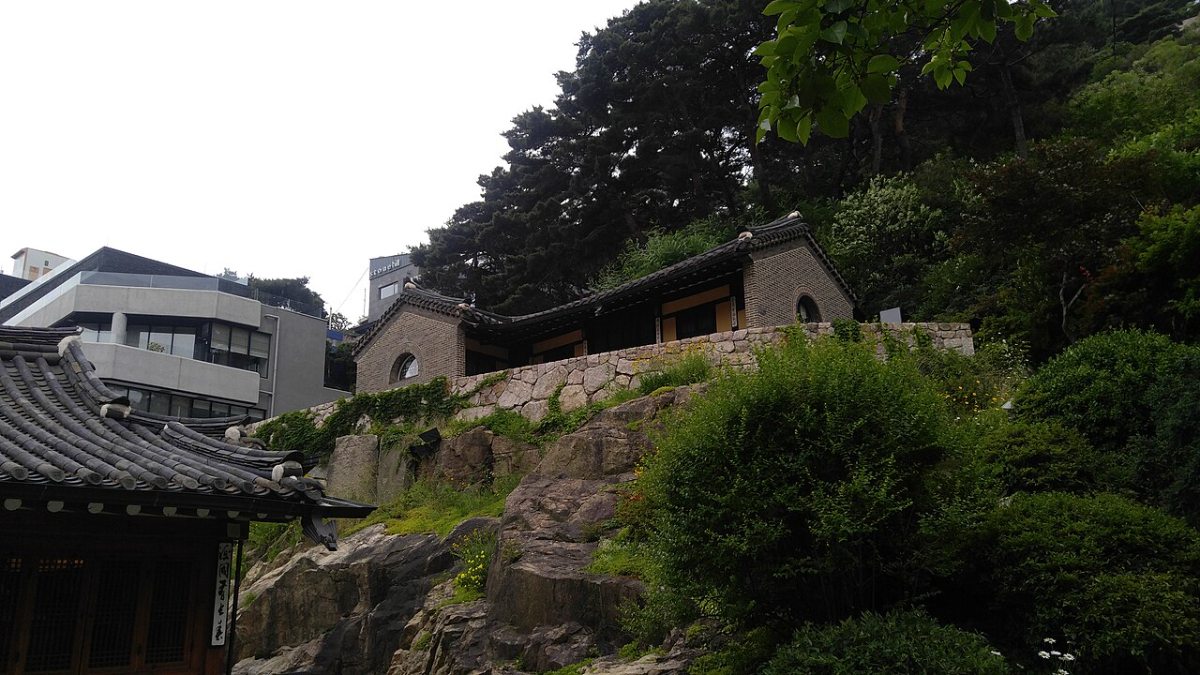
The detached hall associated with Seokpajeong was not always here. In 1958, calligrapher Son Jae-hyeong moved it from the estate in Buam-dong to the present site in Hongji-dong. That journey is essential to understanding Seokparang. The restaurant compound and the original estate are not the same place, and the age of one structure cannot be assigned to every room in which the restaurant serves dinner. 6
The hall’s position above a rock terrace is striking in the photographic record. Its brick end walls and rounded window openings interrupt the expectation of an entirely timber composition. These are useful details because they make the building particular: something more interesting than a generally handsome Korean roof. Accounts of its construction identify both Korean and Chinese influences. 7
Moving a building need not erase its historical value. It does alter its relationship to the ground and to its neighbours. Seokparang asks to be read as a later arrangement containing an important earlier element, rather than as an undisturbed domestic scene. The survival is real; so is the rearrangement.
For a diner, that distinction has an unusually practical consequence. Ask which building will contain the table. A reservation at Seokparang does not, by itself, establish that the meal will take place inside the detached hall. “Private room” is an insufficient answer to a question about architectural access.
The published Subok lunch makes a recognisable formal Korean meal out of porridge, cold preparations and seasonal jeon, followed by more substantial dishes including ginseng-steamed pork and braised short ribs. Rice with accompaniments brings the sequence towards a conclusion. The range is intended to accommodate an occasion, not to concentrate attention on one displayed ingredient. 8
There is value in that comprehensibility. Several generations can approach a meal for different reasons without every course needing to announce an experiment. But a long list of preparations also creates more chances for the kitchen to lose its purpose. Sequence, temperature and restraint matter here as much as abundance. The association with an important building cannot adjudicate any of them.
Lunch is the sensible first reservation for an architecturally motivated visit. Daylight permits the compound to be read, and a shorter course leaves the occasion some room to breathe. For a traveller choosing only one ambitious dinner in Seoul, the published menu and the building’s history do not establish that this should be it.
EDIT27 NOTE
Establish the room before choosing the course. The address is not a guarantee of access to the building that brought you here.
NEIGHBOURHOOD Hongji-dong, Jongno-gu · 309 Jahamun-ro.
AT THE TABLE Formal Korean courses. Our choice: the Subok lunch.
BOOKING & PRICE Reserve directly and request the current tariff and exact dining room; a current course price was not independently confirmed for this edition. 8
BUILDING The compound includes the Seokpajeong detached hall relocated in 1958. Do not extend that history to the entire restaurant. 6
Dugahun 두가헌
Comfort was an architectural intervention.
The view across Dugahun’s courtyard includes a brick building as well as the low hanok frontage. This is not a composition that depends on removing every architectural contradiction. The glass installed during Choi Wook’s 2004 adaptation makes that shared court available from a chair; it changes the boundary without pretending the boundary has disappeared. Korean coverage dates the earlier house to the 1910s, although that date is reported history rather than an archival construction record established here. 1
Glass brings advantages that are easy to overlook when paper doors are treated as an ethical obligation. A diner can remain comfortable while looking across the court. The room need not require participation in an earlier domestic routine. Yet transparency and openness are different things: looking through a fixed pane is not the same experience as opening a room to the air. The intervention gains interest when both observations are allowed to stand.
The gallery connection explains more about the restaurant than a vague promise of serenity. Reporting in the Korea Economic Daily in March 2025 described Gallery Hyundai’s acquisition of the property, previously used by a religious group, and the subsequent division between restaurant and gallery uses. It also offered a revealing account of the kitchen’s audience. A gallery representative said the cooking’s softer textures and lighter salting considered longstanding collectors and older artists. 9
That is a more concrete explanation of restraint than the usual language of elegance. It suggests a restaurant shaped around particular guests rather than around the critic’s expectation that each dish announce novelty. It does not tell us who occupies every table today, but it does establish an intention.
The same report described asparagus with gamtae cream, abalone with garlic butter, and tenderloin with mushroom purée and demi-glace. These are documented spring-2025 dishes, not a promise of the current menu. They locate the cooking between a familiar European course structure and selected Korean ingredients. 9
Familiarity can be a virtue at a table whose purpose includes conversation. It becomes less persuasive when the tariff asks the diner to treat conventional cooking as an event. At the published ₩75,000 lunch and ₩150,000 dinner prices, the distinction deserves attention. Dugahun’s architectural argument is already clear; the current menu and wine selection still have to make the case for an evening. 10
Choose it for a meal whose pleasures include looking, talking and drinking, rather than for the promise of being startled by the kitchen. That is not a lesser category of restaurant. It is simply a category that should be named accurately. The chair matters because the house has been made hospitable to a contemporary body. The menu should be judged with the same regard for whom it is meant to serve.
NEIGHBOURHOOD Sagan-dong, Jongno-gu · 14 Samcheong-ro.
AT THE TABLE European course dining and wine. Best suited to an unhurried, conversation-led meal; our initial choice is the seasonal lunch.
BOOKING & PRICE Catchtable or directly · published lunch ₩75,000; dinner ₩150,000. 10
BUILDING Adapted by Choi Wook in 2004. The house’s earlier 1910s date is reported, not independently proven here. 1
© Basile Morin / Wikimedia Commons · CC BY-SA 4.0 · Source & rights. Uncropped; web-sized and JPEG-optimised on preparation.
Mishmash 미쉬매쉬
A new house, and a view worth not giving up.
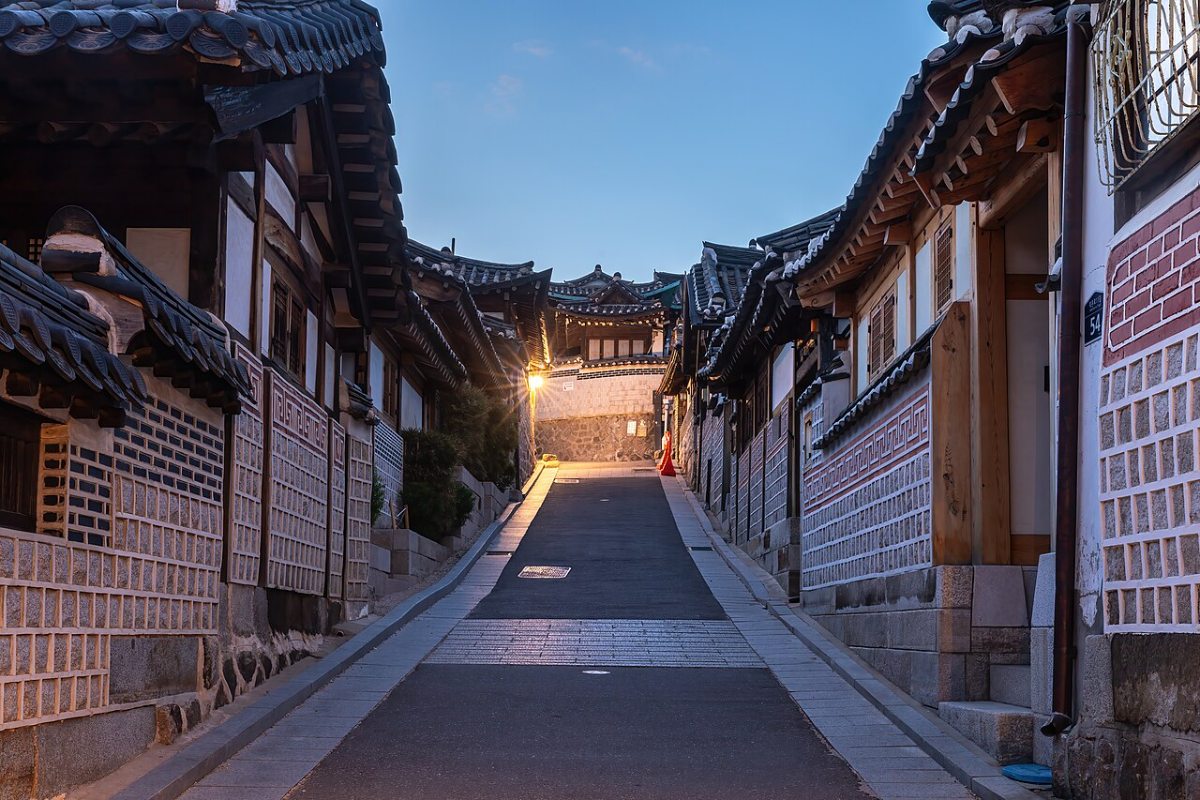
Mishmash occupies Sogongheon, completed in April 2020. CHAMOOREE’s project record identifies the building as a restaurant commission. Whatever associations the site carries, the structure should not be promoted as a centuries-old residence rescued for modern dining. Its recent date is part of the story, not an embarrassment to be concealed. 11
The interest lies in the decision to build a hanok here, beside Changdeokgung, and to make dining part of the relationship between the new building and the palace boundary. Reporting from 2021 places the principal restaurant space upstairs. The setting is outward-looking: its attraction depends on a specific neighbour, rather than on a complete withdrawal from the city. 12
That relationship makes one booking detail particularly revealing. The restaurant’s published information states that the private room, available for up to six people with a ₩50,000 surcharge, has no palace view. Privacy is being sold separately from the setting that many diners will have come to see. 13
For some occasions, the exchange is entirely reasonable. A confidential conversation may matter more than the view. But the supposedly better room is not automatically the more rewarding one. Ask for the main dining room’s table options before assuming that an enclosure and an additional charge amount to an upgrade.
Chef Minzi Kim Wind’s published cooking gives Mishmash a second reason to book. A 2021 profile described smoked pork with black-garlic purée and fish with herb butter and mugwort. Those dishes are useful as a record of approach, not as current ordering instructions: recognisable ingredients worked through preparations that are not required to imitate a formal historical table. 12
The proposition is individual enough to survive an ordinary building. That distinguishes Mishmash from restaurants whose food exists chiefly to make architectural access saleable. Korean references need not be translated into a succession of ceremonial-looking courses to be taken seriously; they can enter through a sauce, a herb, the choice of protein and the way the components are made to belong together.
New construction also removes one convenient excuse. A restaurant designed for its intended use has the opportunity to plan the kitchen, circulation and service requirements from the beginning. The date does not prove those decisions succeeded. It does mean that awkwardness cannot be defended simply as the price of an inherited plan.
With weekday lunch published at ₩70,000–90,000 and dinner at ₩100,000–125,000, the choice can be made around appetite and occasion rather than a dramatic change of category. Daytime allows the building’s location to do more of the work. The most important instruction is simpler: do not pay to surrender the view without first deciding that you genuinely prefer the privacy. 13
EDIT27 NOTE
The private room has no palace view. Here, the extra charge buys separation—not necessarily the better table.
NEIGHBOURHOOD Wonseo-dong, Jongno-gu · 47-2 Changdeokgung-gil.
AT THE TABLE Contemporary Korean cooking. Our choice: the seasonal course in the main dining room, subject to the actual table offered.
BOOKING & PRICE Catchtable · weekday lunch ₩70,000–90,000; dinner ₩100,000–125,000. Weekend and holiday lunch arrangements differ. Private-room surcharge ₩50,000, up to six guests; no palace view. 13
BUILDING Sogongheon, completed April 2020 · CHAMOOREE Architects. 11
A Flower Blossom on the Rice 꽃밥에피다
The ingredient list is the more important inheritance.
Here the argument moves away from the roof. At the Insadong branch of A Flower Blossom on the Rice, the kitchen has a documented purpose that does not need an exceptional building to make it legible. Owner Song Jung-eun’s approach begins with producers, agricultural choices and the Korean pantry. The house provides a setting; it does not have to supply the restaurant’s identity.
In a 2020 Michelin interview, Song discussed direct relationships with farmers, organically grown or pesticide-free produce, and the use of handmade jang, fermented condiments. The conversation also addressed irregularly shaped crops: ingredients whose usefulness at the table exceeds their retail appearance. These are reported sourcing intentions, not a claim that every item on every future plate has been independently audited. They are nevertheless more specific than the word “seasonal”. 14
Such choices can be made invisible by restaurant presentation. A neat composition rarely tells the diner which vegetable would have been rejected by a conventional buyer, or whether a sauce was bought ready-made. The interest here is that the restaurant’s published identity puts those decisions near the centre of the meal rather than leaving them as an optional story for a waiter to recite.
The house asks for a corresponding lack of inflation. No independently established construction date or restoration authorship is assigned to it in this feature. It does not need to have belonged to someone important. The distinction between this branch and the separate Bukchon address is more immediately useful to a diner than an uncertain architectural biography. 15
The current published menu offers a vegan full course at ₩62,000, alongside a ₩28,000 lunch bibimbap set. The restaurant as a whole should not be labelled exclusively vegan. The full course is our more revealing order because it asks vegetables, rice and fermented seasonings to sustain a complete meal, rather than to occupy the spaces around an expensive main ingredient. 16
This is not an argument that responsible purchasing guarantees good cooking. It cannot. A carefully grown vegetable can still be overcooked, and excellent rice can be mishandled. Sourcing establishes something worth examining; execution remains the kitchen’s responsibility. The distinction is important because moral approval can become just as indulgent an excuse as architectural admiration.
Yet the ordinary-building test produces a clear answer. There would still be a reason to consider this restaurant without a hanok. The interest in Korean condiments, producers and plant-led courses would remain. That gives the reservation a sturdier basis than a long menu assembled chiefly to match the expense of its surroundings.
Its place in the selection is consequently not a prize for modesty. Modesty can be affected, too. It is recognition that a restaurant need not make every part of the experience compete for attention. Sometimes the useful contribution of a house is to offer an intelligible scale and then leave the meal to proceed.
NEIGHBOURHOOD Insadong, Gwanhun-dong, Jongno-gu · 3-6 Insadong 16-gil. Book the Insadong branch. 15
AT THE TABLE Plant-led Korean cooking, with vegan courses and other choices. Our order: the vegan full course; confirm dietary requirements.
BOOKING & PRICE Catchtable · published lunch bibimbap set ₩28,000; vegan full course ₩62,000. 16
BUILDING Hanok restaurant conversion; original date and restoration authorship not independently established.
Ca’ del Lupo 까델루뽀
A Korean courtyard need not prescribe a Korean menu.
The case for Ca’ del Lupo begins with scale. In a published trade interview, chef Lee Jae-hoon described the appeal of a smaller restaurant and contact with guests. The Seochon courtyard house accommodates that intention without needing to suggest that a restricted number of tables is, by itself, a cultural achievement. 17
A courtyard can give separate rooms a shared point of reference. It lets the house remain readable as a whole without requiring everyone to sit in one hall. That is a plausible basis for intimacy, although it should never be confused automatically with privacy. A view across a court can reveal other diners as readily as it reveals a tree. Anyone arranging a confidential occasion should establish how the rooms are used.
The Italian menu makes the conversion less literal and, potentially, more interesting. There is no reason to require the kitchen to reenact a Korean domestic past simply because the building belongs to a Korean type. A restaurant participates in its location through ingredients, habits and the scale of its hospitality as well as through the nationality named above the menu.
Lee’s published use of shepherd’s purse in pesto offers a concise example. The Korean spring herb enters the preparation itself, rather than being added as a decorative signal that an Italian dish is being served in Seoul. It is a documented example of the chef’s approach, not a guarantee of a dish available throughout the year. 18
This is the kind of adaptation that makes sense without an elaborate explanation at the table. A diner does not need to accept a grand theory of culinary exchange to understand why a local herb might belong in a sauce. The test remains the sauce.
There is a similar economy to the published lunch proposition, at ₩45,000–55,000. Dinner, listed at ₩119,000, is a more substantial commitment. The difference does not establish which service is better. It establishes how differently the kitchen must justify the same setting. A courtyard does not become twice as useful when the sequence grows longer. 19
For a first encounter, we would choose lunch with pasta where the current course offers it. That choice does not depend on dismissing dinner. It simply allows the chef’s stated interest in a smaller, more immediate kind of hospitality to be considered without requiring the occasion to become elaborate.
Ca’ del Lupo also makes a helpful distinction within Seochon. The house is a working restaurant, not evidence that the surrounding neighbourhood exists as a collection of curated dining rooms. Its architectural contribution is proportionate to the meal. Neither needs an invented century attached to it.
NEIGHBOURHOOD Hyoja-dong, Seochon, Jongno-gu · 5-5 Jahamun-ro 16-gil.
AT THE TABLE Italian cooking with documented use of Korean seasonal ingredients. Our initial order: the lunch course, including pasta where offered.
BOOKING & PRICE Catchtable · published lunch ₩45,000–55,000; dinner ₩119,000. Discuss any private or group arrangement directly. 19
BUILDING Courtyard house adaptation; no independently verified construction date is assigned here.
© Piotrus / Wikimedia Commons · CC BY-SA 3.0 · Source & rights. Uncropped; web-sized and JPEG-optimised on preparation.
Korea House 한국의집
Modern construction, deliberate representation.
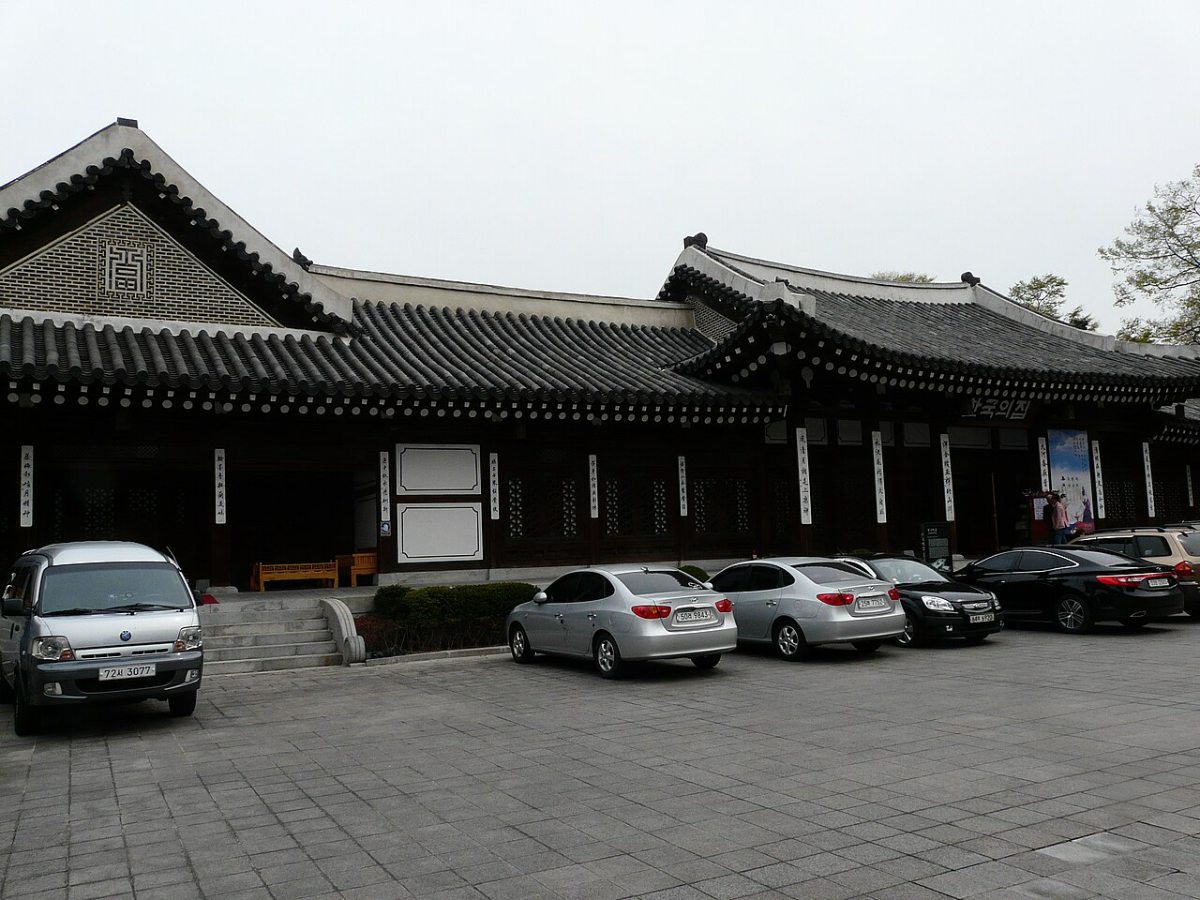
Korea House gives us an unusually clear chronology. The institution records complete new construction in 1980 and a reopening in February 1981. Extensions and alterations followed, with another reopening on 11 March 2026. The older associations of the site should not be used to make the dining buildings older than they are. 20
This is not a compromised version of an ancient residence. It is a modern cultural institution built to receive people and present selected aspects of Korean culture. Its architectural ambition belongs partly to the history of national representation: what a country decides visitors should encounter, and how that encounter should be organised.
The distinction changes the standard of judgment. An institutional complex can accommodate formal dining and events in a way that an ordinary urban house was never designed to do. The organisation of arrival, separation and reception is part of its purpose. It need not borrow the supposed intimacy of a private residence to establish a legitimate kind of hospitality.
The kitchen has a comparably identifiable programme. Korea House names Cho Hee-sook as culinary adviser and Kim Do-seop as head of its culinary research team. Court and aristocratic cooking provide a basis for contemporary menus. That institutional framework is more substantial than the common practice of attaching “royal” to an expensive Korean course. It also creates an obligation to explain what has been researched and what has been newly devised. 21
A documented preparation of chicken and mung bean, for example, has been presented as an adaptation rather than an untouched historical dish. The distinction matters more than a ceremonial-looking service piece. A contemporary kitchen can draw on an earlier technique or record without claiming that its present course sequence was once eaten in precisely the same way. 22
Historical research is not a seasoning. It cannot make an unsuccessful dish satisfying, and institutional authority should not protect a kitchen from criticism. But it can give an ambitious meal a coherent subject. The question becomes whether the menu makes ingredients and methods more intelligible, or leaves the diner with an expensive collection of historical references.
The room tariffs make another part of the proposition explicit. Published 2026 menus put main-building lunch at ₩120,000 and dinner at ₩200,000, against ₩170,000 and ₩250,000 in the annex. Separation has a price. It does not necessarily confer a superior culinary programme or a closer relationship to the past. 23
For an initial reservation, the main-building lunch gives the kitchen sufficient room to state its intentions without treating enclosure as an automatic improvement. A private occasion may justify the annex; the reason should be the occasion itself.
Korea House belongs here because it makes interpretation visible. The architecture was commissioned, the institution has changed, and the food is being developed. There is more intellectual confidence in acknowledging those facts than in pretending that the visitor has gained access to an unaltered fragment of court life.
NEIGHBOURHOOD Pil-dong, Jung-gu · 10 Toegye-ro 36-gil.
AT THE TABLE Contemporary presentations of Korean court and aristocratic cooking. Our first choice: the seasonal main-building lunch.
BOOKING & PRICE Catchtable or directly. Published 2026 tariffs: main-building lunch ₩120,000 / dinner ₩200,000; annex lunch ₩170,000 / dinner ₩250,000. Confirm the applicable seasonal menu. 23
BUILDING Rebuilt in 1980; reopened in 1981; further reopening in March 2026. 20
Samcheonggak 삼청각
The roof belongs to a twentieth-century history of power.
Samcheonggak is often made to look older by the language used around it. Trees, pavilions and distance from the street suggest a retreat from modern Seoul. The more consequential history is modern: a complex associated with the inter-Korean diplomatic context of the early 1970s, elite entertainment and formal hospitality. Its architecture was involved in the presentation of power. 24
That history includes a material distinction that the roofline obscures. Ilhwadang, the principal building containing the restaurant, is concrete construction in hanok form. Other buildings on the grounds use timber. Reporting drawing on interviews about the original construction distinguishes the systems rather than allowing their related outlines to imply that they are identical. 24
Concrete is not an accusation. Here it is evidence of the project’s period, scale and ambitions. To insist that the site becomes culturally valuable only when mistaken for an older domestic ensemble would discard the most specific part of its identity.
Its subsequent public use is equally important. Seoul’s refurbishment and the 2022 reopening belong to a different relationship between the compound and the city. A place associated with selective access can be brought into a broader civic life without ceasing to carry the associations of its earlier one. 25
For the restaurant guest, however, the compound is not a single interchangeable experience. A café terrace, an event building and a dining room provide different relationships to the grounds. The most persuasive photograph may have been made somewhere other than the table available for reservation. Establish the room, the route and any access arrangements before building an occasion around the view.
Formal Korean course dining is the published culinary proposition, with premium courses listed at ₩130,000, ₩170,000 and ₩230,000. These are published examples, not a verified statement of the least expensive meal available on every date. At that level, the kitchen needs to provide more than an orderly succession of prestigious ingredients. 26
There is not enough current, independent culinary evidence to nominate Samcheonggak as a priority for a diner interested solely in exceptional cooking. That is a limit on the recommendation, not a negative tasting report. The stronger reason to book is an occasion that can make use of the setting and its modern history: a formal group meal, for instance, where the architecture and arrangements matter to the gathering.
Ask for the shortest suitable weekday lunch and the precise conditions of any private room. Additional courses are not necessary to make the building’s history more intelligible. Samcheonggak deserves to be seen as a modern representational complex, not softened into a story about an old house waiting quietly among the trees.
NEIGHBOURHOOD Seongbuk-dong, Seongbuk-gu · 3 Daesagwan-ro.
AT THE TABLE Formal Korean courses in Ilhwadang. Best for an occasion that genuinely uses the setting; ask about the shortest appropriate lunch.
BOOKING & PRICE Reserve directly. Published premium courses ₩130,000 / ₩170,000 / ₩230,000; request current lunch choices, room charges and minimums. 26
BUILDING Early-1970s complex. Ilhwadang is concrete construction in hanok form; other structures use timber. 24
© S h y numis / Wikimedia Commons · CC BY-SA 4.0 · Source & rights. Uncropped; web-sized and JPEG-optimised on preparation.
Oncheonjip Ikseon 온천집 익선
The courtyard has become the product.
Glow Seoul’s description of Oncheonjip does not leave much room for confusion. An existing hanok courtyard was recast as a hot-spring garden, with white gravel, a fire feature and a wooden tub forming the central scene. The surrounding dining spaces were arranged to look towards it. The design has a commercial purpose and an intelligible spatial method. 27
It would be lazy criticism to pretend that the method does no architectural work. The centre remains open. The separate parts of the restaurant share an orientation. A diner can understand the relationship between the enclosing rooms and the space they face. This is more coherent than attaching a tiled roof to a restaurant that operates internally as an unrelated box.
What has changed is the courtyard’s task. A domestic space that could accommodate work and movement has become something to contemplate from a seat. Its usefulness to the business depends on a fairly stable view. The activity that would make a yard ordinary might also interfere with the image being sold.
The hot-spring reference should be recognised as the operator’s concept, not as evidence of an inherited Korean domestic arrangement. No verified building date supports a convenient claim of antiquity here. It is a commercial adaptation of existing hanok fabric, and that is a sufficiently interesting description without embellishment. 27
The published food offering is much easier to understand than the atmosphere might suggest: shabu-shabu and related hot-pot preparations. Miso shabu-shabu is listed at approximately ₩24,000–32,000, depending on the option. At that level, paying partly for the setting is not inherently unreasonable. A restaurant need not produce an important culinary statement to justify an ordinary meal. 28
It still has obligations. Broth, the condition of the vegetables, the quality and quantity of the meat, and the practical ease of eating are not peripheral to hot pot. The garden cannot make those questions disappear. Nor would it be fair to invent a disappointing tasting simply because the design is overtly theatrical.
The more precise reservation is about making a special journey. On the available culinary evidence, Oncheonjip does not supply the same food-specific argument as the more individual kitchens in this selection. The setting accounts for much of its editorial interest. Without it, the published menu would read as a straightforward choice for hot pot rather than a destination around which to organise an itinerary.
Order the basic miso shabu-shabu and allow it to be that kind of meal. There is no need to punish a restaurant for being commercially articulate; there is also no need to promote commercial articulation into cultural importance. The courtyard is composed with a clear understanding of how diners look. Whether it contributes enough after the first look is the more useful question to carry to the table.
EDIT27 NOTE
A coherent piece of commercial design. Treat the reservation as a hot-pot lunch with a setting, not as evidence of exceptional cooking.
NEIGHBOURHOOD Ikseon-dong, Jongno-gu · 31-8 Donhwamun-ro 11na-gil.
AT THE TABLE Shabu-shabu and related hot-pot dishes. Our order: basic miso shabu-shabu.
BOOKING & PRICE Catchtable; check the current reservation and walk-in arrangements. Published miso shabu-shabu approximately ₩24,000–32,000. 28
BUILDING Existing hanok adapted to Glow Seoul’s hot-spring-garden concept; original construction date not independently established. 27
The next use
A moved building, a glazed courtyard and a newly commissioned hanok cannot be given the same account of survival. Seokparang retains a particular historic structure within a later arrangement. Dugahun has altered the habits the house accommodates. Mishmash has chosen to build anew in a recognisable architectural language. Korea House and Samcheonggak carry the history of modern institutions as well as older forms.
None becomes easier to understand when its dates are blurred. Nor does a building’s commercial success tell us everything about what has been preserved. A house may receive repairs while the street loses residents. A courtyard may remain unbuilt while becoming unavailable for anything except looking. Continued use deserves attention, but “use” is too broad a word to settle the matter.
The restaurant is one possible future. It can pay for maintenance, admit new people and give an old room a place in daily life. It can also make the room so dependent on a purchasable atmosphere that ordinary occupation starts to seem inconvenient. Public cultural uses, housing and less profitable forms of work belong in the same conversation.
For the diner, there is a smaller decision to make. Choose a place because the room has a particular relationship to the meal, then allow the kitchen to be judged without architectural indulgence. A careful conversion does not deserve poor cooking in its defence. A serious kitchen should not need a fictitious building history to attract a reservation.
Eventually the table has to be cleared. Someone carries the dishes through a doorway, moves a chair and turns off a light. A house that can accommodate those ordinary actions without its entire attraction collapsing has retained something more useful than a good image of itself.
About this feature. This is a source-reported editorial selection, not an account of anonymous EDIT27 visits or tastings. Architectural records, Korean reporting, interviews and published menus inform the assessments; dated dish examples are identified as such. Public sources were checked for this edition on 9 October 2026. Prices are published information, not live quotations. Photographs are credited archival or neighbourhood views, not a record of current restaurant inspections.


.png)


