



.png)
A sweet potato given half an hour. Sushi rice with something to say. A small bowl of chicken and egg. Four Ginza counters worth choosing for the dinner.
This is a researched critical feature, not an account of visits made for EDIT27. It draws on Japanese-language interviews, published meals and official information checked on 9 October 2026. Historical dishes are identified as such; changing menus may offer something different.
Fumio Kondo’s sweet potato spends about half an hour in the oil. It is cut thick, more stump than slice, with enough substance to make the instruction to eat tempura immediately seem an incomplete account of the problem. The cooking has already required patience. Kondo explains that it continues inside the coating after the vegetable leaves the pan. His ambition is quite earthly: to make a sweet potato that tastes better than a baked one.1
That is a more appetising reason to pursue a counter reservation than the chance to inspect a celebrated person at close range. There is something to understand here, and something to eat. The two activities need not compete.
Consider the carrot alongside it. In a meal published in 2025, Notorious Foodie describes the vegetable being peeled into sheets, finely cut and fried into an airy tangle. The sweet potato is protected by its thickness; the carrot is transformed by being reduced to strands. One method, two very different ideas of what a vegetable might become.2
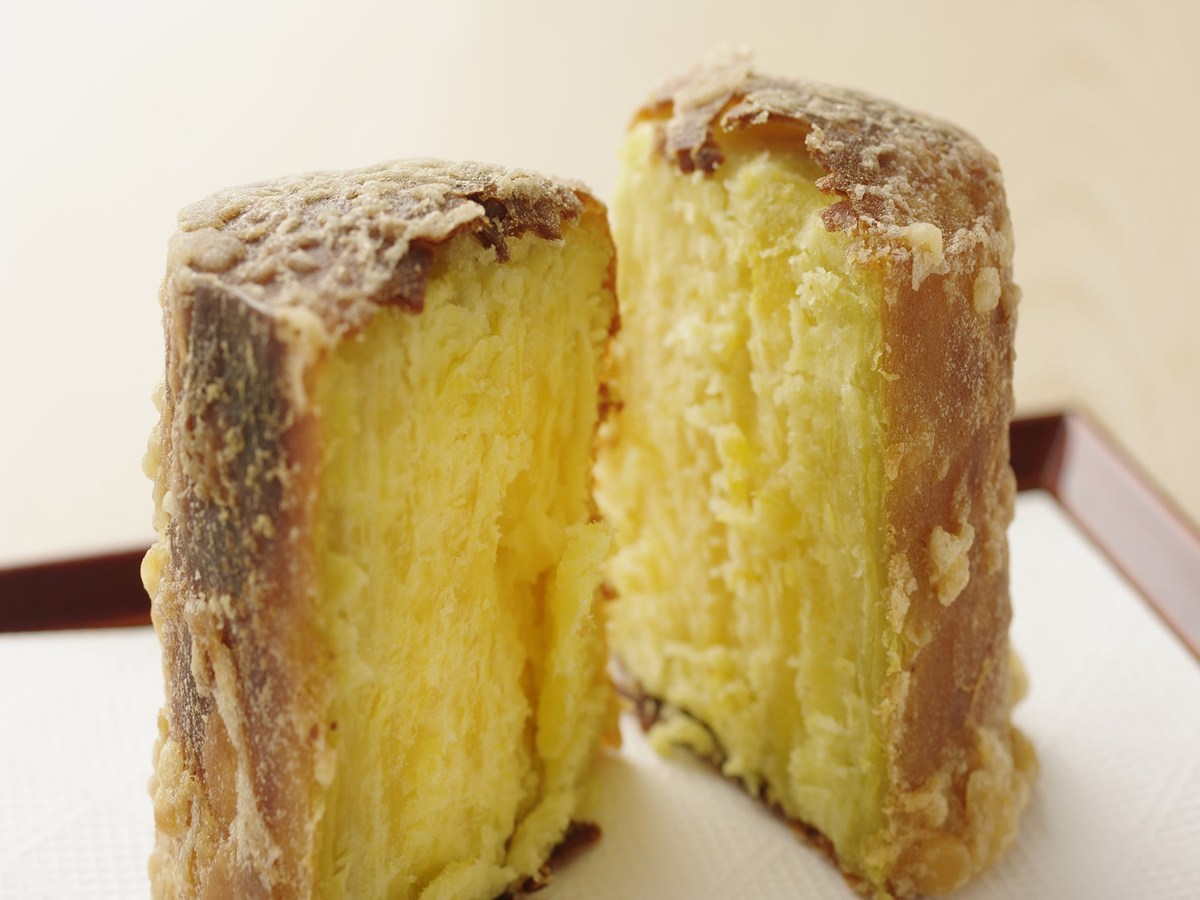
Image source: Tempura Kondo. Photographer not identified by the source.
The counter makes that distinction available without requiring a lecture. Looking can sharpen the appetite. It can also become work: remembering an explanation, keeping up with a sequence, wondering whether the appropriate response has been supplied. A person may be grateful to have dinner decided for them and still wish to talk to their companion.
The four restaurants considered here are all in Ginza. This is a deliberately concentrated selection, rather than an attempt to distribute recommendations across Tokyo’s map. Their dinners do different things with the space between cook and guest: tempura, Edomae sushi, a seasonal Japanese menu, and a chicken course built around the grill. None needs to represent a national temperament. Each has enough to explain on its own plate.171217
Tempura Kondo
A whole dinner of fried food has a structural difficulty. However fine the batter, crispness alone cannot carry the evening. There must be a reason to want another piece when the novelty of the first has gone: a different density, a release of moisture, a change from savoury to sweet. The interest of Kondo’s vegetables lies in their ability to make those changes substantial.
In a 2012 interview with Nippon.com, Kondo challenged the assumptions that had kept vegetables at the margins of prestigious tempura. The useful question was whether the result tasted good, rather than whether the ingredient conformed to an inherited definition of the cuisine. His argument was for a broader dinner, not for a vegetable interlude between the important things.3
The difference matters when deciding what to value in an expensive course. A carrot does not become interesting because someone has made an inexpensive ingredient expensive. Nor should it have to impersonate seafood. Its justification is the particular mouthful the preparation produces: a proportion of vegetable to coating that would be impossible in a thick slice.
Notorious Foodie’s 2025 account is especially persuasive on the range of the meal. Corn was crisp and juicy, its interior almost creamy; sea urchin was enclosed in shiso and briefly fried. The writer repeatedly admired the light coating on seafood. These are observations from that dinner, not guarantees about the next one. They nevertheless suggest a kitchen using tempura to preserve differences rather than to impose the same crunchy surface on everything.2
The counter’s contribution is unusually concrete. Frying and serving belong to the same sequence, and the guest can see the point at which an ingredient leaves the oil. Kondo’s account of residual cooking makes that handoff more interesting than a race against cooling. The endpoint has to be judged for the ingredient in question. A thick sweet potato and a fine strand of carrot cannot be governed by the same impatience.1
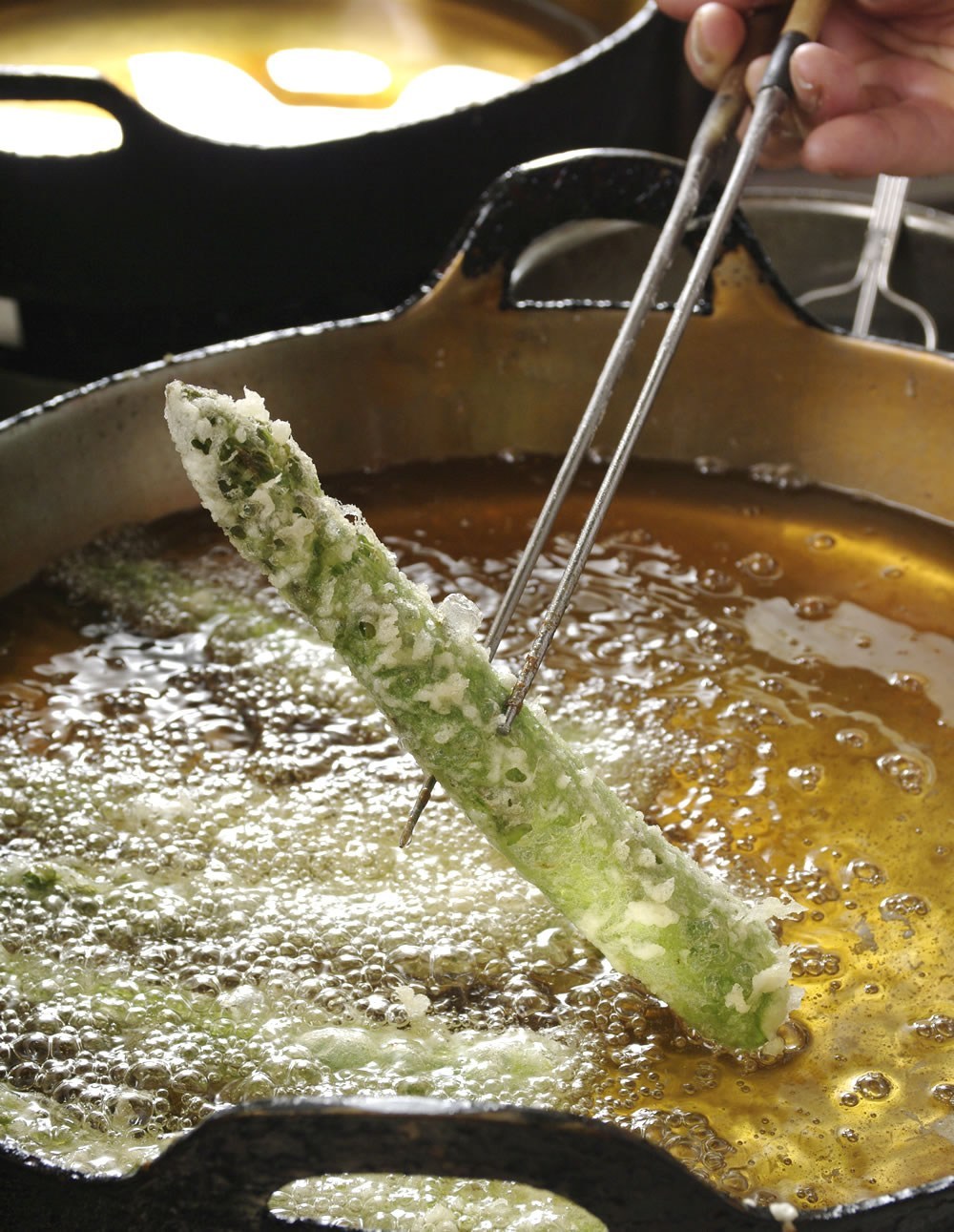
Image source: Tempura Kondo. Photographer not identified by the source.
There is another pleasure later in the meal, when crispness is allowed to surrender some of its authority. In The Ranting Panda’s 2018 lunch account, the kakiage of prawn and scallop could be served separately from the rice or dipped in tendon sauce and placed over it. That is an old menu choice, not a promise of today’s service, but it reveals a useful distinction.4
The separate fritter asks to be appreciated through contrast. Sauce and rice invite a more integrated mouthful. Neither preference requires defending. A guest who likes the coating softened by sauce has not failed to appreciate the frying; they are enjoying another consequence of it. The rice is where an extended succession of carefully handled pieces can become the satisfying end of dinner.
It would be a mistake, however, to book the restaurant as though it contained one chef and one privileged vantage point. Kondo has two counters. The public information does not establish a particular position or chef for every booking. Those details should be confirmed for the actual service being purchased. The name on the restaurant is not a promise that every guest will sit directly in front of the same person.15
The appropriate question is what the restaurant can sustain across those services. Delegation is essential to a working institution; it does not, by itself, establish equivalent execution. Published admiration of one meal should not be passed on as an assessment of an untried colleague. Readers whose choice depends on who is frying should clarify that before paying.
The international booking route also changes the bill. Its fifteen per cent charge brings the entry dinner to ¥25,300 before drinks and additions. That deserves to be considered as part of the price of this seat, rather than treated as an administrative detail outside the restaurant decision.6
Kondo’s strongest argument remains the width of its subject. The carrot and sweet potato are not two demonstrations of a single effect. They ask different things of the oil, and offer different reasons to be hungry. A guest interested in that distinction has a more reliable basis for choosing dinner than the hope of being acknowledged by the person holding the chopsticks.
Hakkoku
At Hakkoku, the rice is allowed to insist on its presence. The restaurant’s profile in Hitosara describes red-vinegar seasoning and tuna selected by the wholesaler Yamayuki to suit it. The supplier relationship is the restaurant’s account; the culinary proposition is clear enough. The fish is being considered in relation to the rice, rather than the rice being asked to disappear beneath the fish.8
This is a good reason to prefer a sushi counter to a display of expensive ingredients. The relevant unit is the finished mouthful. Richness needs somewhere to go; seasoning gives it shape. A piece of tuna that would be magnificent on its own is not automatically the right piece for a particular rice.
The current dinner is twenty-five pieces of Edomae sushi. That number establishes the scale of the meal, not its merit. A long sequence becomes rewarding through differences that remain worth noticing after the first few pieces, when the guest is no longer especially impressed that another one is coming.7
A Hitosara editor’s 2022 dinner at Hiroyuki Sato’s counter gives some substance to that prospect. The sequence included seared pike conger, vinegar-cured cherry salmon and sardine with plum, garlic and shiso. Spanish mackerel received a miso treatment. Three tuna preparations formed a concentrated passage; the writer particularly admired the softness of the marinated tuna. Crisp green pepper seasoned with kombu interrupted the fish and rice.9
These are more useful distinctions than a roll call of rare toppings. Curing changes the relationship between seasoning and flesh; searing introduces another surface; herbs and plum can redirect a rich bite. The pepper has a role beyond giving the diner a moment’s rest. It reminds the mouth that dinner need not remain within the same small range of textures.
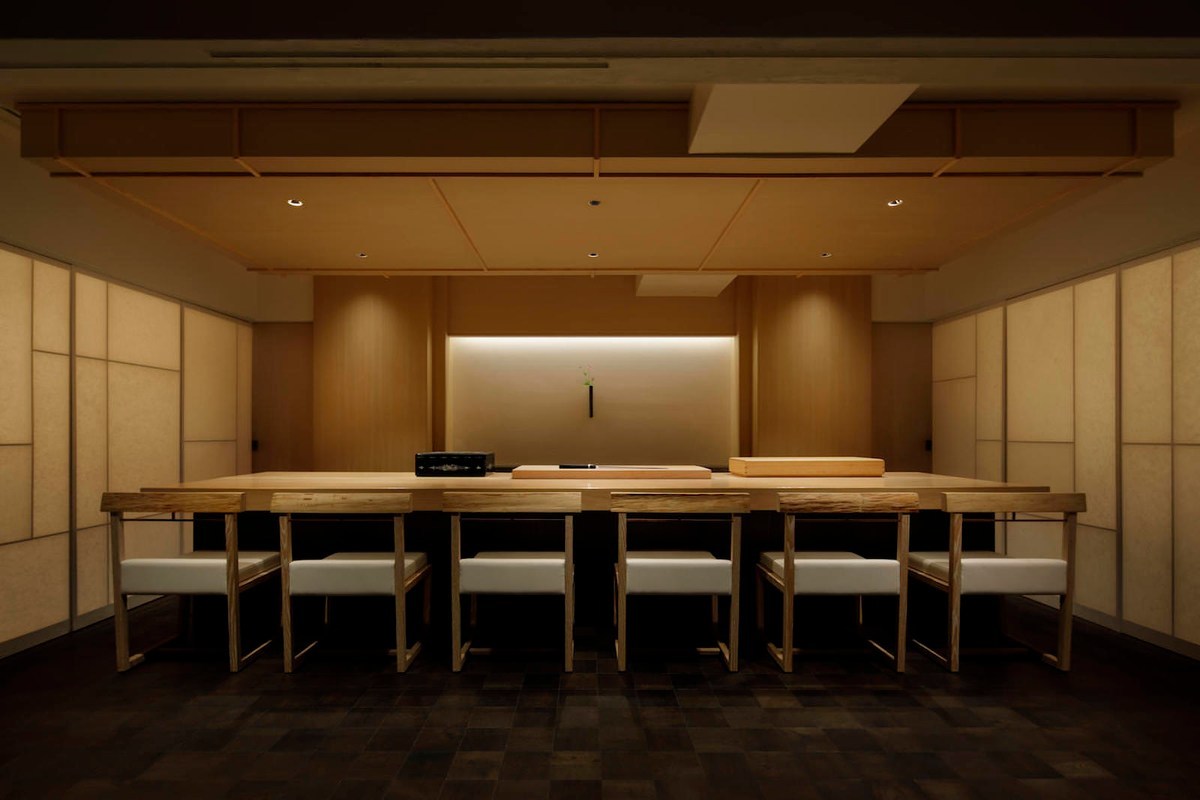
Image source: Hakkoku’s OMAKASE listing. Photographer not identified.
TABLEALL’s description identifies a low, flat counter without a raised shelf dividing cook from guest. That matters more than the small capacity alone: the place where the mouthful is finished remains in the same field of view as the place where it will be eaten. It is a close view of the work, not a promise of personal access to the person doing it.23
For companions, that arrangement has a particular rhythm. Both can follow the same preparation without needing to interpret it for one another. But sitting side by side also gives conversation a different geometry from facing across a table. Someone planning an evening of sustained private conversation should consider that as carefully as the menu’s length.
The final assembly is visible, but much of the cooking has happened earlier. Hitosara’s description of the anago is instructive: the eel is simmered with sake and water, rested overnight, then grilled; the cooking liquid contributes to its glaze. The counter completes that preparation. It cannot show an overnight rest in real time, and should not be expected to.8
This is one limitation of treating visibility as proof of transparency. Watching a cook form a piece of sushi tells a guest something about the last stage of the work. It reveals much less about preparation, storage, purchasing or the colleagues whose labour has made that final stage possible. The meal can be admired more accurately once those omissions are acknowledged.
Hakkoku’s arrangement makes a particularly interesting accommodation for its cooks. There are three separate six-seat counters, rather than one eighteen-seat room. In a 2020 Hitosara interview, Sato explained that a shared counter would leave younger colleagues conscious of his observation, and guests conscious of the hierarchy. Separate rooms gave each cook responsibility for a service. Buying and preparation were shared, but he did not claim identical skills or universal agreement with his own taste.10
A restaurant is rarely discussed in terms of how uncomfortable its arrangement might make the cook. Here that discomfort helped shape the room. The six-seat format is therefore doing more than producing scarcity. It allows a colleague to work without the proprietor becoming the inevitable centre of the guest’s attention.
The current reservation page names Sato, Miwa and Fukasawa, as well as an unassigned option. The choice should be read literally. These are different services within one restaurant, not an original and several substitutes.7
A review published by DanielFoodDiary in April 2025 offers a useful account of Hiroki Fukasawa’s shorter meal. The rice was tangy and lightly salty without overwhelming the fish; warm anago stood out for its delicacy. Young sea bream and pen shell made less impression, and the Spanish mackerel’s flavour faded quickly. The reviewer also appreciated Fukasawa’s approachable manner, some English conversation and unobtrusive service. That approximately twenty-piece meal should not be confused with the present twenty-five-piece dinner.11
The mixed response is useful. It gives the reader a dinner to consider, with high points and quieter passages, rather than a demand to accept the restaurant’s reputation intact. Equal prices invite scrutiny of each service; an admirable training structure cannot make an ordinary mouthful extraordinary.
Sato had worked as a waiter before becoming a sushi cook. In the 2020 interview he described reducing the quantity of rice as a guest’s pace slowed; the Hitosara editor subsequently observed the adjustment in the 2022 dinner.109
This is a modest intervention with considerable value. The next piece can remain desirable without a guest having to stop the service and negotiate. Observation has made dinner easier. It does not mean the fixed menu can be reconstructed to accommodate any preference; it means someone has noticed the person eating it.
The seat suits a diner who wants to attend to fish, rice and the changing relationship between them for the length of a substantial course. Companions can enjoy that concentration together. They need not mistake it for an obligation to deliver twenty-five separate expressions of approval.
Ginza Shinohara
There is also room for a dinner that enjoys being looked at. Takemasa Shinohara moved his restaurant from Shiga to Ginza in 2016. Early reporting in Dressing described a spring hassun—an assembled course of small preparations—whose freshwater fish, vinegared lotus root, eel and other elements occupied an elaborate seasonal arrangement. Dashi and the layering of flavour were central to the cook’s stated ambition: a substantial meal that would not wear out the person eating it.13
The arrangement is part of the offer. A reader who dislikes seeing food composed into a view may never find this the right dinner. But it is equally limiting to assume that a visually ambitious plate must be compensating for its cooking. Anticipation, amusement and the pleasure of choosing where to begin can all belong to a good meal.
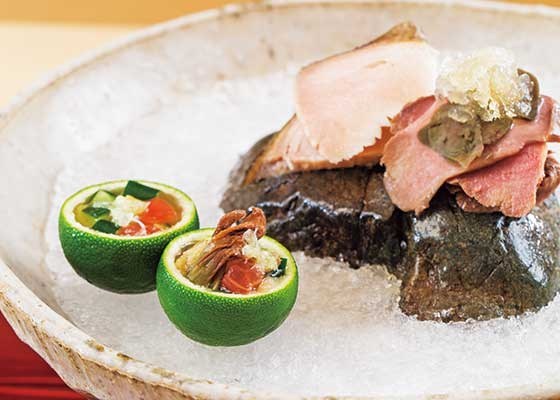
A much smaller preparation explains the kitchen more precisely than its largest display. In an interview published online by Cuisine Kingdom in 2021, Shinohara demonstrated a hollowed sudachi filled with finely cut vegetables and a jelly of diluted soy sauce and citrus. On top went a frozen preparation using the fruit’s membranes and white pith as well as its flesh. He wanted the cold to delay the perception of bitterness, allowing it to arrive after the first impression.14
Photograph: 富貴塚悠太, published by 料理王国 / Cuisine Kingdom.
The citrus accompanied cured Biwa trout and cold summer boar. Its contents were intended as a sauce, changing the experience of the rich fish and meat. This is an archival preparation, not a dish to request for an autumn reservation.14
Even at a distance, the idea is compelling. The decorative vessel contains something with an argumentative edge: sourness and bitterness brought into the same mouthful as richness. It gives the guest an action with a culinary consequence. Taking the sauce with the fish should alter dinner more meaningfully than learning another ingredient’s price.
What the recipe cannot establish is whether every contrast was successful on the tongue. A chef’s explanation is evidence of intention. A tasting is evidence of a result. Keeping the two separate leaves more room for useful criticism than assuming that an intelligent idea must have tasted exactly as planned.
Tiffany Tu’s account of an October 2024 dinner supplies a diner’s response that is both enthusiastic and selective. She admired fluffy grilled anago and a clear soup of sea bream and mushrooms with yuzu. The large seasonal display impressed her more visually than gastronomically; an additional matsutake preparation did not seem worth its price. She nevertheless wanted to return for another menu.15
Those judgments can coexist. A beautiful evening does not require a retrospectively perfect mushroom. Nor does disappointment in an expensive ingredient oblige a diner to dismiss the broth, the eel and everything else around it. A long seasonal meal is especially vulnerable to this sort of unevenness: the sequence must accommodate many more ideas than can be judged by the photograph of its most elaborate course.
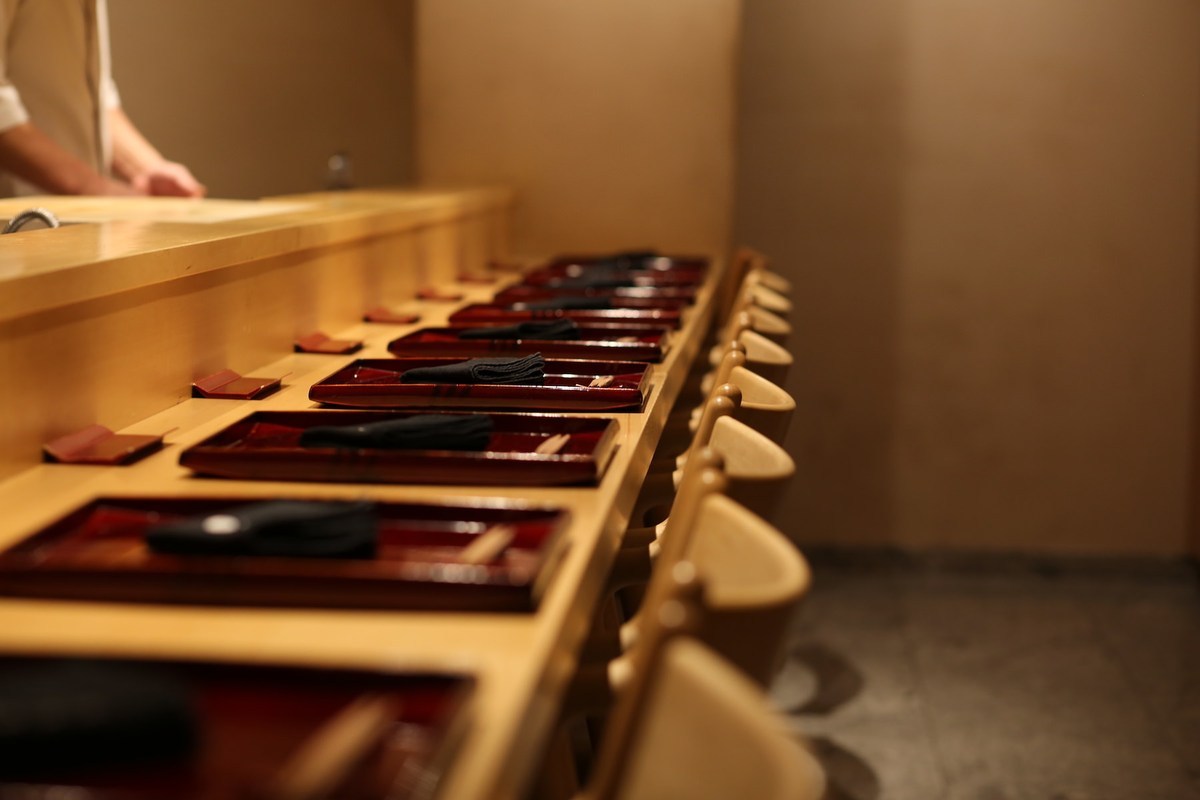
Image source: Ginza Shinohara’s OMAKASE listing. Photographer not identified.
Tu also noticed the team assembling plates between courses, and credited a younger chef with translating explanations and helping her feel comfortable at her first full dinner of this kind. The hospitality she valued depended on someone other than the most recognisable person in the room.15
That is one of the counter’s practical possibilities: a complicated course can be made intelligible by the person available to explain it, without stopping the whole kitchen or requiring the proprietor to perform every role. Watching the final assembly may deepen a guest’s understanding of the meal. It does not account for all the broths, sauces and preparations that arrived at the counter already well advanced.
The current booking page makes another part of the experience explicit. The seasonal course starts at ¥36,000 including tax, with optional dishes from ¥6,400. The public information does not settle the service-charge treatment sufficiently to promise a final all-inclusive figure.12
Supplements can be welcome. They can also return a spending decision to a guest who thought dinner had already been decided. A price clearly supplied in advance allows the choice to remain about appetite and value. There is no evidence here that declining creates tension; neither should an expensive addition be treated as necessary to appreciate the restaurant.
Shinohara is the most expansive of these propositions. The attraction is the changing scale of the meal: an arrangement to explore, a concentrated broth, an accompaniment whose bitterness has been considered. A guest who enjoys some display has a reason to come. The important reservation is the ordinary critical one: the smaller mouthfuls must be allowed to make a stronger impression than the larger spectacle.
Bird Land Ginza
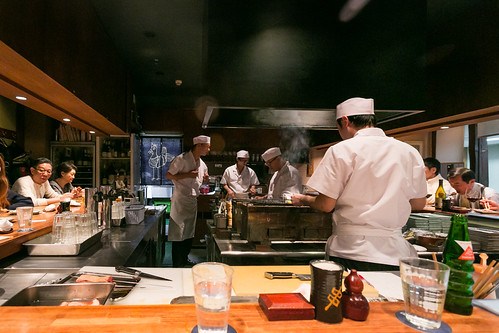
Bird Land’s counter surrounds a shared working space. Tokyo Calendar’s 2024 reporting describes staff moving within its U-shaped arrangement. The view is of a restaurant getting dinner out, not simply one cook producing a personal sequence for a handful of spectators.16
The central ingredient is Okukuji shamo from Ibaraki. Bird Land describes the chicken in terms of its firm texture and relatively low fat: meat intended to be chewed and tasted, rather than praised only for disappearing. That supplier description is a starting point, not proof that every skewer will be beautifully cooked.18
Toshihiro Wada’s explanation of skewering, in the Tokyo Calendar interview, is more practical than picturesque. Avoid crushing the flesh as the skewer enters; avoid turning the meat unnecessarily over the charcoal. Continuous movement would make a busier show. It would not necessarily make better chicken.16
© City Foodsters · “Inside Bird Land” · CC BY 2.0. Licence.
The menu gives that chicken more than one form. The middle course includes liver pâté, tenderloin with plum and shiso or basil sauce, eight skewers, sansho-seasoned chicken, grilled cheese and a small oyakodon. It has a shape beyond the serial presentation of different cuts.17
The change of preparation is important. Pâté asks for a different pace from a skewer; herbs and plum offer another register around the meat; chicken, egg and rice finally bring the separate eating into a bowl. The course has room for someone who likes grilled chicken without wanting the whole evening to become an anatomical inventory.
Tokyo Calendar described the pâté as smooth and rich, with careful cleaning of the liver behind the result. The oyakodon received equal attention: chicken stock and eggs cooked to a softly set finish. These are dishes whose success cannot be measured by how impressive the grill looks from the seat.16
An older review usefully limits the temptation to make Bird Land represent uncomplicated perfection. Writing in 2017, Jennifer Che of Tiny Urban Kitchen enjoyed the animated counter but preferred the grilled meat at another restaurant. Among her particular pleasures here were creamy tofu and the herbs around the sansho chicken. The comparison is historical; it cannot rank today’s grilling. It does show that the appeal of a restaurant can be broader than the supremacy of its headline technique.19
That breadth is part of the reason to choose this dinner. The menu containing the small oyakodon comes to ¥12,980 with the published service charge. It should be judged as a substantial restaurant bill, not excused because the other meals in this selection cost more. The argument is the completeness of the course, and whether its changes of texture and preparation keep the chicken interesting.1720
There are tables as well as counter seats. A group that wants to face one another may reasonably prefer them. The counter offers a view into the shared work; it also arranges companions around that work rather than around their own conversation. Neither choice carries more authority.21
The restaurant’s booking communication helps keep the decision ordinary. It directs solo guests and parties of three or more towards the telephone, and explains that a full online allocation need not mean every seat is taken. Counter preferences can be entered, but should be confirmed rather than assumed. No particular stool, or personal service from Wada, is being promised here.21
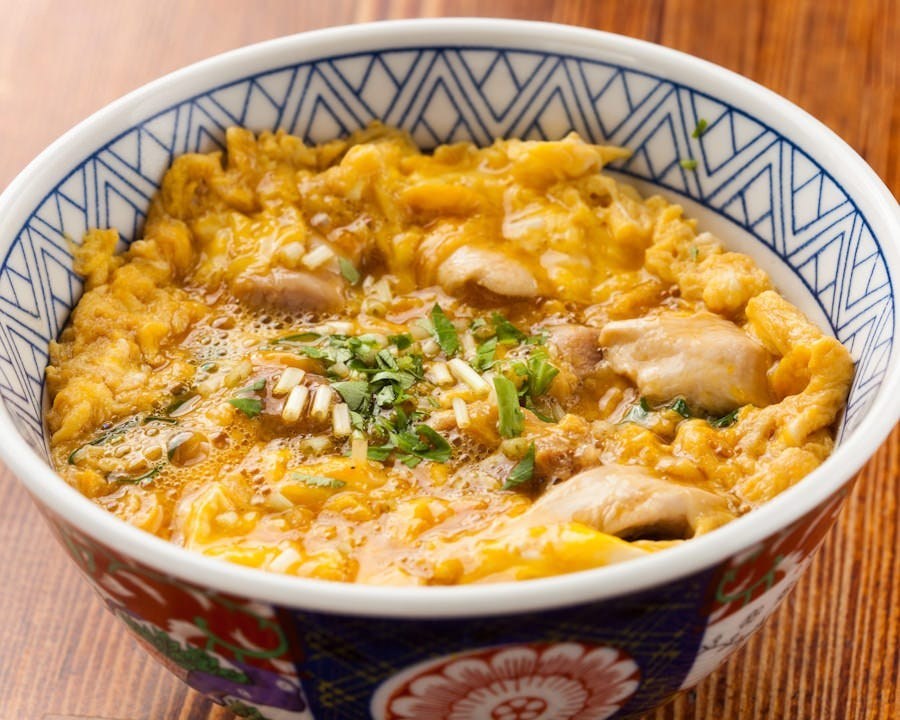
Image source: Bird Land’s Rakuten Gurunavi listing. Photographer not identified.
For the oyakodon, the most revealing equipment is a small pan. In a 2019 Favy interview, Wada recalled finding the version he preferred while cooking at a department-store event. His own pans did not suit the heating equipment; another exhibitor was selling a thicker one that worked better. He bought the available stock.22
Later he had the handles set lower, making it easier to see the eggs as he moved the pan. The modification is hard to turn into a prestige story. It concerns a better view of something that can go too far in a short space of time.22
The bowl needs the judgment. The guest does not need the explanation. After the skewers, there is the prospect of stock, chicken and soft egg coming together with rice, without another decision to make about how closely to watch.
The interviewer asked how the pans stayed so clean. Wada said he washed them with a sponge. Pressed on how they still looked good after years of use, he offered a less elaborate explanation.
He did not burn things in them.22
Before booking
Checked 9 October 2026. Prices are per person in yen, before drinks and optional additions unless specified. Release schedules do not establish availability.
Tempura Kondo · てんぷら近藤
Where: Sakaguchi Building 9F, 5-5-13 Ginza, Chuo-ku. Dinner: tempura courses; two counters, 12 and 8 seats; 17:00 or 19:30, with 2½ hours allocated. Courses ¥22,000 / ¥27,500 / ¥33,000 including tax. International booking totals: ¥25,300 / ¥31,625 / ¥37,950 with the official route’s 15% charge. Use the official website and its multilingual booking form; prepayment is required. The format is counter seating; whether a particular position can be requested remains unverified. Confirm the assigned chef and any desired signature additions.
Important: shared frying oil and utensils; no vegan menu. The international terms allow a full refund until 15:00 JST three days before; later cancellation is non-refundable. More than 15 minutes late means cancellation without refund.
Hakkoku · はっこく
Where: La-pe Building 3F, 6-7-6 Ginza, Chuo-ku. Dinner: 25-piece sushi course; three six-seat counters. From ¥36,690 including advertised tax/service and the ¥390 booking fee; procurement can affect the price. Book through OMAKASE, checking the named chef or unassigned option. Counter seating is integral; individual positions are not verified as requestable. Releases are irregular, with a window of up to two months.
Important: coordinated starts; no raw-fish-free or vegetarian reconstruction. Payment is by card. Cancellation: 5% from booking, 50% from seven days before, 100% from two days before.
Ginza Shinohara · 銀座 しのはら
Where: B1F, 2-8-17 Ginza, Chuo-ku. Dinner: seasonal omakase; current booking page lists 12 counter seats, with 17:00 and 20:30 starts. From ¥36,390 including advertised tax and the ¥390 booking fee; this is a floor, not a verified all-inclusive total. Service-charge treatment needs confirmation. Optional dishes start at ¥6,400. Book through OMAKASE; releases are on the 25th at 00:00 JST. No precise counter position is promised.
Important: guests must be 16 or older; broad dietary exclusions may prevent acceptance. Cancellation: 5% from booking, 30% from seven days before, 100% from three days before.
Bird Land Ginza · 銀座バードランド
Where: Tsukamoto Sōzan Building B1F, 4-2-15 Ginza, Chuo-ku. Dinner: chicken courses and yakitori; U-shaped counter and tables. The course discussed here is ¥12,980 with tax and service. Use the official website’s booking links or call +81 3 5250 1081; the restaurant recommends calling for solo guests and parties of three or more. Choose a confirmed counter category or obtain confirmation: a request alone is not a guarantee.
Important: the official direct-booking policy states ¥11,000 per person for same-day cancellation, with no charge when notified by the previous day. Read the conditions attached to the actual reservation; plan-specific terms take precedence.
For all four, confirm any required step-free route, seating dimensions, dietary accommodation and service-language support before committing. An English booking form does not establish English-language service. Photography rules and the attendance of a particular chef should also be checked directly.


.png)