



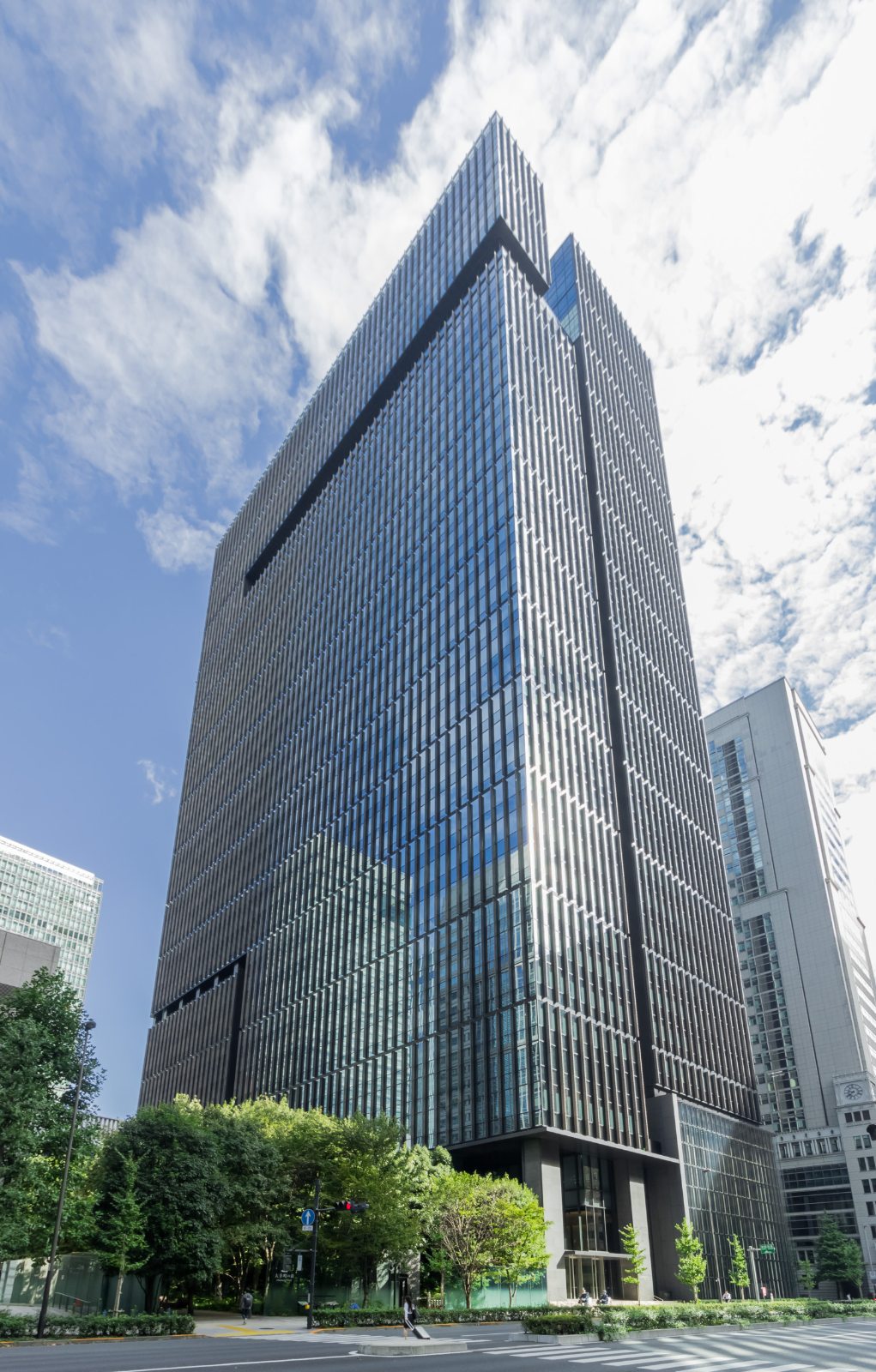
At Aman Tokyo, the bathroom can be closed. Shoji doors separate the deep soaking tub and double basins from the bedroom. Open, the arrangement belongs to the familiar photograph: pale planes, dark framing, the city beyond. Closed, it accommodates something the photograph rarely includes—two people who have chosen to spend the night together and would still appreciate a little distance while getting ready.
The doors offer a more useful definition of discretion than the colour of the stone. A guest can change the room without changing rooms.
The more mischievous question is whether Aman has become the H&M of hotels. As a comparison of prices, scale or operations, it collapses immediately. As a question about the convenience of a recognisable identity, it lasts a little longer. A brand can assemble a look so persuasively that buying it begins to feel like having invented it. The appetite for a reliable expression of taste is hardly confined to one price bracket.
But what, precisely, is the uniform? It cannot simply be the interior. Aman Venice occupies Palazzo Papadopoli, with frescoes and Rococo decoration; Tokyo occupies the upper reaches of an office tower. Those differences are substantial. What may travel between them is an expectation: that the business of being somewhere else will be arranged with unusual control. Whether that expectation survives a particular stay is another matter.
There is also a perfectly sensible reason to book a familiar hotel. One has other things to think about. Requiring every reservation to demonstrate originality merely gives the traveller a second job.
Tokyo makes these questions unusually concrete. In Otemachi, two hotels close to one another organise withdrawal in almost opposite ways. The Okura puts a private steam sauna inside an ordinary Heritage room. At Palace, a balcony gives the guest a small piece of outside space without requiring a trip through a lobby. None of these arrangements makes anyone anonymous. They make different parts of a stay easier.
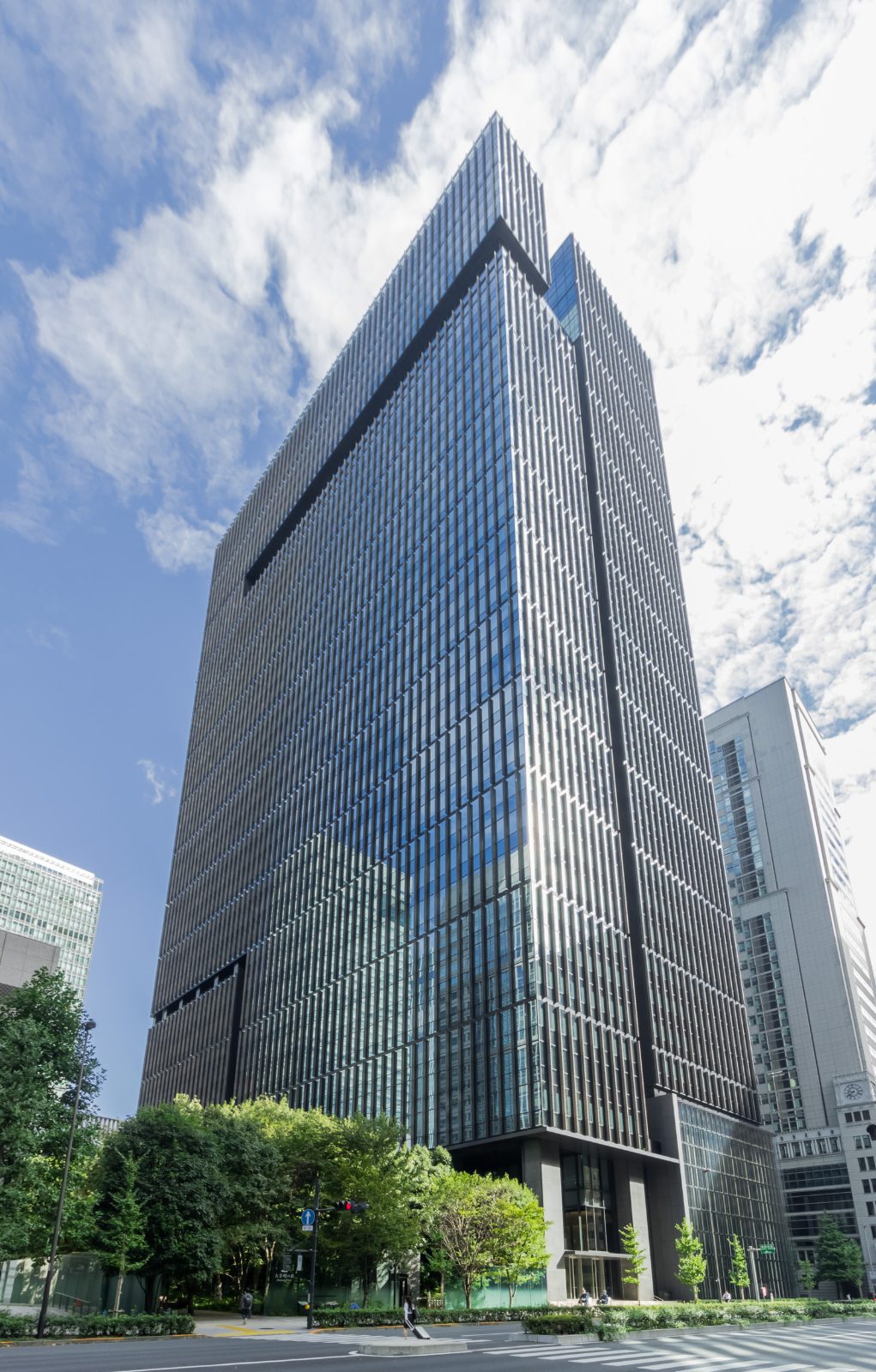
Photograph: Kakidai · October 2024 · Wikimedia Commons · CC BY-SA 4.0. Web-optimised.
Aman Tokyo: the view, and the doors
Kerry Hill Architects gave Aman Tokyo a room that is anything but retiring. Its vast lantern-like volume, timber and stone enlarge the architectural language of a house into something almost civic. In his Architecture Australia account, Erwin Viray describes the passage from compression into that extraordinary expanse. The release is the point. A subdued vocabulary can still be used at full volume.
It would be perverse to deny the pleasure of such a space because other people recognise it. Nor is the lounge’s afternoon-tea trade a scandal concealed in plain sight. A hotel may have a public room worth visiting and accommodation worth withdrawing to. The two activities need competent management; they do not cancel one another out.
The more persuasive reason to stay is the Deluxe Suite, the 71-square-metre entry category. There is a writing desk, a daybed and a sunken sitting area at the foot of the bed. The level change gives the accommodation a second register without pretending to be a separate, enclosed living room. “Suite” should not be mistaken for a door between work and sleep.
For one person, that distinction is less troublesome than it may be for two with different schedules. The desk allows a laptop to stay somewhere other than on the duvet; the daybed gives reading a different posture from working. These are small freedoms, but they are the substance of spending time in a hotel rather than merely passing through one. A large bedroom becomes useful when its furniture allows more than one occupation.
The west-facing windows take in the Imperial Palace gardens and the towers of Shinjuku, with Mount Fuji visible in clear conditions. The generosity is in the foreground as much as the distance: space to sit and look without balancing a cup on a bedside table. The bath belongs to the same composition, but the sliding screens allow the composition to be interrupted. Admiration need not be maintained throughout the evening.
The hotel’s current offer includes daily breakfast and non-alcoholic in-room refreshments. The breakfast plan examined for this feature specifies a choice of restaurant or in-room dining, with Japanese or Western sets. That is a useful piece of operational discretion: taking breakfast privately need not mean abandoning the breakfast already purchased. The venue should nevertheless remain explicit in the booking, rather than assumed from the word “included.”
At Arva, Masakazu Hiraki’s Italian cooking works with seasonal Japanese produce. More relevant to an unplanned evening is the coexistence of courses and an à-la-carte menu. The latter has a later last-order time. The restaurant therefore accommodates different appetites and different amounts of available evening. Dinner for one need not become an endurance event staged to justify the reservation.
Otemachi’s practical advantage is the connection to a working transport district, not a generic promise to escape Tokyo. The tower connects to Otemachi Station and its five subway lines. The room is far above the street while the hotel remains connected to the city below. For a guest moving between appointments, that separation is efficient. For someone who likes to wander out repeatedly, taking the lift becomes part of every excursion. Neither preference is more sophisticated.
What the address cannot establish is sound insulation. A view over an immense distance says nothing reliable about a connecting door or a mechanical system. No acoustic test underpins this recommendation. Its basis is the room’s scale, its separable bathroom and the advertised arrangements for eating and working. Those advantages survive the Aman joke. The hotel may be an easily understood choice and still be exactly the right one.
Hoshinoya Tokyo: six rooms to a household
Hoshinoya Tokyo answers the office district at a different scale. Its patterned façade is not an attempt to go unnoticed; it changes the building’s apparent texture. Closer to the ground, the landscape designers, studio on site, describe making a recognisably private forecourt without erecting a wall between the inn and the city. Smaller planting, patterned paving and benches establish a threshold through detail rather than exclusion.
This is more interesting than the usual urban-retreat story. The designers were not given a rural garden, and did not pretend otherwise. The project belongs to the redevelopment of Otemachi. Rie Azuma’s ryokan planning and interiors, within a building designed by Mitsubishi Jisho Sekkei and NTT Facilities, make a contemporary proposition about living in that district. Shoes come off; tatami connects the accommodation to the shared spaces. The change is bodily before it becomes decorative.
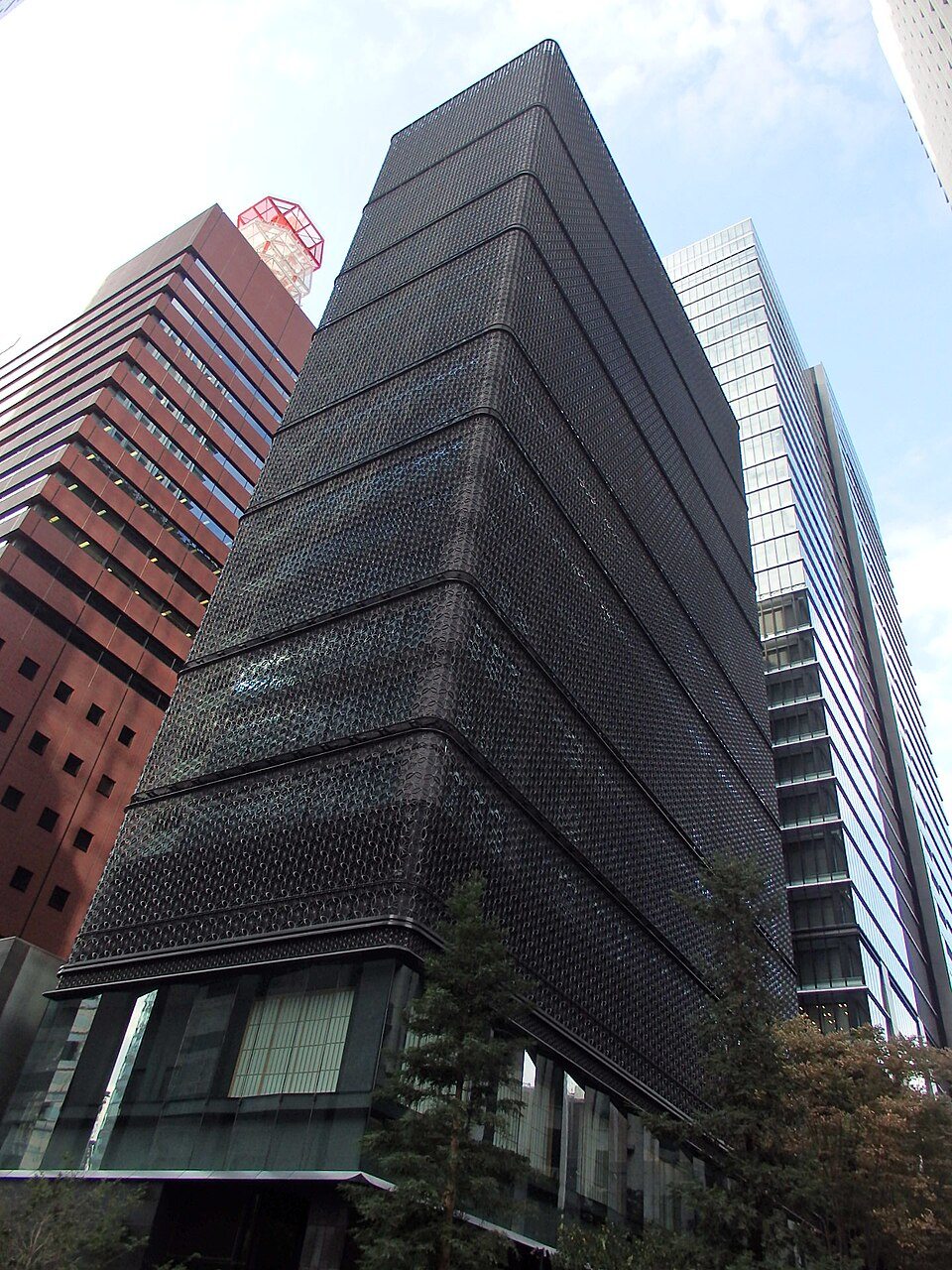
Photograph: ブツチチ · 7 October 2016 · Wikimedia Commons · CC BY-SA 4.0. Archive photograph; web-optimised.
The decisive unit is a floor. Six guest rooms share an ochanoma lounge, available around the clock to residents of that floor. There are books, drinks and changing refreshments. A guest travelling alone has somewhere beyond the bedroom to sit without buying another coffee or making another reservation. The room acquires an anteroom, although it does not acquire exclusive possession of it.
The lounge programme is unusually explicit about the degree of preparation required. Its tea sessions and other activities need no reservation, and the hotel permits its own loungewear. That removes two minor pieces of friction: deciding sufficiently early, and dressing for something that was meant to be restful. The offer includes morning letter-writing with Edo washi and evening caffeine-free drinks. A letter is an appealing alternative to another device charging beside the bed; it is also something one may decline to write.
There is a social price to this intimacy, though not necessarily a disagreeable one. With six rooms sharing a sitting room, faces can become familiar. A guest who likes the mild companionship of an inn may find that reassuring. Another may prefer a large lobby in which nobody’s presence is particularly remarkable. Smallness narrows the circle. It does not automatically reduce the feeling of being noticed.
The Yuri room—百合, the king-bedded category—extends the low, domestic arrangement with screened light, tatami and a sofa. Hoshino’s English property profile specifies approximately 45 square metres. It is a different proposition from Aman’s broad, western-facing room: more inwardly composed, with the floor lounge doing some of the work that Aman keeps inside the accommodation. Someone expecting conventional desk-height living throughout the day should examine this arrangement closely rather than assume that every piece of low furniture will become comfortable through cultural goodwill.
Upstairs, the natural hot-spring baths supply a reason to stay that has little to do with proving taste. Indoor and open-air bathing make the roof part of the experience of the inn. These are shared baths, not a private onsen attached to the Yuri. For someone who wants hot-spring bathing, that is an attraction; for someone who wants every bath to be taken alone, it is a qualification that should appear before payment.
The dining room turns towards another kind of domestic inheritance. Its menu, “Lost Flavors of Japanese Home Recipes,” reworks preparations that have become uncommon in home kitchens. Wallpaper’s account gives salmon head with soybeans and octopus with aubergine as examples of its starting points. They are examples from that reporting, not a promise about tonight’s courses. The appeal lies in ingredients acquiring meaning through use, rather than arriving with prestige already attached.
The premise has a complication worth retaining. Domestic cooking often solves a problem of time, cost or availability; an expensive tasting menu removes those conditions. What remains valuable is the cook’s particular combination or technique, not the flattering suggestion that a costly dinner is an act of preservation. Hoshinoya offers a culinary argument worth considering. Its title alone cannot settle that argument.
Nor is this dinner the whole food operation. The current Japanese dining page advertises an in-room evening menu from 17:00 to 21:00, with no advance reservation, and lighter in-room dining until midnight. Restaurant dinner, by contrast, requires booking by 20:00 the previous day. The inn can accommodate a decision to stay upstairs, but not every appetite at every hour.
Breakfast is the detail to settle in writing. The current Japanese page places its Japanese and Western breakfasts in the dining room; the English press profile describes in-room breakfasts. The discrepancy does not prove poor service. It does make Hoshinoya a less straightforward reservation for someone whose private breakfast is non-negotiable. Choose it for the household scale, the lounge and the baths, not simply because its façade appears more reticent than its neighbours.
The Okura: arrangements that endure
The Okura’s famous lobby is often treated as a survivor. More accurately, it is a reconstruction. The hotel reopened in 2019 with a re-creation of the 1962 interior, overseen by Yoshio Taniguchi, whose father, Yoshiro, designed the original. Low tables and chairs arranged in plum-blossom groups retain the room’s recognisable grammar. Continuity here required decisions, drawings and new construction.
That lobby belongs to the Prestige Tower. The rooms considered here are in the Heritage Wing. The distinction is important: the image that persuades someone to book is not always the building in which they will sleep.
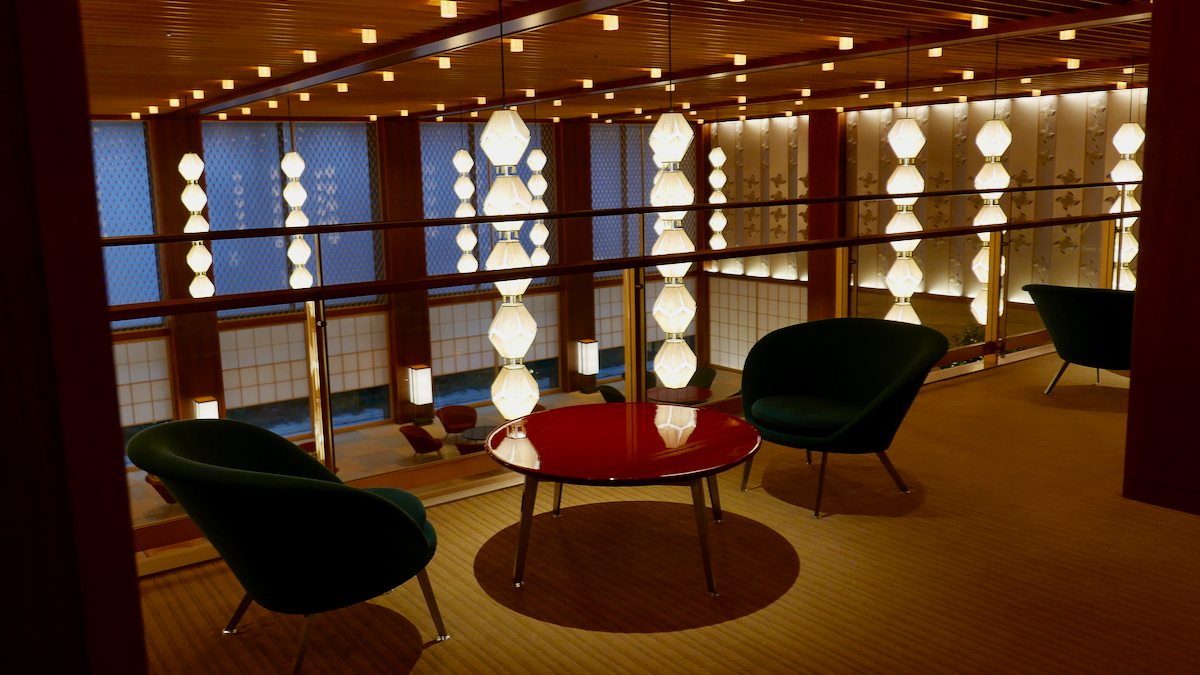
Photograph: Matsujima · 20 November 2019 · Wikimedia Commons · CC BY-SA 4.0. Archive photograph; web-optimised.
A Heritage King occupies 60–63 square metres and is offered in two telling configurations: Spacious Living and Bath With a View. The former puts a window more than six metres across beside the sitting area and an engawa-style bench. The latter gives the bathtub a picture window. These labels describe an allocation of useful space rather than another rung on a ladder of flattering adjectives.
They are not, however, promises that a particular layout can be selected in the examined booking plan. Its terms explicitly decline requests for a specified layout, outlook or floor. Someone choosing the Okura principally for one of those configurations needs an agreement from the hotel, not a screenshot of the more appealing plan. A recommendation should not turn a preference into an entitlement that the reservation never supplied.
What the Heritage specification does include is unusually persuasive: a private steam sauna, a jet bath, twin basins, a separate toilet and a walk-in wardrobe. The wardrobe is the least photogenic of those provisions and potentially one of the most civilising. Luggage can be unpacked without colonising the sitting area. Two people can get ready without converting the bathroom into a series of appointments.
A steam sauna inside the room is emphatic luxury, whatever the restraint of the surrounding timber. Its value is equally literal. There is no shared facility to enter, no need to time a visit around another activity, and no requirement to make a spa outing of a wish to be warm. For a solo guest, the room supplies an evening rather than merely sheltering the gap between dinner and sleep.
Breakfast makes the operation more convincing. On the hotel’s published breakfast-inclusive arrangements, guests can choose room service instead of the restaurant. The alternatives include the Orchid buffet and Yamazato’s Japanese breakfast; Heritage residents may also use Nouvelle Epoque. The important provision is the unglamorous one: breakfast in the bedroom is an acknowledged use of the entitlement.
Ordering can be done on the room’s tablet or by telephone. Neither channel is inherently superior. A guest who would rather specify a meal without making conversation has an option; a guest with a question still has someone to call. This is an actual service decision, and a more informative one than claiming that staff somehow know what everyone wants.
The late menu is similarly legible. From 22:00 until midnight, it offers beef curry and rice, spaghetti Bolognese, kitsune udon and onigiri, among other dishes. The rice balls come with pickles, miso soup and fruit in the Japanese description. An individual appetite has been considered beyond the obligatory sandwich.
At ¥4,800, the curry is not an argument for inexpensive eating. It is an alternative to organising another outing. The distinction becomes particularly useful when two people do not want the same dinner, or when one person wants something substantial without the full social apparatus of a restaurant. The service stops at midnight. A beautifully appointed room is still capable of leaving a late arrival hungry; Palace has the clearer proposition after that hour.
Another current detail deserves attention before booking. Since 1 July 2026, Heritage Rooms have been sold with club-lounge access as an option, rather than through the previous pair of room labels. The complimentary refrigerator minibar and pressing of five garments per stay remain with the room. There is no basis for assuming that this change makes a reservation cheaper. It does make the purchase more intelligible: a guest can decide whether another shared room is useful.
For arrival, the hotel publicly offers check-in from the Library as an alternative to the front counter. This is not clandestine access or a favour that requires a well-connected introduction. It is an ordinary arrangement to ask about. The Okura’s case rests on that kind of explicit provision—small, understandable choices supported by a substantial institution.
Of the four categories examined, Heritage makes the strongest documented case for conducting more of the stay inside the room. The qualification is important: the specification and the food arrangements are unusually complete; they do not certify every night’s maintenance or every interaction. Still, a private sauna, somewhere to put the luggage and breakfast delivered under the booked plan amount to considerably more than an atmosphere.
Palace: a little outside space
At Palace Hotel Tokyo, the most attractive argument is a door leading out. The Deluxe King with Balcony looks towards Wadakura Fountain Park and the Imperial Palace plaza. The balcony is furnished. It allows the guest to take a drink outside without first deciding to leave the accommodation, a pleasure that does not need to be enlarged into a philosophy of retreat.
Its exposure is part of its value. Weather reaches it; the city remains present. It is not an invisible box attached to the bedroom. A person who wants complete enclosure may prefer Aman’s high windows. Someone tired of spending a trip in conditioned air may find the Palace arrangement more immediately useful.
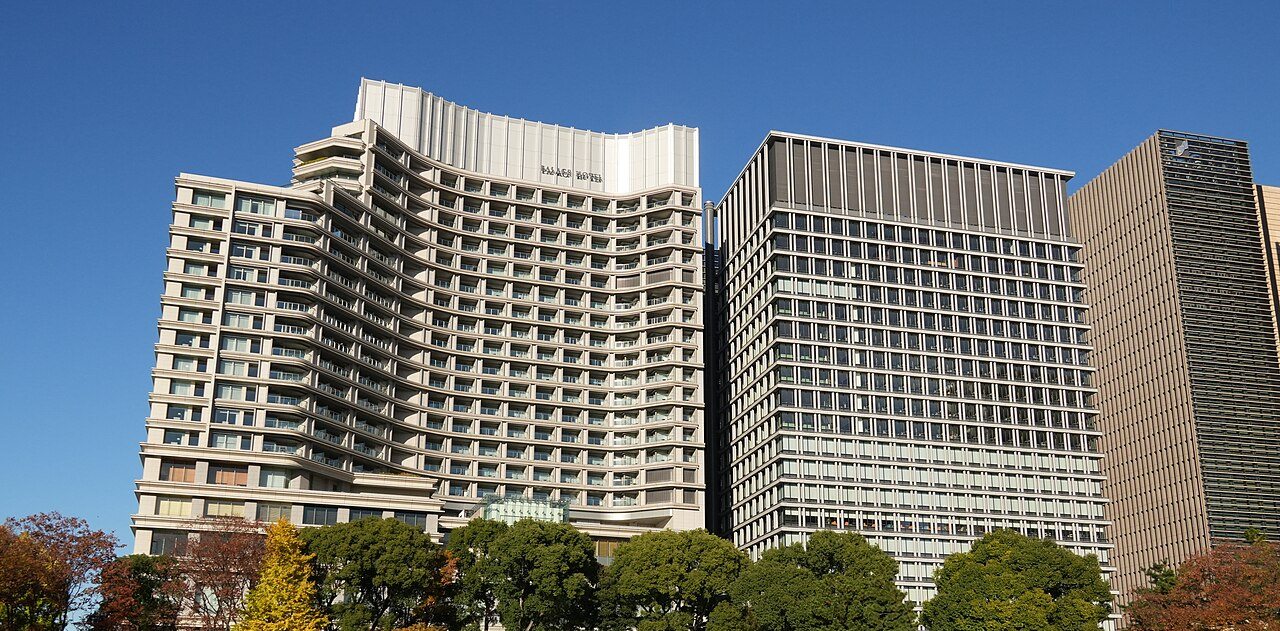
Photograph: Tokyo538 · 1 December 2024 · Wikimedia Commons · CC0. Cropped to the architecture and web-optimised.
The category is 45 square metres. Its published king-room plan places a sofa and table by the balcony, with the bed behind and the bathroom closer to the entrance. There is a separate shower and an enclosed toilet, but one basin rather than the double arrangement at Aman and the Okura. A shared stay requires accepting that smaller working area. The bath’s glazing also makes the available screening worth confirming directly; the illustrative plan does not resolve it.
For one person, the sequence of places is convincing: a table, a sofa, a bed, an outdoor chair. The room allows a change of mood without requiring an enormous floor area. There is somewhere to leave a meal or a piece of work without immediately clearing it away to sleep. The balcony extends that sequence into the air rather than adding another interior vignette.
Palace publishes 24-hour in-room dining. That does not mean that every dish from every restaurant can be ordered at any time; selections from its Japanese and Chinese kitchens follow their own service periods. It means that food remains part of the hotel’s offer through the night. For the late arrival, or the guest who has failed to become hungry at the socially convenient moment, this is a substantial advantage.
Downstairs, the Royal Bar provides a reason to leave the room without arranging an entire evening. Its restored counter comes from the original Palace Hotel bar, opened in 1961 and associated with chief bartender Kiyoshi Imai. The choice of seat has an architectural consequence for solo travel: a place at a counter faces into a shared room without leaving an empty chair opposite. Conversation may be welcome, or it may not. The furniture supplies a form of company without establishing an obligation to entertain it.
The bar’s laptop rule makes another distinction cleanly. Computers are not permitted at the counter; guests wishing to use one are directed to table seating. This is a restriction with an alternative, not a vague suggestion that work is aesthetically inappropriate. A hotel need not let every activity occupy every surface. It should make the available arrangements understandable.
Palace is less permissive about room visitors than a reader might infer from its generous public hospitality. Its published rules direct meetings with visitors to the lobby and prohibit unregistered overnight occupancy. A room booking should not be treated as permission to receive a non-resident upstairs. Two registered adults staying together are a different situation, and should book accordingly. The distinction belongs in practical advice, not in gossip about who might be meeting whom.
The recommendation is consequently quite specific. Palace suits a guest who wants an outdoor perch attached to the room, food available late and the option of a public bar without making that bar the centre of the stay. It is not the largest accommodation here, nor a promise of exemption from the rules. Its pleasures are ordinary enough to be used repeatedly.
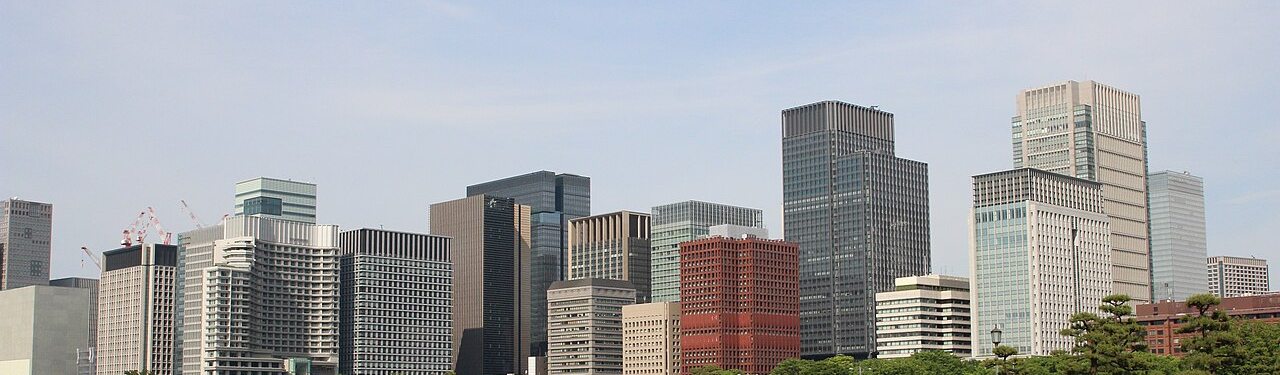
Photograph: Samuele Schirò · 17 May 2015 · Wikimedia Commons · CC0. Archive photograph, cropped to the skyline and web-optimised.
What the hotel needs to know
There is a point at which the architecture stops answering the question. Screens separate a bathroom; they do not govern what happens to a guest’s information. Aman’s privacy notice, for example, describes collecting preferences and information relating to companions, as well as sharing data within specified corporate and service relationships. That is a published account of data handling, not evidence that confidentiality is either flawless or routinely disregarded.
A preference cannot be remembered without something being retained. The useful boundary is between remembering and interpreting. A guest may appreciate the same breakfast and arrive with a different companion. They may return alone and prefer not to be welcomed into a story about the previous visit. They may want a long conversation with the concierge and no conversation at dinner. These are ordinary possibilities, not contradictions for the hotel to solve.
The service evidence available for these four hotels supports choices of venue, ordering channel and amenity. It does not establish how consistently a request for fewer interruptions passes between departments, or how gracefully an old preference is revised. Neither a celebrated name nor the absence of a public complaint supplies that missing evidence. A discreet-looking hotel should not receive credit for a confidential operation that has not been demonstrated.
Lawful registration is a separate matter again. Japan’s health ministry requires foreign nationals who do not have an address in Japan to provide nationality and passport details, and present their passport for copying. That particular requirement should not be indiscriminately extended to foreign residents. Privacy is compatible with accurate registration. None of the recommendations here depends on concealing occupancy, and none implies a day-use arrangement.
Adults sharing a room need no invented circumstances to make that room interesting. A bathroom that closes, a place for each person’s belongings and food that arrives when it is wanted are relevant to intimacy without advertising it. Equally, a single guest need not be resting from a crisis. There may simply be a book to finish and no desire to discuss the fact.
The stay extends to departure. The bill, contact details and preferred method of communication remain practical matters even when the public rooms have been enjoyed lavishly. A guest can like being welcomed and still want the business of leaving to be uncomplicated. The useful question to put to a hotel is specific—how to arrange housekeeping, which channel to use for a request—rather than whether it possesses a mysterious talent for discretion.
There are good reasons to choose every hotel here, and no reason to make the choice carry more personal meaning than it can bear. Aman’s room remains generous after the novelty of its name has worn off. Hoshinoya offers the pleasures, and the proximity, of a small resident household. Palace permits an evening to move between a bar and a balcony. The Okura provides unusually complete arrangements for staying upstairs.
In a Heritage room, the published laundry instruction is to place the clothes in the service box. Pressing for five garments is included in the stay. It is a precise, finite offer, with room for different kinds of evening: work, dinner, another day in the city. The hotel has specified the number of garments. It has left the occasion to the guest.
Reporting note: This is a researched critical selection, not a series of original overnight reviews. It draws on hotel documents, published plans, architectural accounts and attributed reporting. Sound insulation, temperature stability, maintenance and individual service responses were not independently tested. Operational information was checked on 9 October 2026.
Booking notes
Reading the rates. The figures below are public starting prices retrieved on 9 October 2026, not matched-date quotations. The Ikyu examples concern one room for two adults for one night, with no stay date selected, before loyalty discounts. They include consumption tax as displayed; local accommodation tax is generally additional unless expressly included. Service charges are not separately itemised in the retrieved listings. Hoshinoya’s figure is an operator-published guide, not a Yuri quotation. Obtain an all-in price, for the correct occupancy, with the required meal and cancellation terms.
Aman Tokyo · アマン東京
Where: Otemachi Tower, 1-5-6 Otemachi, Chiyoda-ku. Examined: Deluxe Suite, king / デラックススイート — キング, 71 m². Indicative rate: from ¥331,760 with breakfast, on the date-unspecified basis above; retrieved plan requires online card payment and permits cancellation without charge until 15:00 two days before arrival. The case: generous internal living space and a closable bathroom. The limit: a well-known public lounge is not a promise of solitude; acoustics and confidentiality were not tested. Confirm the breakfast venue in the booked plan. Checked 9 October 2026.
HOSHINOYA Tokyo · 星のや東京
Where: 1-9-1 Otemachi, Chiyoda-ku. Examined: Yuri / 百合, king-bedded; approximately 45 m² in the operator’s English press specification. Indicative rate: from ¥182,000 per room per night in the operator’s 28 April 2026 guide, including tax and service, excluding meals; not category- or date-specific. Confirm live booking and cancellation conditions. The case: a resident lounge shared by six rooms, with 24-hour access. The limit: household-scale familiarity is not anonymity; baths are shared, and the breakfast venue needs written confirmation. Checked 9 October 2026.
The Okura Tokyo · オークラ東京
Where: 2-10-4 Toranomon, Minato-ku. Examined: Heritage Wing / オークラ ヘリテージウイング, Heritage King / ヘリテージ キング(ジュニアスイート), 60–63 m², non-balcony category. Indicative rate: from ¥132,824 with breakfast, without club access, on the date-unspecified basis above; retrieved plan permits cancellation without charge until 15:00 the previous day. The case: private steam sauna, useful storage and a published in-room breakfast option. The limit: layout requests are not accepted under the examined plan; room service ends at midnight. Club terms differ around New Year. Checked 9 October 2026.
Palace Hotel Tokyo · パレスホテル東京
Where: 1-1-1 Marunouchi, Chiyoda-ku. Examined: Deluxe King with Balcony / デラックスキング with バルコニー, 45 m². Indicative rate: from ¥151,800, room only, on the date-unspecified basis above; retrieved plan is for one to five nights and permits cancellation without charge until 15:00 three days before arrival. The case: attached outdoor space and 24-hour in-room dining with a time-dependent menu. The limit: confirm bathroom screening; visitor meetings are directed to the lobby. The balcony is not visually secluded from the city. Checked 9 October 2026.


.png)


.jpg)