



.png)
A planted atrium in Yeouido, a former bank near Myeongdong, a Korean lunch in Gangnam. Inside Seoul’s department stores, the invitation to stay deserves a closer look than the invitation to buy.
A researched editorial selection, updated 9 October 2026. No firsthand store visits or tastings are claimed. Archive photographs are dated in their captions.
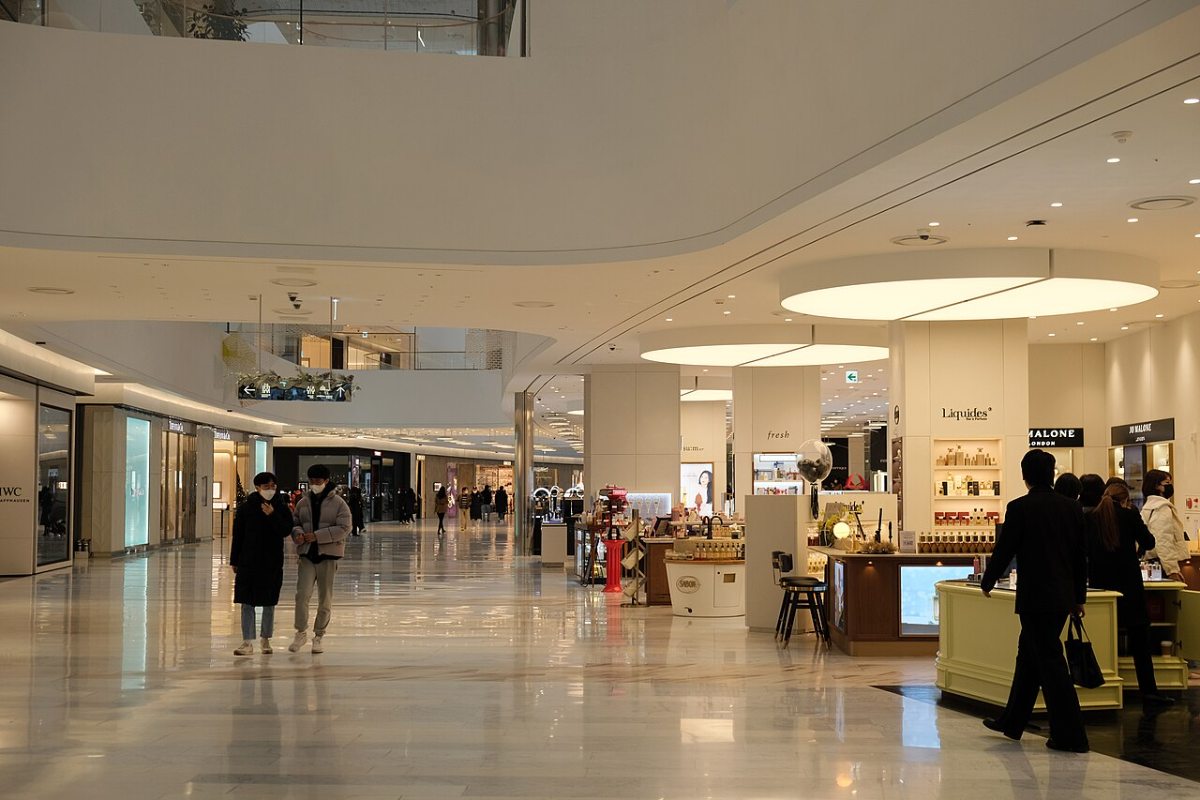
© kallerna / Wikimedia Commons · Source · CC BY-SA 4.0 · Uncropped; resized for web.
The Art Hall closes at seven. At Lotte’s Jamsil AVENUEL, that small detail is more useful than much of the language surrounding the building. A visitor can arrive for a painting and miss it while the shops are still open. The exhibition has its own timetable. The department store is not one continuous invitation.
It is tempting to treat these places as enormous interiors into which an afternoon can simply be poured. A map of floors encourages the idea: food below, fashion in the middle, something green towards the roof. Everything appears to have been arranged. But entering a store is easy; finding a reason to remain takes a little more discrimination. A place to sit may belong to a café. A room described as a lounge may require a year’s worth of spending. A gallery may be a gallery, or several paintings distributed along the route to handbags.
The differences matter. A traveller who has given an afternoon to a building is spending something, even without making a purchase.
In Seoul, the department store, or baekhwajeom, gives that afternoon an unusually broad menu. The floor plan of The Hyundai Seoul places a planted interior between selling floors and a level devoted to dining and art. At Shinsegae Gangnam, a separately organised dining destination brings a store-developed Korean restaurant into the same setting as branches of established restaurateurs. These are different ways of making a visit less dependent on buying an object. Neither requires the visitor to believe that commerce has disappeared.
The interesting question is what happens to the activity once the store accommodates it. Lunch gains a defined location and a managed setting; it also becomes part of a larger selection controlled by one landlord. Art gains access to people who may not have planned a gallery visit; it must sometimes share their attention with everything else for sale. A garden gains maintenance and shelter from weather, where indoors, but loses the open-endedness of a piece of the city that does not close with a business.
None of those exchanges is automatically a bad one. There are days when a clear address and a roof are more attractive than another discovery. There are also days when a building’s determination to keep you interested begins to feel like work.
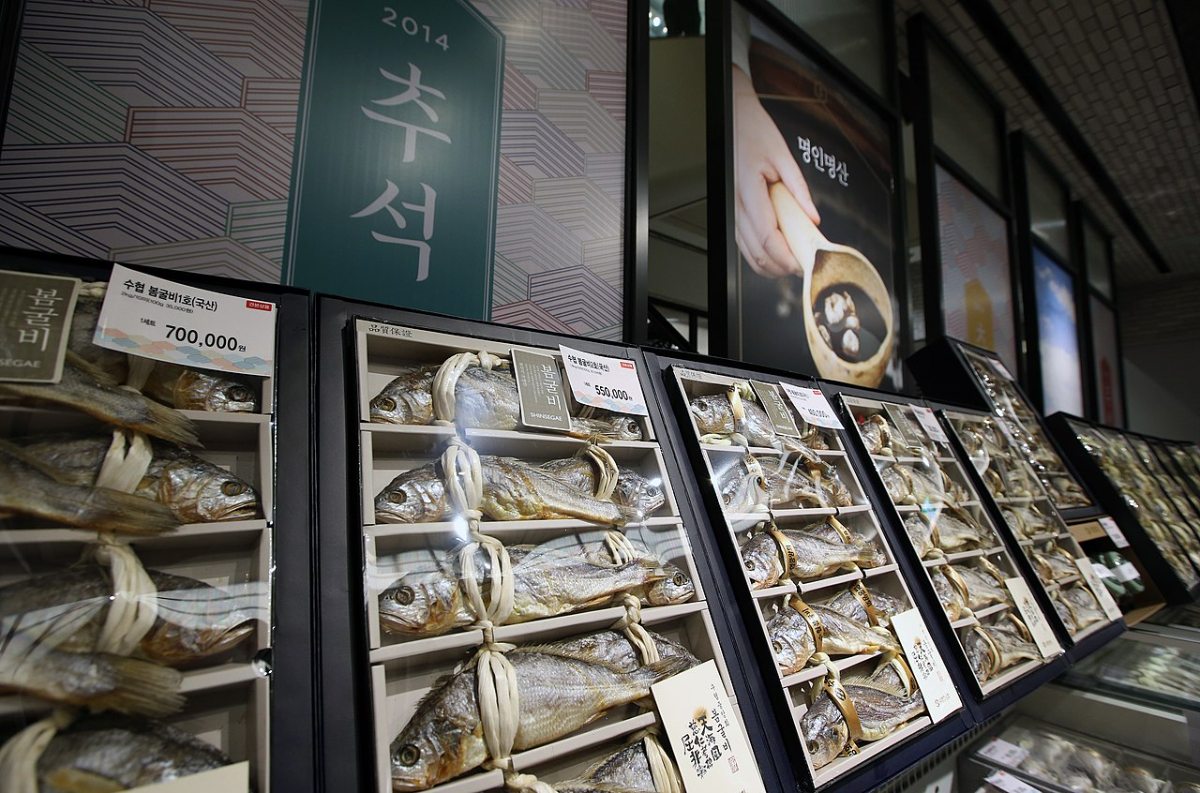
Food makes the distinction particularly visible. A restaurant table and a takeaway box solve different problems. So do a lunch and a gift. In the archive photographs accompanying this piece, taken at Shinsegae Main before Chuseok in 2014, apples and pears sit in individual protective sleeves, arranged with the regularity of an object collection. The fruit is being prepared for presentation as well as eating. Its appearance has a job to do before anyone takes a bite. That is worth understanding, rather than dismissing as packaging or mistaking for a recommendation about where to have lunch.
The most useful selection, then, cannot be a ranking of entire stores. At one branch the architecture earns the journey. At another, a particular exhibition does the work. A third makes sense when lunch is already part of the plan. The expensive floors are not inherently the least interesting: design can be more revealing there than another branded installation upstairs. Equally, descending to the basement is not an act of cultural discernment in itself.
Six addresses follow, with deliberately unequal claims on your time. Two are substantial reasons to change direction. Others are good places to know when nearby. None requires a private room, a shopping performance or the completion of every floor. The point is to leave with a better idea of where to go, and fewer reasons to keep circulating.
The Hyundai Seoul
A building you can read across
The strongest architectural visit begins before Sounds Forest. On the lower levels, the curved edges of the atrium draw the eye along the building and upwards. In Burdifilek’s womenswear interiors, softly modelled ceilings and diffused light keep the fittings from becoming a row of competing shopfronts. This is selling space, designed to make clothes look desirable. It is also worth examining as an interior, without pretending to be interested in a fitting.
What distinguishes the arrangement is the continuity between its parts. You can look across a substantial opening rather than learn the store exclusively by following corridors. The opening puts other retail floors in view, which is commercially useful. It also makes the building easier to understand. A visitor benefits from that second effect without needing to disapprove of the first.
Design Monthly’s account of the project describes seven bridges linking the inner and outer areas of the fifth floor, beneath the glazed roof. The important architectural move is not the addition of trees to a shop. It is the decision to make an upper-floor destination visible as part of the building’s larger organisation. Sounds Forest becomes an orientation point. On the sixth floor, the edge overlooking it offers another way to understand the relationship between planted space, circulation and dining.
That gives a non-shopping visit a workable shape: the first-floor atrium and Waterfall Garden, the fifth-floor landscape, then a look back from the sixth. There is no obligation to investigate all the merchandise between them. The official floor guide is more helpful here than a list of fashionable tenants.
The forest is less effortless than its name suggests. Landscape practice AEL records repeated work on Sounds Forest, including a 2024 renewal. Its subsequent project record continues into 2025 and 2026. Planting in a retail interior is an ongoing technical undertaking, not a decorative decision completed on opening day. Someone has to keep the supposedly natural part of the building alive.
That maintenance deserves recognition. It does not establish that the floor will be quiet, or that a seat will be waiting. A broad view across greenery is one pleasure; a comfortable place to remain is another. Published plans and photographs are good evidence for the first and poor evidence for the second. Treat Sounds Forest as a designed indoor landscape whose use can change, rather than a park with a guaranteed mood.
The sixth-floor ALT.1 exhibition space is a separate decision. Its current Banksy exhibition runs until 3 November 2026, with standard adult admission of ₩23,000. The advertised presentation includes reconstructed settings. Anyone considering a ticket should read the contents as carefully as the artist’s name; an exhibition inside a department store is no more exempt from that scrutiny than one elsewhere.
For the building alone, allow an hour to ninety minutes. It survives the removal of the temporary show, which makes it the most dependable dedicated visit in this selection. The basement food floor can wait. Another hundred choices will not necessarily improve the afternoon.
Shinsegae Main: The Heritage
Which history is being preserved?
There are two buildings to keep apart. The former Mitsukoshi department store dates from 1930. The former bank now called The Heritage was completed in 1935. Both belong to the present Shinsegae Main setting; they do not have the same history. The bank, at 42 Namdaemun-ro, is the one to choose for the current art-and-architecture visit. The Academy of Korean Studies identifies its original use as the Chōsen Savings Bank, built during Japanese colonial rule.
The distinction is more than an address correction. “Heritage” can make a complicated past sound like an inherited style. A bank built under colonial government was an institution before it became an attractive survivor. Its present cultural use need not be condemned for that history, but the history should not be edited down to stonework and longevity.
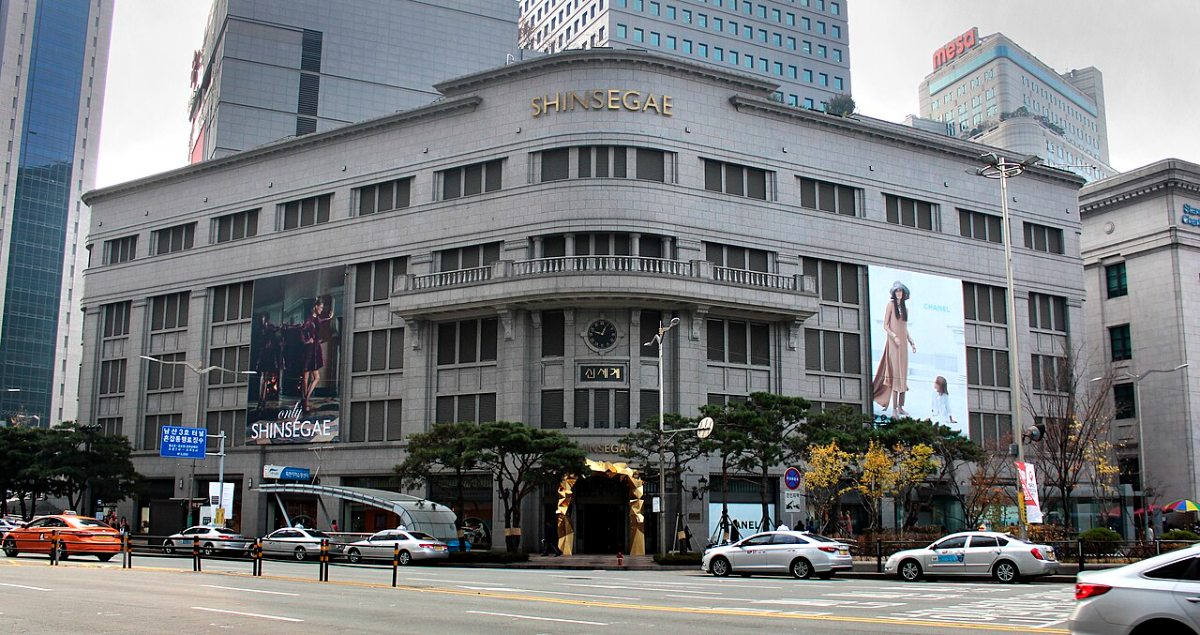
© Minseong Kim / Wikimedia Commons · Source · CC BY-SA 4.0 · Uncropped; resized for web.
The adaptation completed in 2025 has given the former bank exhibition and public-facing cultural spaces. C3’s architectural account places the project within that existing fabric, rather than treating it as a new store with a period theme. The fourth-floor museum and fifth-floor courtyard are the useful destinations. The lower retail interiors need not become a preliminary tour that a visitor completes before being allowed to look at art.
Until 19 October 2026, following an extension, the principal exhibition is Bahk Seon Ghi’s The Origin of Space. The gallery’s extension notice supersedes the September closing date circulated earlier. The show is free to enter. Its presence is a reason to make an effort now, rather than an evergreen promise about what will be upstairs whenever you arrive.
Bahk suspends charcoal fragments so that they gather into architectural forms. A hanok structure is evoked through a material that was once wood and has been transformed by burning. The published installation views show how much air remains inside the apparent construction. Design Plus’s account emphasises the changes produced by the viewer’s position, alongside works in plywood and steel. The image assembles, loosens and assembles differently as it is seen from elsewhere.
That is an unusually apt demand to make in this setting. A bank’s architecture declares permanence. These constructions ask the eye to negotiate something provisional. The work does not need a story about escaping shopping to justify itself; it has a material and spatial argument of its own.
There is also a useful difference between looking at a photograph of suspended charcoal and standing at several positions around it. A reproduced image fixes the very thing the installation unsettles. Spend the available time with that distinction, rather than treating the room as a handsome backdrop to the fact of having arrived.
The building supports a wider programme: the fifth-floor House of Shinsegae provision includes Korean desserts and tea as well as craft-related presentation. That is a separate commercial offer, not a refreshment entitlement attached to the exhibition. It is perfectly possible to visit the art and leave without ordering.
The Heritage earns a substantial central-Seoul detour, roughly forty-five minutes to an hour and a quarter. After 19 October, check what is installed and whether the rooms are open between shows. The architecture remains; the reason to give it quite so much time may change.
Shinsegae Gangnam
Begin with the bowl of rice
At Shinsegae Gangnam, the precise address within the address is House of Shinsegae, B1. This dining area is not the same thing as Sweet Park, the grocery floor, Famille Station or a restaurant in the adjoining hotel. The distinctions sound administrative until you are hungry and have been directed vaguely towards “the basement.”
Hankyung Business’s opening report describes the conversion of former duty-free space into separately conceived restaurant environments. This is not simply a set of takeaway counters gathered around shared tables. The room and the meal can belong to a single operator, which makes it easier to decide what kind of visit you are buying.
Jaju Hansang is the clearest Korean-lunch proposition here. It is Shinsegae’s own restaurant concept, developed through its Korean Food Institute, rather than a family restaurant discovered elsewhere and transported intact. The same dining development also brought in Kim Susa, an established restaurant opening another branch. One is a retailer’s culinary project; the other arrives with a restaurant history. A famous name, in either case, does not establish who is personally cooking on a particular service.
At Jaju Hansang, the rice is a more interesting place to begin than the decor. In a 2024 company interview, buyer Han Sang-woong described a blend of Samgwang, Yeorihyang and Baekjinju rice, tested for texture and aroma. The same account named fermented seasonings and preserved ingredients sourced through the retailer’s Balhyo:Gotgan food project. These are the operator’s descriptions, not tasting notes, but they identify decisions that can actually be assessed in a bowl and on a plate.
They also expose the less photogenic work behind an apparently simple meal. Someone chooses the rice, tests a blend, specifies an ingredient and has to reproduce the result. “Traditional Korean food” is too broad a claim to settle any of those matters. Procurement can make a regional product easier to encounter in Seoul; it can also remove it from the context in which a diner would otherwise understand its producer. The restaurant has to give the ingredient a convincing second setting.
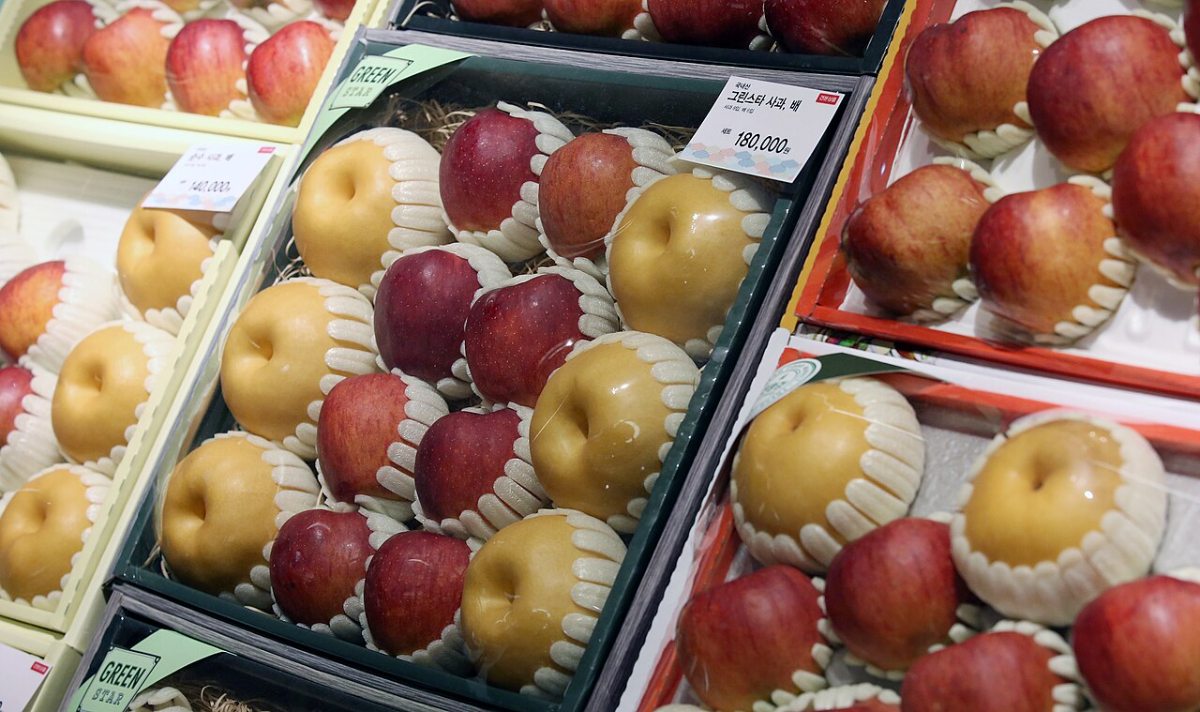
© Jeon Han / Korea.net / Wikimedia Commons · Source · CC BY-SA 2.0 · Uncropped; resized for web.
The practical order is a bansang, a meal organised around rice, a main dish and accompaniments. Current menu listings put the spicy pork set at approximately ₩25,000; the restaurant’s booking listing shows a gulbi set at ₩37,000. The latter centres on dried croaker. The opening-period account described fish dried at Beopseongpo in Yeonggwang and prepared for convenient eating, but a current menu should take precedence over any historical description of a supplier or presentation.
This is a recommendation for a specific, seated Korean meal with identifiable authorship and a knowable budget. It is not a claim that its fish outcooks a specialist elsewhere in Seoul. Without a tasting, the responsible distinction is straightforward: the restaurant gives enough evidence to merit consideration, not enough to award it an invented superlative.
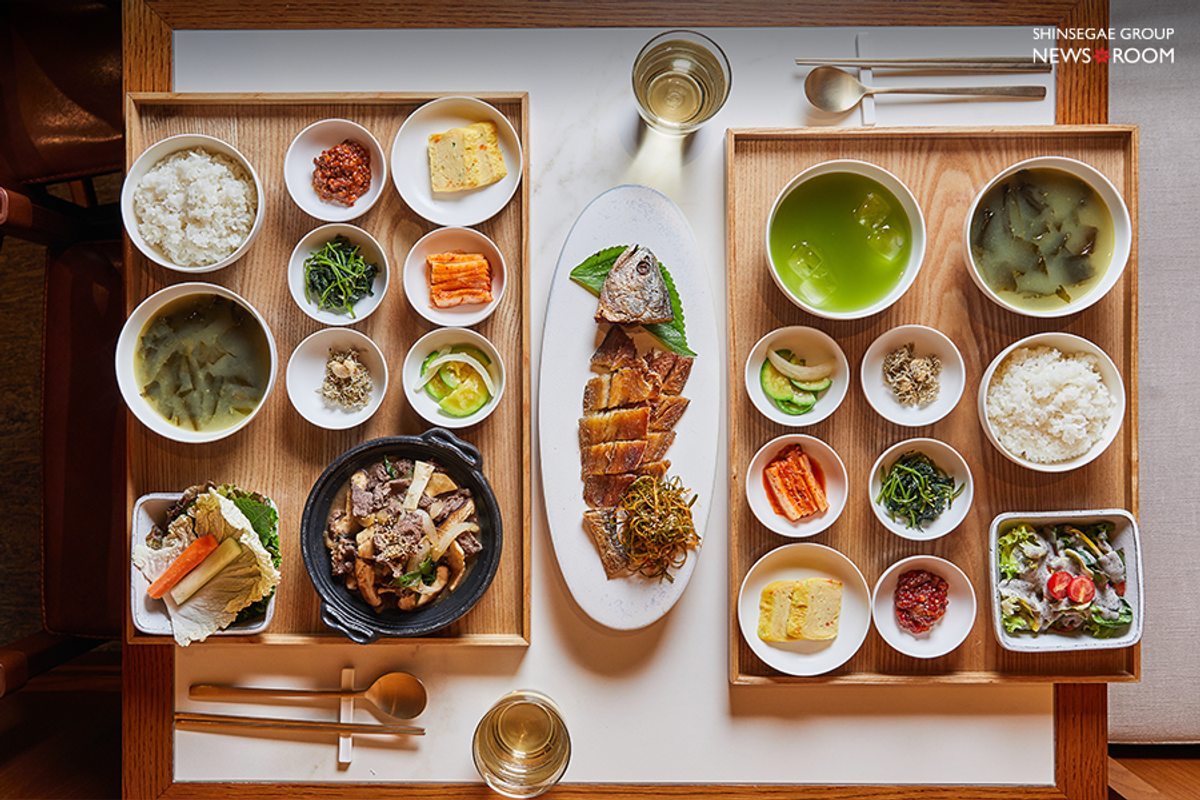
© Shinsegae Group Newsroom · Source · Published media-reuse permission, with source credit · Uncropped; resized for web.
The format makes sense for lunch alone. An individual set gives the visit a proportion without requiring a diner to turn it into a communal feast. Confirm service and the current menu through the restaurant’s listing; a booking platform is not a promise of an immediately available table.
Sweet Park, also on B1 but a separate destination, is better approached afterwards. The interesting objects there need not be things to eat immediately. For Chuseok 2026, Shinsegae presented Piaf’s fifteen-bonbon gift box, from chocolatier Ko Eun-su’s brand, in a sleeve referring to Korean mother-of-pearl decoration. That was a seasonal edition, not a promise of current stock. Its packaging belongs to the act of giving, just as its contents belong to eating.
© Jeon Han / Korea.net / Wikimedia Commons · Source · CC BY-SA 2.0 · Uncropped; resized for web.
Food in this setting travels in several directions: to a restaurant table, out in a takeaway bag, or into another household as a gift. Those uses deserve different judgments. A box designed for presentation should not be condemned for failing to be lunch; a takeaway lunch should not be recommended without somewhere to eat it.
Allow an hour and a quarter to two hours, including the meal. This branch is a food-led visit with a real bill, approximately ₩25,000–₩37,000 for the named sets before extras. The upper shopping floors can remain entirely unvisited.
Hyundai Department Store Trade Center
The value of an uncommitted hour
The Trade Center branch makes a smaller claim on the day. Its tenth-floor renewal, opened at the end of August 2026, places EP.1, a shared rest area, among the dining spaces, with Novas Park on the eleventh floor. The branch’s facility directory distinguishes these spaces from the customer-service counters and the individual restaurants. That is the useful part of the project. A seat does not become a café table merely because food is nearby.
The setting is carefully manufactured. Kyunghyang’s report of the opening describes an interior built around planting and lighting, with the rooftop given its own evening sound and light programme. The operator specifies recorded insect sounds among the elements of that atmosphere. Nature has been provided with a soundtrack.
That detail might invite an easy joke. It is more revealing to leave the possibility of pleasure intact. An outdoor terrace can be enjoyable even when its effects have been planned. The problem begins when an image of greenery is asked to establish comfort, availability or access on its own. Those are matters of operation, not art direction.
For someone spending time around Samseong, the tenth and eleventh floors offer a plausible pause between other commitments. There is no need to turn the stop into another destination meal. The publicly listed rest areas carry no advertised purchase or membership condition; the tables of a café are a different arrangement. Whether the shared seats are available when you arrive remains a practical uncertainty.
Till White, on 10F, gives the paid alternative an intelligible scale. The branch’s menu lists a latte at ₩6,500, its signature coffee at ₩7,000 and kimchi fried rice at ₩19,000. This is Hyundai’s café brand. Its renewed food menu was developed with Yoo Gi-yeong of Ppommo, a collaboration that should not be translated into a claim that the chef will personally cook your lunch.
The distinction between buying a coffee and buying access is worth preserving. A visitor who wants a table in the café pays for its provision. Someone who only needs the shared rest area should not be sent to the till by an article that has quietly conflated the two. The project is more useful when its different invitations stay legible.
Novas Park is advertised until 22:00. The reviewed information does not establish the exact street entrance and lift route available after the principal store closes. Arrive during normal retail hours rather than plan an evening around an assumed late entrance. Outdoor access can also depend on weather or maintenance.
This is a good Samseong detour, not yet a reason to travel across Seoul for the building alone. Half an hour can be sufficient. Allow more when you choose to eat, rather than because a visit seems obliged to fill its advertised surroundings.
Lotte Jamsil: AVENUEL Art Hall
Choose the exhibition, then the building
Jamsil requires an act of subtraction. The relevant destination is AVENUEL Art Hall on 6F, at 300 Olympic-ro. It is not the original Lotte department-store building at 240 Olympic-ro. Nor does this recommendation extend automatically to every attraction in the connected development. The gallery’s own programme is enough to make the decision.
Until 22 October 2026, that decision concerns Shim Moon-seup’s To the Island. The show is advertised as free, with no reservation required. Unlike an installation distributed along shopping floors, the Art Hall is a dedicated exhibition space. Its closing time, 19:00, gives the afternoon a practical boundary.
© Christophe95 / Wikimedia Commons · Source · CC BY-SA 4.0 · Uncropped; resized for web.
The artist’s relation to the sea offers a useful entry into the paintings. In a 2022 Yonhap interview, the Tongyeong-born Shim discussed a sea reconstructed through memory rather than copied directly from a view. That is background to the work, not a description of every painting in the present show. It nevertheless asks for a different kind of looking than a quick recognition of water.
Repetition can initially make a painted surface seem easy to grasp. The eye registers a field, a colour, a direction. Staying with it is how the differences begin to matter: the marks that do not behave quite alike, the interruptions in an apparent rhythm. This is a more promising use of the Art Hall than treating the artist’s name as a cultural credential for the shops beneath it.
There is no reason a gallery must lose that possibility because its host sells clothes. Equally, the presence of a gallery does not confer its seriousness on everything else in the building. The selection here is narrow on purpose. Come for the exhibition; decide separately whether anything else deserves time.
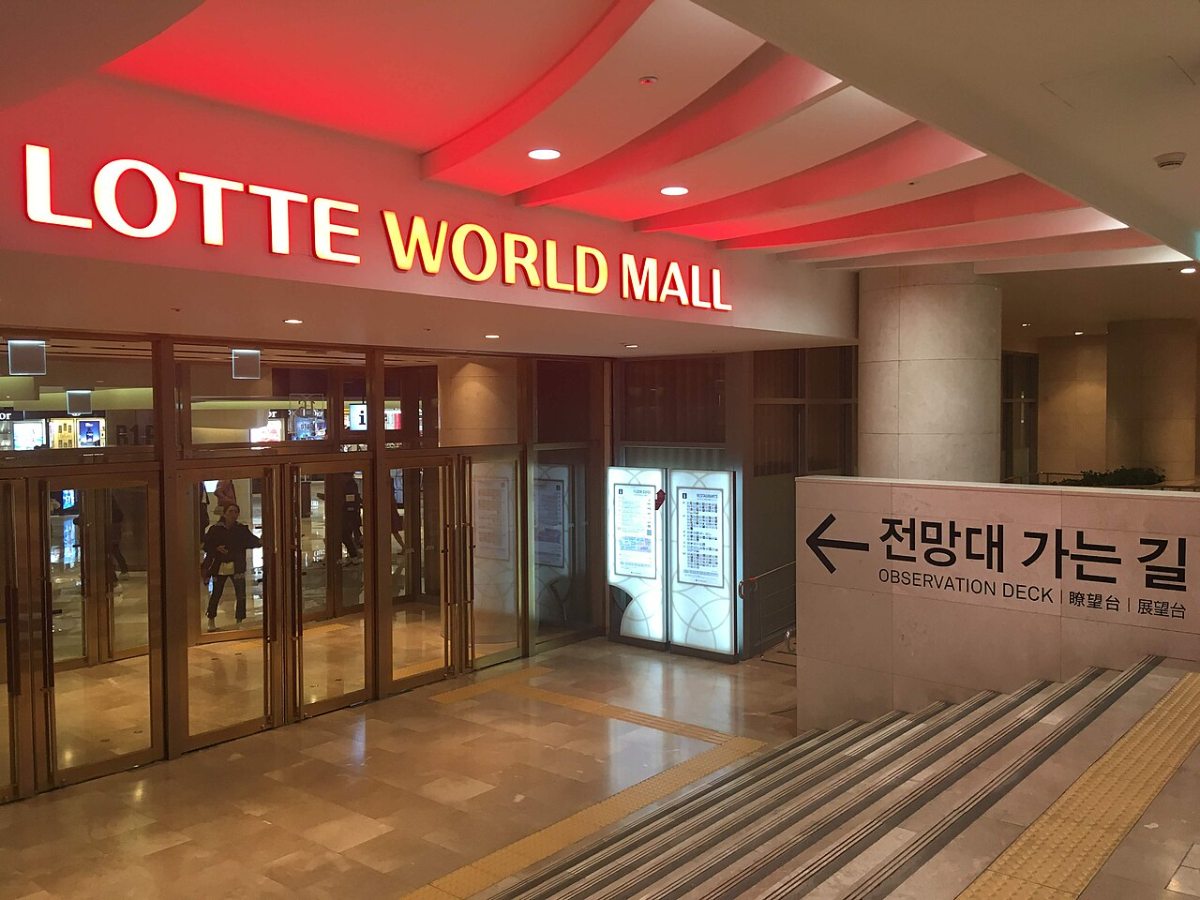
The Lotte Museum on the seventh floor of Lotte World Tower is another institution, with its own programme and admission arrangements. A connecting route does not merge the two. Nor should a photograph of the tower or an observatory view be used as proof that the AVENUEL Art Hall is worth seeing. Its case has to be made by the work inside.
Give the exhibition thirty minutes to an hour. It works as a self-directed visit, including alone; no English-language guided programme is promised here. For someone already in Jamsil, it is a worthwhile detour. Crossing the city should be a decision about Shim, or whichever artist follows him, rather than about the scale of the development.
Lotte Main: AVENUEL Art Wall
An interruption in the shopping route
Lotte Main’s smaller offer is worth keeping small. Its AVENUEL Art Wall occupies floors 1–4, where Kim Sang Yeoul’s Beyond the Landscape runs until 2 November 2026. The published invitation is free and does not require a reservation. These are public-facing displays within retail circulation, rather than a separate museum.
That arrangement is its opportunity and its limitation. Someone can encounter the work without making a formal gallery visit. Someone who has come specifically for the work has to accept the building around it. Attention is shared with shopfronts and movement between floors. No photograph of a single wall can establish how concentrated the encounter will feel on a particular day.
Here the luxury floors do supply a reason to look beyond the familiar brands. The paintings are the reason. Their presence does not require an appointment, entry into a consultation room or an affected interest in merchandise. A public Art Wall should be approached through its public route.
Lotte Gallery’s platform also sells art. That is not a disqualification, and there is little purpose in concealing it under grand claims about civic culture. The more useful question is whether someone who is not buying can still give the work their attention. This format makes that possible, although less separately from commerce than the Art Hall at Jamsil.
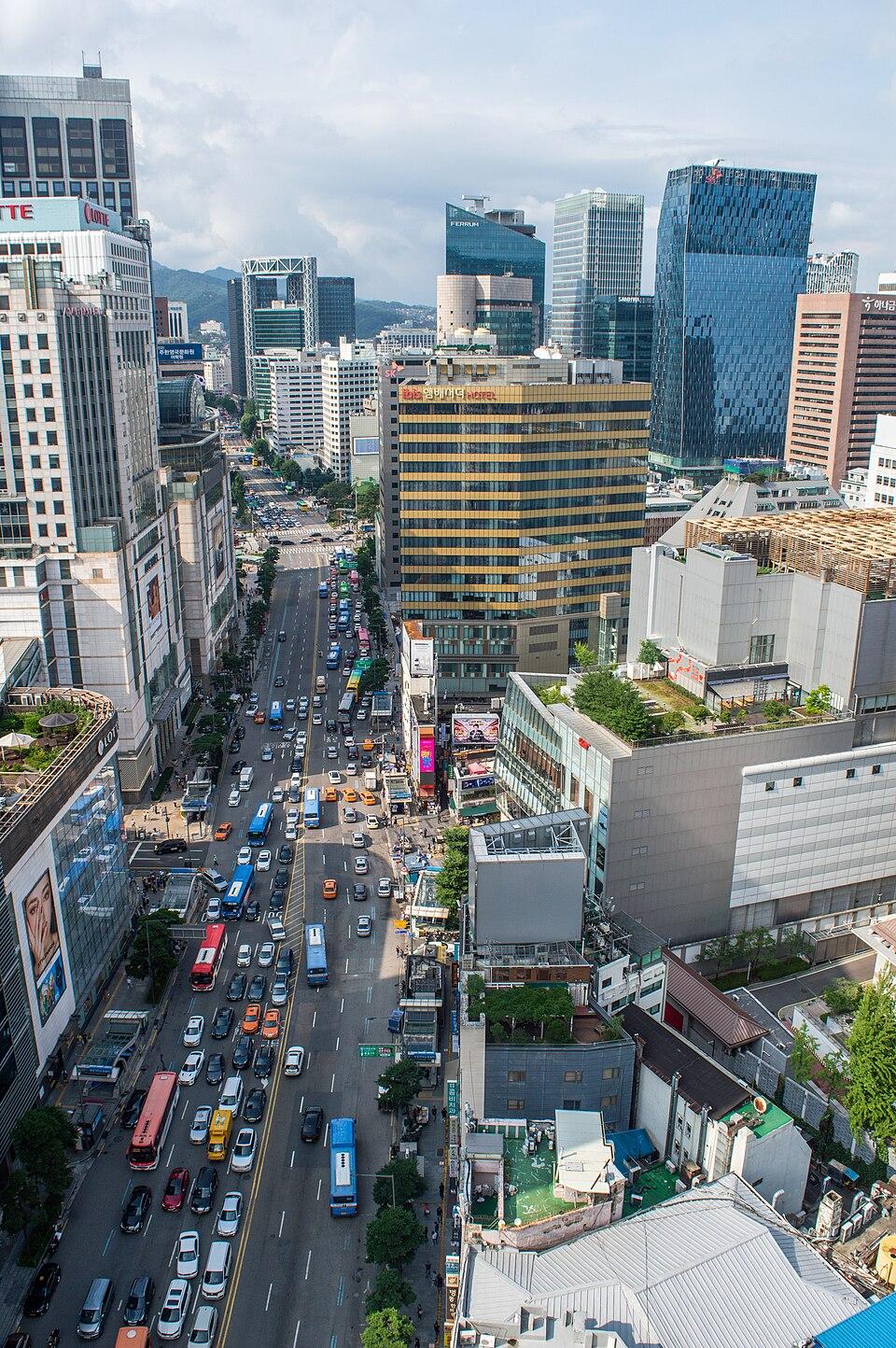
Allow twenty to forty minutes while already near Myeongdong or Euljiro 1-ga. The exhibition’s distribution across four floors entails more repeated vertical movement than a single-room show, which matters to a visitor trying to limit walking or standing. It is a useful stop, not an essential Seoul address. No additional lunch or shopping floor is needed to make the time count.
The room marked “lounge”
Public seating, a paid café and a membership lounge are three different provisions. Hyundai Trade Center makes a fourth distinction: its tenth-floor Customer Service Lounge is listed for services such as cards, gift certificates and customer benefits. Its name should not be read as an invitation to refreshments. The nearby EP.1 rest area has a different purpose.
At Shinsegae Main, the Members Lounge is listed on 14F of The Estate. It is restricted. The published 2026 Gold conditions provide one example of qualifying access: at least ₩30 million spent across twelve or more shopping days in the preceding year. Gold members may use the Members Lounge with up to two guests, once daily across the network, carrying the required registered card. The published lounge rules do not specify advance booking. They do not offer ordinary visitors entry because they hold a passport, a duty-free account or a particular expectation of hospitality.
That room is relevant as a boundary, not a destination in this article. The difference between it and an open rest area tells us how precisely a store can divide the invitation to stay. One provision attracts or accommodates visitors in general. Another rewards an existing spending relationship.
There is no need to turn that distinction into a private-room fantasy. Nothing recommended here depends on getting beyond it. A charcoal installation does not become less interesting because someone elsewhere has a quieter chair; a paid lunch need not be disguised as a complimentary benefit to justify its cost.
The proper test of the accessible building is whether it stands up on its own. The Hyundai Seoul does so through its spatial organisation. The Heritage currently does so through a particular conjunction of architecture and art. At other branches, the answer is smaller and more conditional. That is a useful result, not a failure to discover the secret floor.
© Tristan Surtel / Wikimedia Commons · Source · CC BY-SA 4.0 · Uncropped; resized for web.
Back outside
A department-store visit can finish early. It can end after one exhibition or a bowl of rice, before the building has exhausted its invitations. There is a peculiar pressure in large interiors to continue simply because another level remains. Nothing in this selection requires obedience to it.
What these places offer is often ordinary in outline: somewhere to meet, a meal, an interval between appointments. Their significance lies in the means and the conditions. A privately maintained building can make those parts of the day easier without becoming public space. A visitor can enjoy the arrangement without mistaking it for disinterested generosity.
At Jamsil, the Art Hall closes at seven. The paintings have given whatever attention you were able to give them somewhere to go. There is no corresponding requirement to continue through the shops. The next useful address may be outside.
Planning the visit
Operational pages checked 9 October 2026. Exhibition dates are time-sensitive; use the linked branch pages before travelling. Durations below are editorial estimates. Choose a destination, not a six-store itinerary.
The Hyundai Seoul · 더현대 서울
108 Yeoui-daero, Yeongdeungpo-gu. Yeouido station, Lines 5 and 9; the official approach includes the underground connection from Exit 3 to B2. Visit 1F, 5F Sounds Forest and the 6F overlook. No-purchase route; 60–90 minutes. No membership is required for these public floors. ALT.1 is optional: the current Banksy show is ₩23,000 standard adult admission, through 3 November. Add roughly an hour for it. Seating and event layouts vary.
Shinsegae Main / The Heritage · 신세계백화점 본점 / 더 헤리티지
The Heritage: 42 Namdaemun-ro, Jung-gu; main complex: 63 Sogong-ro. Hoehyeon, Line 4, is a useful approach. Visit 4F Heritage Museum and 5F courtyard. No-purchase, exhibition-led route; 45–75 minutes. Bahk Seon Ghi’s free show is extended through 19 October; no advance-booking condition was identified in its public notice. Recheck access during exhibition changeovers. The Estate’s Members Lounge is restricted and excluded from this route.
Shinsegae Gangnam · 신세계백화점 강남점
176 Sinbanpo-ro, Seocho-gu. Express Bus Terminal, Lines 3, 7 and 9, connects with the complex. Choose House of Shinsegae B1 for Jaju Hansang, then Sweet Park B1 separately. Food-led route; 75–120 minutes. Allow approximately ₩25,000–₩37,000 for the named set meals, before extras. No store membership is needed. Check the restaurant listing for service, menu and booking or waiting arrangements; immediate seating is not guaranteed. Takeaway purchases do not secure a table.
Hyundai Department Store Trade Center · 현대백화점 무역센터점
517 Teheran-ro, Gangnam-gu. Samseong, Line 2, Exit 5, connects with B1. Visit EP.1 on 10F and Novas Park on 11F. No-purchase route, with optional café spending; 30–60 minutes. Till White: latte ₩6,500; signature coffee ₩7,000; kimchi fried rice ₩19,000. No membership or purchase requirement is advertised for the shared rest spaces. The rooftop is listed until 22:00, but late-entry routing needs direct confirmation. Arrive during retail hours; outdoor access can vary.
Lotte Jamsil AVENUEL · 롯데백화점 잠실점 에비뉴엘
300 Olympic-ro, Songpa-gu. Jamsil, Lines 2 and 8. Visit AVENUEL Art Hall, 6F, not the separate tower museum. No-purchase, exhibition-dependent route; 30–60 minutes. Shim Moon-seup’s To the Island runs through 22 October, advertised free without reservation. Gallery hours are 10:30–19:00, subject to store closure days. No membership is required. English-language guided provision has not been established.
Lotte Main AVENUEL · 롯데백화점 본점 에비뉴엘
AVENUEL: 73 Namdaemun-ro; main store: 81 Namdaemun-ro, Jung-gu. Euljiro 1-ga, Line 2. Visit the Art Wall on 1–4F. No-purchase, exhibition-dependent route; 20–40 minutes. Kim Sang Yeoul’s show runs through 2 November, advertised free without reservation. No membership is needed for the public displays. This is shopping-floor circulation, not a dedicated gallery with assured seating. Check store closure days.
Mobility: these are useful transport connections, not audited step-free routes. Upper-floor visits require lifts. Continuous routes from station platforms to the recommended rooms, rooftop thresholds and after-hours exits still need direct checking for anyone unable to use steps or escalators. The four-floor Art Wall involves the most repeated vertical movement.


.png)

.jpg)

.jpg)

