



Image source: Kodaiji Wakuden · © respective rights holder
The dinner was meant to encourage her. In a public account of a November 2022 meal at Kodaiji Wakuden, Yumi Aikawa explained that another woman had offered to treat her. A summer reservation had been postponed as coronavirus infections rose. Eventually they settled on a crab dinner. Aikawa was delighted by the prospect of leaving cooking and housework behind. [1]
There is already something more substantial here than the desire to enter a beautiful room. Someone has noticed that another person might like to be relieved of things. The proposed gift is not simply an expensive meal, but the chance to arrive without being responsible for producing it.
A private room is an attractive place to put that hope. It can remove the neighboring table from consideration, give a celebration somewhere to happen without spectators, permit two people to be untidy in their conversation. A beautiful one adds another possibility: that the person invited will recognize care in the choice before the first dish arrives.
But the giver has also taken a risk. An elaborate reservation can become an assignment for its recipient. Enjoy this properly. Understand what it cost. Be pleased in a way that makes the planning worthwhile. Behind a closed door, there is less surrounding life into which either person can retreat.
The room cannot settle that difficulty. Nor should it be dismissed because it cannot. Architecture and cooking have more interesting responsibilities than guaranteeing that people feel what someone hoped they would feel.
A room booked for one party and a whole restaurant booked for one service can be equally exclusive in occupancy and very different in use. Neither establishes that the menu was developed for those guests. A fixed menu, meanwhile, need not prevent a host from responding to them.
The useful question is not which arrangement sounds most exclusive. It is what would have been different had someone else made the reservation.
Sometimes the honest answer is: almost nothing on the plate. That may be exactly why the dinner was chosen.
A room with work to do
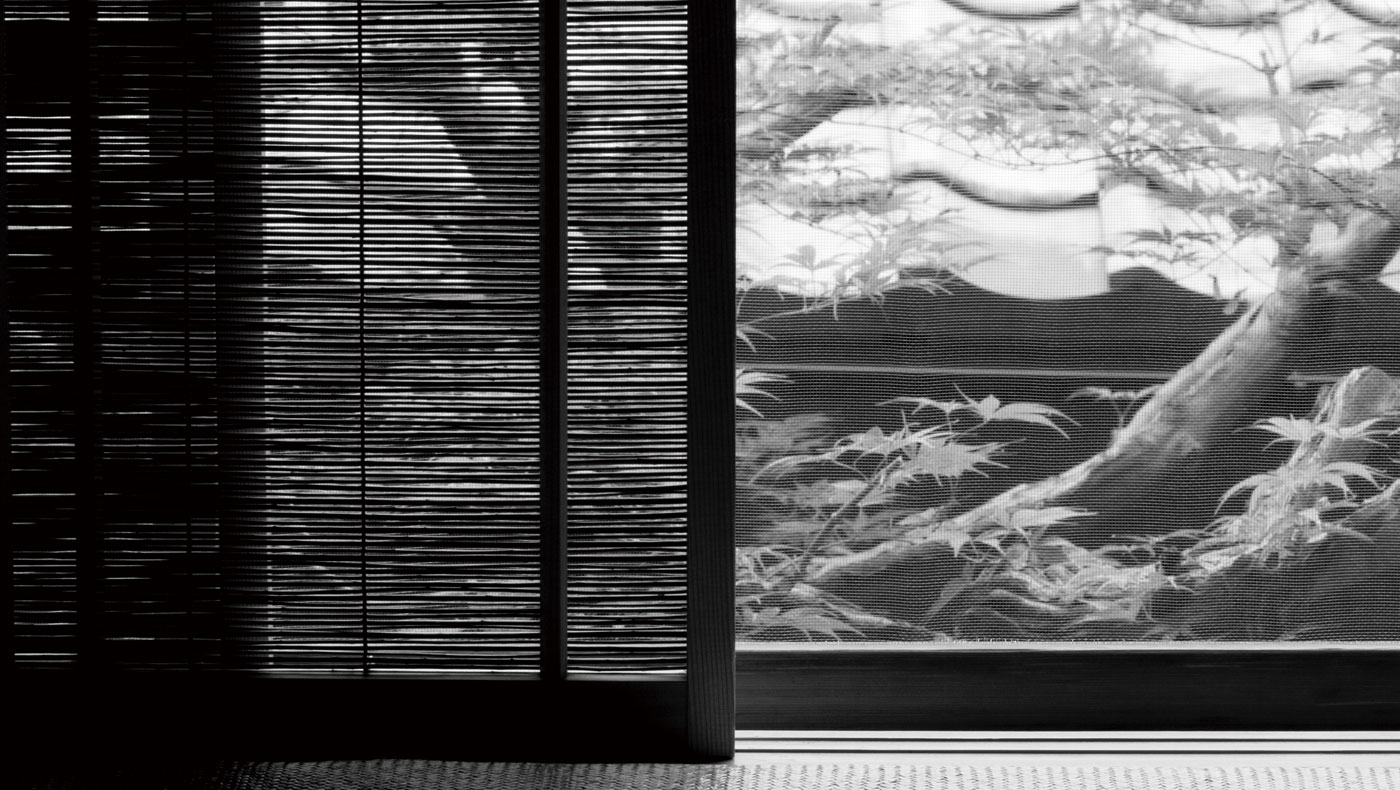
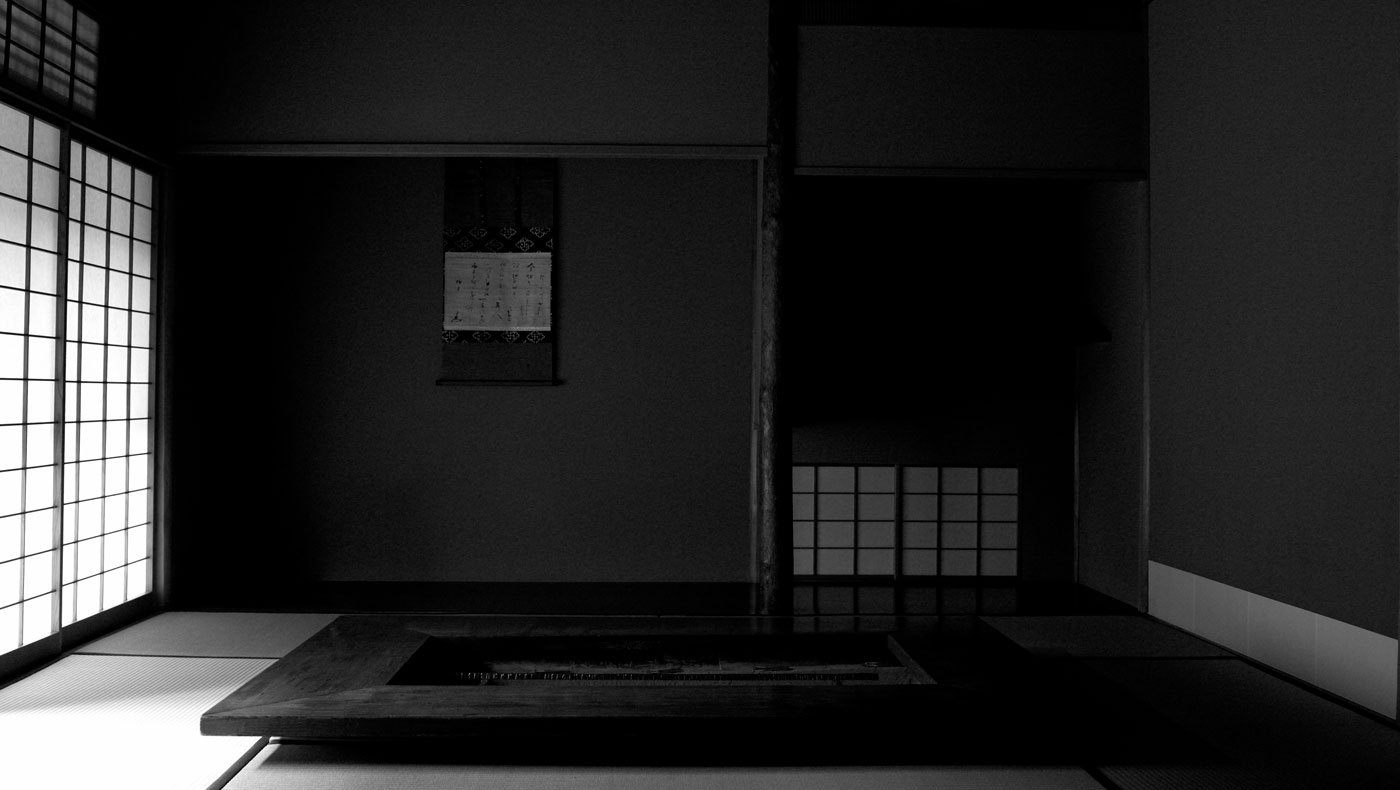
Kodaiji Wakuden’s hearth is not a rustic accessory introduced to make formal dining appear less formal. In a 2018 interview with the journalist Yumi Kiyono, proprietress Yuko Kuwamura explained that her mother established the Kyoto restaurant in 1982 after the family’s Tango inn business had struggled. Rather than imitate metropolitan Kyoto cuisine, she made grilled crab from the family’s home region a specialty, cutting a hearth into a dining room. Kuwamura dated the original house, built by the sukiya master Nakamura Sotoji, to 1952. [2]
This history matters because it describes a decision, not merely an inheritance. The room was altered to accommodate a way of cooking. Its distinction lies partly in the relation between the refined domestic building and the substantial business of grilling dinner inside it. The hearth gives the space a center that is not simply a flower arrangement or the most important guest.
Michelin’s current assessment still identifies that sunken hearth and crab as defining features of the restaurant. The continuity matters: what began as a commercial response to difficulty became a recognizable way of feeding people. It was not made more sincere by ceasing to be a business. [3]
For a visitor, the reason to request an appropriate hearth room is therefore concrete. The cooking belongs to the room’s organization. Removing it to a conventional kitchen and installing a decorative brazier would not produce an equivalent evening. But a hearth is also a heat source, and the person eating beside it has a body, not just an appreciation of Japanese design.
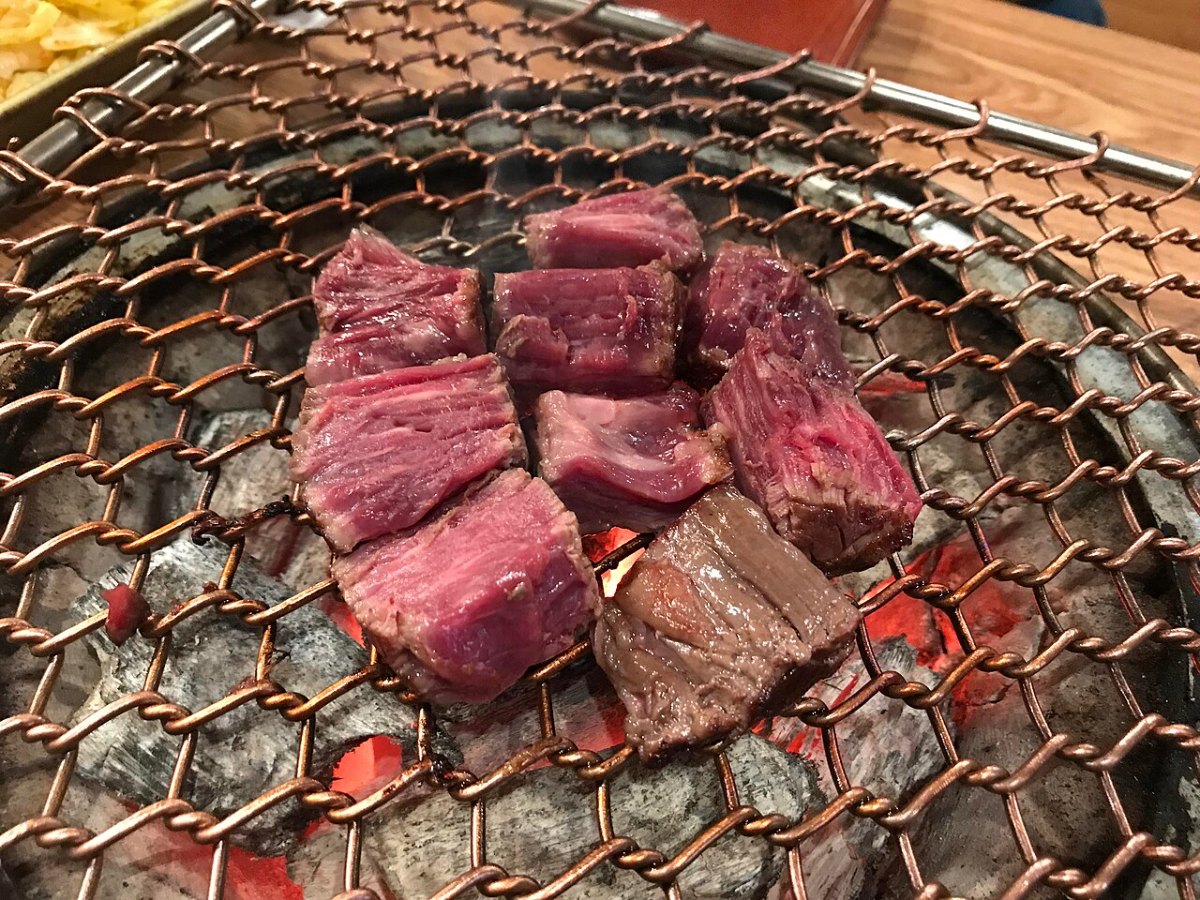
Aikawa recorded that lighting the charcoal made the room hot; she asked for a window to be opened. She also requested that the crab be cooked rare. Her account describes crab-miso soup served in the shell and the remaining meat destined for rice dishes. [1]
The window is the more revealing detail. No one had to redesign a menu around a biography. A guest said what she needed, and the room was allowed to change. Nor must the initial discomfort be rewritten as a charming imperfection. She was hot. Opening the window addressed that.
This is the difference between admiring architecture and using it. A room must survive the arrival of heat, appetites, possessions and preferences. Its beauty is not invalidated by an adjustment. The adjustment may be what allows its beauty to remain available to the people actually there.
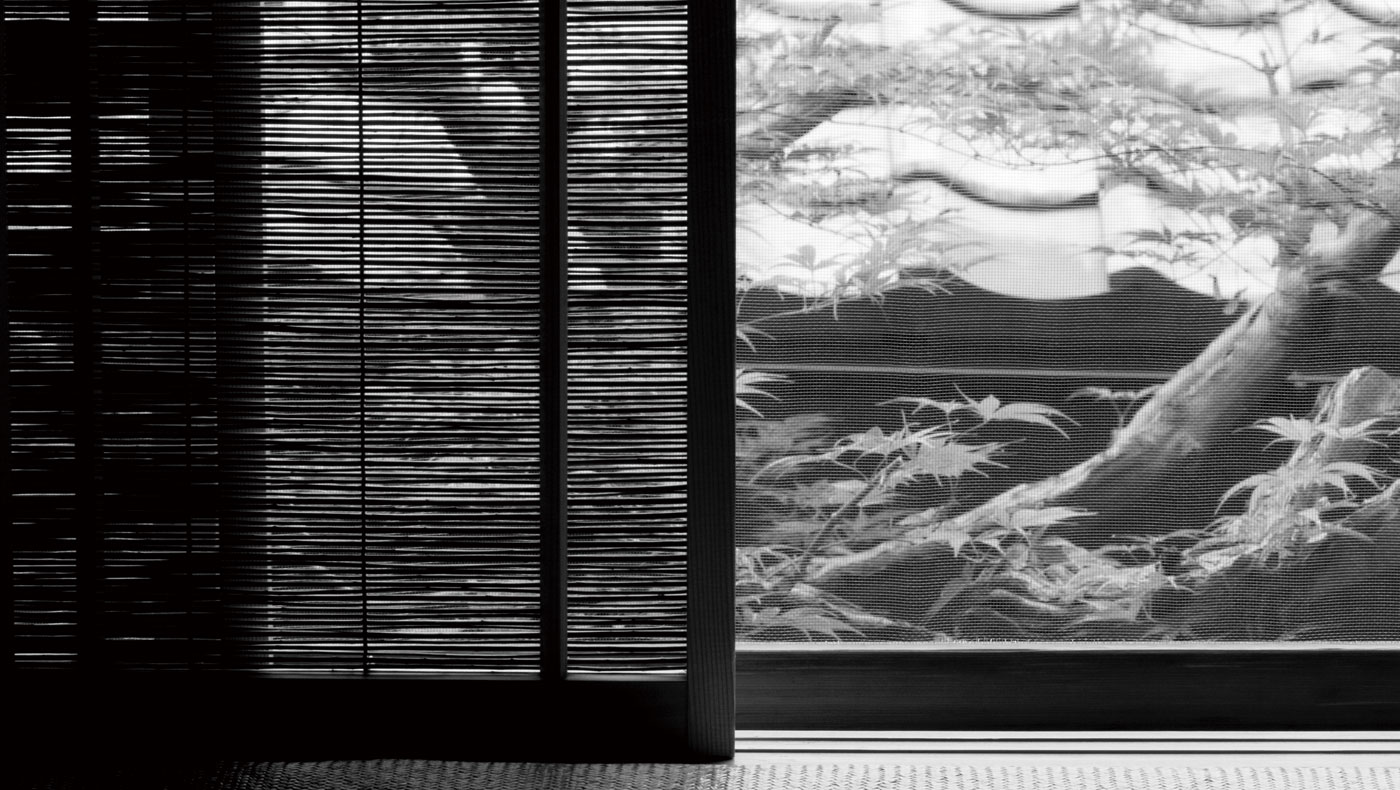
Image source: Kodaiji Wakuden · © respective rights holder
Wakuden’s current crab offering is also less vague than the usual promise of seasonal abundance. It advertises November 7 to March 20, with crab kaiseki from ¥88,000 and a grilled-crab course from ¥99,000 per person, including tax and service. Origin and auction prices can change the charge. These are substantial sums, and the dates do not guarantee a particular port’s crab on demand. [4]
The attraction should not be reduced to the price of the animal. A dinner organized around one ingredient needs to do something with its successive appearances. Different preparations must preserve distinctions rather than repeat an expensive noun. The documented progression from grilled flesh to shell-based soup and rice describes the right kind of ambition: not constant novelty, but attention to what different parts and treatments can contribute.
There is no reason to insist that this structure be invented again for every party. To arrange it for someone who has wanted to eat it is already an act of selection. The restaurant’s responsibility is to deliver the cooking and accommodate the person where accommodation matters—not manufacture a story in which the dish has been waiting for them.
Where repetition becomes intelligence
Hyōtei, near Nanzenji, makes an unusually persuasive case for the conventional private room. Its main restaurant has four tea-house buildings with distinct interiors. Tansentei is a four-and-a-half-mat room; Shinseki has a characteristic round window. A reservation here is not exclusive possession of Hyōtei, and a preferred room is a request rather than a guaranteed allocation. [5]
A circular opening and a broad glazed wall make different architectural propositions. One frames a bounded composition; the other gives more of the wall to the view. Neither is inherently more generous. The question is how the opening, the surrounding surface and the scale of the room hold together.
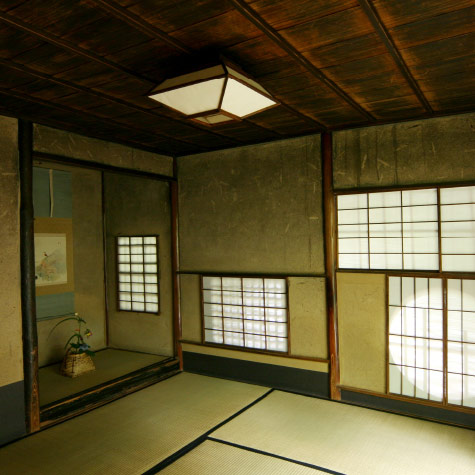
Image source: Hyōtei · © respective rights holder
At Hyōtei, there is also evidence of design responding to something less photogenic than a garden. In the account of its architecture published for a 2021 crowdfunding project, the restaurant explains that the Hiroma was altered in 2000 because more guests were finding floor seating difficult. Recessed leg spaces, with removable semicircular openings, allowed guests to sit with their feet below the floor while retaining service on individual legged trays.
The achievement is the negotiation. Rather than preserving an image at the expense of the guest, or replacing the entire arrangement with an unrelated dining set, the room was changed around a difficulty. The tray, the server’s approach and the seated body were considered together.
It complicates what people mean by personalization. The alteration was made years before today’s guest booked. It cannot have been designed specifically for their knee, their age or their patience. Yet it can respond to them more effectively than a congratulatory message written on a dessert plate.
Elsewhere, the architecture retains demands of its own. The current booking form warns about low ceilings and deliberately subdued illumination. It asks for care around shoji, fusuma and plaster surfaces. This is practical information about occupying the building, not evidence that darkness or fragility is inherently refined. [6]
The attraction of such a room is its concentrated scale: the relationship between a seated person, a tray, a window and a small area of floor. Large dimensions are not a prerequisite for generosity. But neither are low light and floor-level dining universally comfortable. Someone booking for another person should be willing to ask the unglamorous question before selecting the glorious photograph.
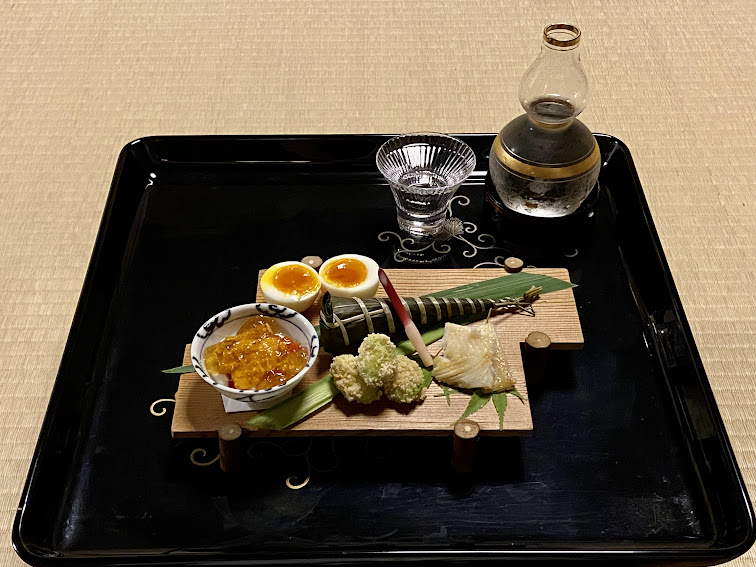
The food makes a related argument. Hyōtei’s egg is not interesting because an egg is intrinsically humble or because simplicity is automatically profound. It is interesting as an established dish whose continued presence gives the kitchen nowhere to hide behind invention. Hitosara describes its soft texture and dashi-soy seasoning; its published autumn examples place it in a hassun with such preparations as seared barracuda sushi and chestnuts and ginkgo nuts cooked in a sake syrup. [7]
Photograph: Kykk wiki / Wikimedia Commons · CC0 1.0
That juxtaposition gives a reason to want the meal beyond its setting. The egg belongs among a collection of differently treated ingredients, not at the end of a speech about minimalism. The pleasure being proposed is variation within a measured sequence: a familiar center with changing company.
Yet familiar does not mean unchanged. In his 2015 Hitosara interview, fifteenth-generation proprietor Yoshihiro Takahashi explained that his father had replaced bonito flakes with tuna in the dashi, seeking a different aromatic and savory balance. He had subsequently adjusted the tuna-to-kombu ratio himself. His tomato soy sauce for Akashi sea bream answered, he said, a contemporary preference for subtler aromas and flavors. Michelin’s 2026 description continues to identify these developments. [8]
Hitosara’s description of the sea bream specifies two accompaniments: tosa soy and the more acidic tomato version. Its soup example combines kuzu-treated hamo with matsutake. These published dishes are evidence of a culinary vocabulary, not a menu promised for every date: precise changes to seasoning and texture within a recognizable meal. [7]
A guest does not need to have requested the tomato sauce to benefit from the thought behind it. Nor would replacing that work with a hurried invention based on a stranger’s questionnaire necessarily be more considerate. There are evenings when being asked fewer questions is part of the pleasure.
Takahashi also described soliciting opinions from his father and employees before introducing new work. The apparent stability of the restaurant conceals discussion. What reaches the dining room looking settled need not have been produced by unquestioning obedience. [8]
This does not exempt Hyōtei from criticism. A familiar sequence could still become mechanical; a guest could still find the room uncomfortable. But the evidence challenges the notion that routine is the enemy of attention. Here, adaptation can happen in the recipe, the floor and the preparation before a guest ever arrives.
The booking limits are equally instructive. Hyōtei requires one course choice for the party and declares that it cannot accommodate certain diets, including vegan and halal requirements. Those limits make it unsuitable for some dinners. They are not failures to achieve an imaginary standard of infinite flexibility. The thoughtful choice may be to book elsewhere, rather than force this kitchen to become another restaurant for the night. [6]
Alone together, facing the cook
Gion Hanamai changes the geometry. The invitation is to a six-seat counter made from a single slab of Yoshino hinoki, beneath an ajiro-pattern woven ceiling. This is private dining, but not a separate private dining room. The party occupies the dining counter rather than withdrawing from a larger restaurant into an enclosure. [9]
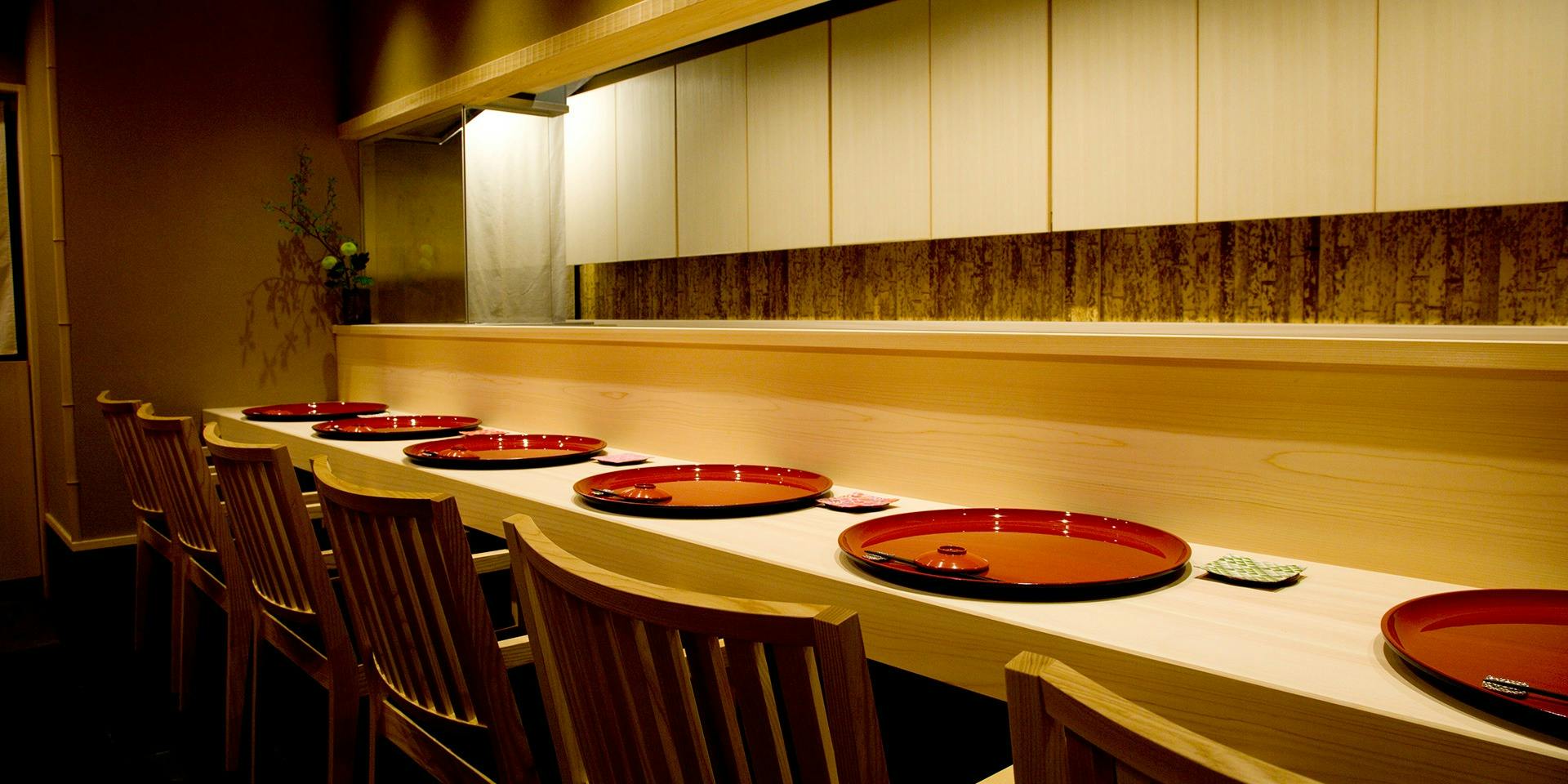
Image source: Gion Hanamai / Ikyu · © respective rights holder
One distinction needs to be settled before the romance begins. The website uses language equivalent to one party per day. Chef Nobuhiro Miyako’s own public profile specifies one party at lunch and one at dinner; an August 2026 published visit makes the same clarification. The promise should therefore be understood as exclusivity for the service, not ownership of the restaurant’s entire day. [10]
That remains a meaningful offer. Two people need not buy six dinners to sit without unrelated diners beside them: the booking system accepts parties of two to six. But exclusivity determines who else is admitted. It does not determine how much the chef speaks, what the party discusses, or whether anyone feels free from observation. [11]
Visual separation, sound isolation and freedom from interruption are different provisions. A room can remove another table from view without establishing that a conversation is confidential. A sole-use booking still includes the people serving dinner. The word private does not answer every question about how an evening will work.
A counter directs attention toward work. That can be absorbing when the work is what everyone has come to enjoy. For a gathering that needs long stretches of conversation turned inward, it may be less suitable than a room with a table. This is not a defect in Hanamai’s design. It is a reason to choose the format consciously rather than treat proximity to the cook as an unconditional upgrade.
The material restraint also has a function beyond signaling taste. A continuous wooden counter establishes a common surface between the places where dishes are presented and received. The woven ceiling supplies a different scale of detail above it. Neither makes a claim to historic domestic life necessary. The room can be judged as a contemporary place of professional hospitality without pretending that its guests have been admitted to the chef’s home.
The recent cooking gives the invitation substance. In August 2026, the kitchen documented a bowl of botan hamo: finely bone-cut pike conger opened by cooking into a peony-like form, with winter melon, plum paste and yuzu. The flower is not simply an ornament laid on top. It is the result of knife work and heat changing the fish’s structure. [12]
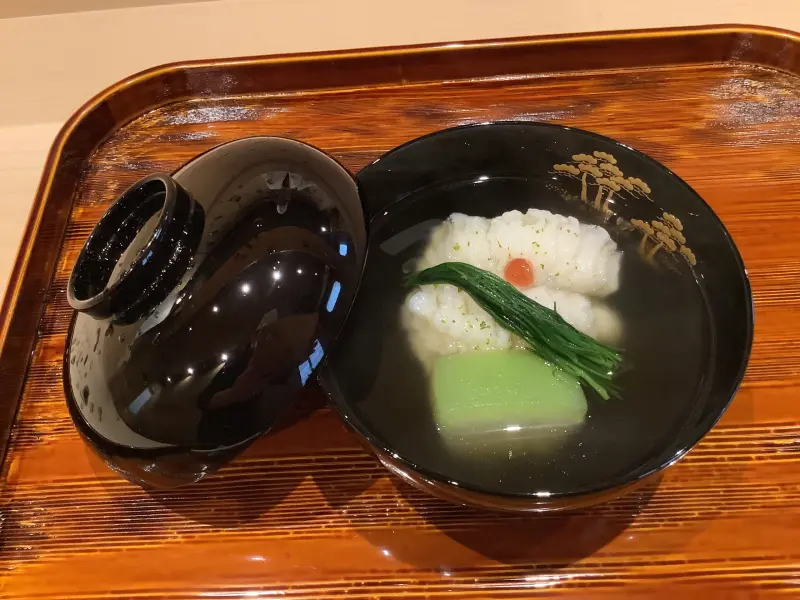
Image source: Gion Hanamai · © respective rights holder
Another August entry describes live-delivered ayu cooked over charcoal, with the arrangement of coals, distance and cooking time adjusted to the fish. This is the kind of variability that matters before anyone asks for customization. A repeated dish still requires judgment because its raw material is not identical. [13]
The sequence remains recognizable kaiseki, proceeding through opening dishes, soup, sashimi, simmered and grilled preparations, and a closing sequence of rice and sweets. Seasonal courses centered on hamo, crab, matsutake or fugu can be discussed separately. [9]
Hanamai also makes a specific distinction between its dinner tiers. The ¥42,350 course, compared with the ¥24,200 standard dinner, advertises ingredients selected around guests’ wishes and dishes different from the standard course. On paper, that is more than an allergy-substitution offer. Its scope still needs agreement: naming a preferred fish is not the same as jointly developing a menu, and neither determines how the evening will feel. [11]
The boundaries become firmer in the reservation conditions. Everyone in the party takes the same course. The restaurant lists extensive limits on dietary accommodation and asks for allergies and dislikes in advance. Its seafood-centered format is not an appropriate surprise for someone whose restrictions conflict with it. [11]
There is a temptation to treat those conditions as an embarrassment beneath the phrase “for you.” In fact, they establish the working agreement. The guests choose whether they want this cooking; the kitchen decides what it can responsibly undertake. Personalization is not the suspension of professional judgment.
Nor is the chef’s personality the missing ingredient that the purchase entitles someone to extract. Questions about technique belong naturally to this encounter. A demand for private memories does not. Warmth can be professional without being false. A host need not become a friend in order to have cared how dinner went.
Hanamai warns that it may not answer the telephone during service. It also asks for cancellation notices by email. These are small operational boundaries, but they counter the fantasy of constant availability. The time being sold has to be made somewhere in a working day. [9]
The counter’s promise is strongest when kept at that scale: a party, a cook’s established work, a defined period without other diners. It offers concentrated attention. Whether that attention feels companionable or demanding is not settled by the booking confirmation.
The mountain is not the menu
Miyamasou lies in Hanase, within Kyoto City’s Sakyo ward, despite the distance and mountain roads separating it from the familiar visitor districts. It is a cooking inn, not an informal household invitation. Its public offering includes lunch and dinner without a stay; private indoor dining must be distinguished from its counter seating and from photographs of accommodation. [14]
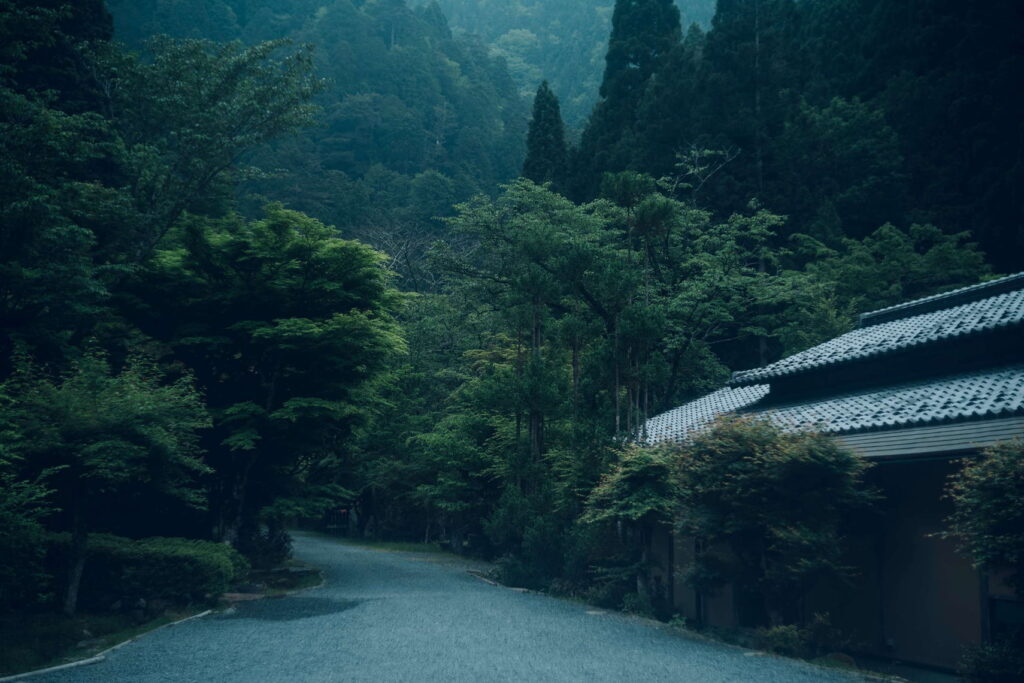
Image source: Miyamasou · © respective rights holder
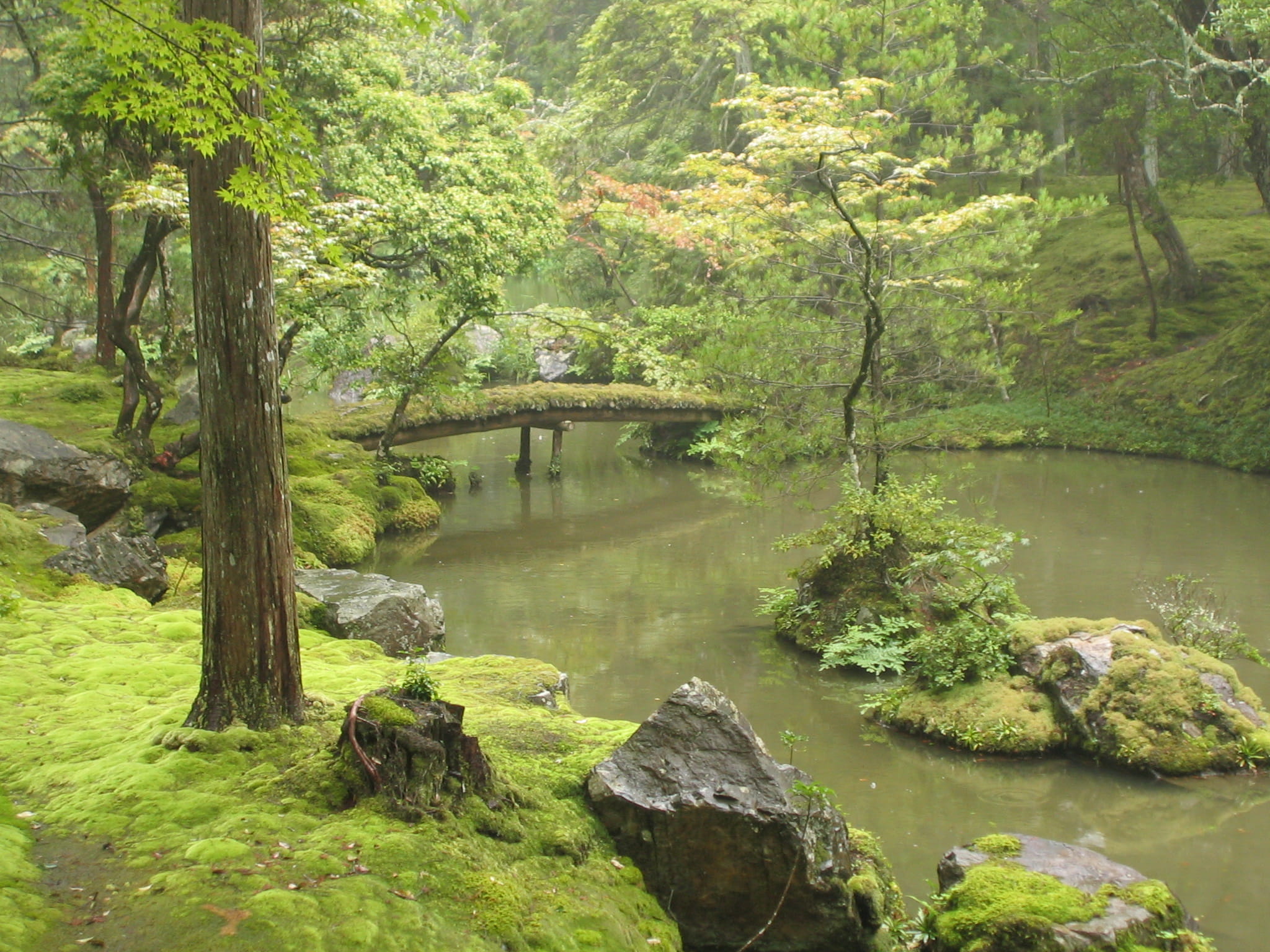
The inn credits Nakamura Sotoji’s firm with architectural refurbishment. The connection to the craft lineage of Wakuden unsettles the idea that leaving the city means leaving designed hospitality behind. This is not nature on one side and artifice on the other. The rooms make a particular relation to their surroundings possible. [14]
An account of a June 2026 lunch by Matthias Ruhl supplies a description of one room in use: tatami seating with backrests but no recessed leg space, and full-height windows toward a stream that could be heard but not seen. He found the seating a minor inconvenience and the setting worth the journey. That is his judgment of that room, not a guarantee about every guest’s comfort. [15]
It is also more informative than an unqualified promise of a river view. What can be seen, what can be heard and how one sits to experience either are separate architectural facts. A traveler who cannot sit comfortably on the floor should not be asked to accept the landscape as compensation. Room allocation and seating need to be settled before the drive.
The culinary identity is tsumikusa ryōri, developed at the inn around gathered plants and the foods of the surrounding mountains and rivers. Present proprietor Hisato Nakahigashi works within that inherited practice. The inn explicitly includes ingredients supplied by fishers and hunters as well as those gathered by its cooks. “Foraged” does not mean vegetarian, and it does not mean that one man personally retrieves every ingredient. [14]
The interesting question is what happens after gathering. In a technical account published by Ryori Oukoku, Nakahigashi explains why tender, aromatic tazeri is added after rice has cooked rather than being boiled through with it. In the documented recipe, trout is salted and grilled before cooking with the rice; the chopped greens enter at the end. [16]
His treatment of bracken is equally specific. He describes seasoning it without dashi, rather than allowing stock to make different mountain plants taste too much alike. Elsewhere, spinach helps color a kinome-miso preparation without requiring an excessive amount of the more forceful herb. These are decisions about what to restrain as much as what to add. [16]
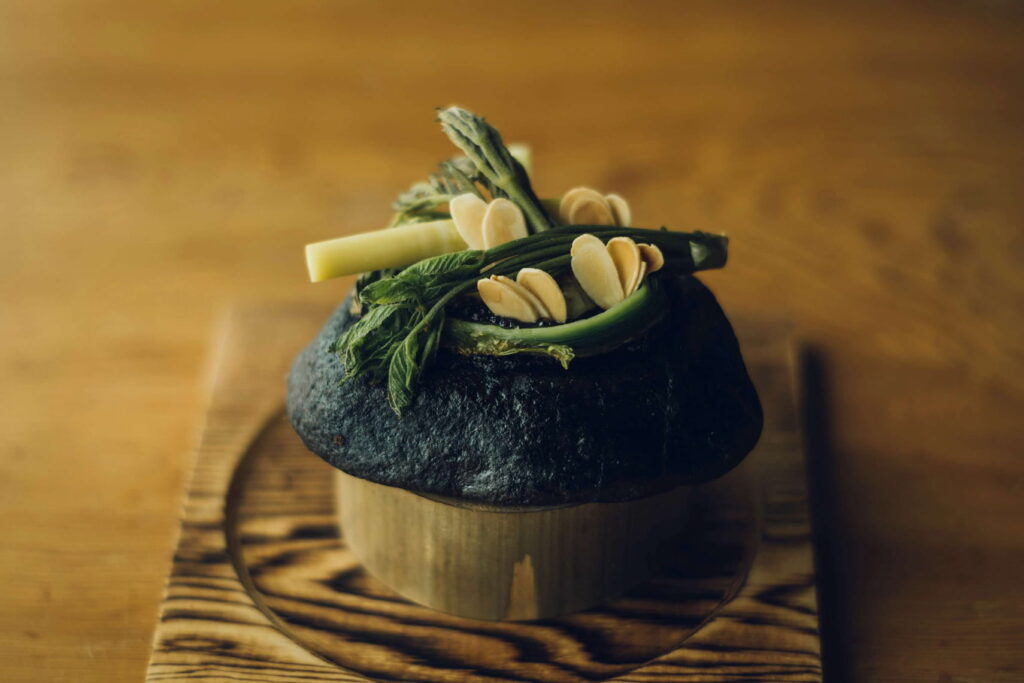
Image source: Miyamasou · © respective rights holder
That is a substantial reason to seek out this cooking. An ingredient’s unusual origin is not being asked to do all the work. It meets a body of methods concerned with aroma, bitterness, texture and proportion. The mountain matters, but so does the refusal to treat everything it provides in the same way.
Repetition has a place here too. Kateigaho’s 2024 account identifies ginkgo miso as an inherited dish anticipated by returning guests. Nakahigashi’s published chef profile describes local ginkgo with a house-made miso preparation involving dried shiitake and ginger, cooked for hours, then served on a leaf over charcoal. A guest might travel precisely because that dish returns. [17]
There is no need to improve the story by claiming it could not exist elsewhere. Recipes travel. What is less readily transferred is the continuing relationship between ingredient supply, accumulated judgment and a setting maintained for the meal. Even that relationship must prove itself in the eating.
Here the published verdicts deserve to remain untidily separate. Michelin promoted Miyamasou to three stars in 2026. Ruhl, writing about his June lunch, admired the warm, intensely seasoned eel and the trout with vinegared rice, but found several other dishes more persuasive visually than in flavor. He recommended the overall experience more confidently than a journey for the cooking alone. [18]
One diner’s account does not overturn a guide’s assessment. Neither should a guide’s assessment erase a diner. The disagreement is especially relevant in a restaurant where the landscape makes such a strong argument on its own behalf. A beautiful room can enlarge the pleasure of dinner without supplying flavors that the plate has failed to deliver.
Miyamasou remains worth considering for that unusually explicit relation between plant knowledge, cooking and an inhabited landscape—not as a guaranteed superior alternative to the city. Go interested in the food, with the seating confirmed and without making a particular stretch of weather responsible for the occasion. A wet, dark view may simply be less satisfying than the one imagined. It need not be renamed a gift.
What remains available
The most consequential responsiveness in these settings is not necessarily the most advertised. It can happen before the booking, in the proportions of a room or a recipe refined over years. It can happen when a guest asks plainly for a window to be opened. It also depends on work that should not disappear behind the idea of a gifted host.
In her Nippon.com interview, Kuwamura resisted assigning the success of a meal to a single person. Cooking, carrying the dishes and preparing the room all contributed. Michelin recognized her with its Kyoto Osaka service award in 2026, but even an award attached to a name does not turn that name into the whole operation. [2]
The important question is not how much personal access an expensive dinner buys. It is whether the arrangement gives the people working enough structure to do their work, and the people eating enough ease to enjoy it. Published philosophies cannot establish wages, staffing adequacy or the experience of every shift. Those questions should remain visible rather than be dissolved into praise of generosity.
A later Wakuden account offers an ungrand example of what structure can permit. Writing about a January 2026 lunch, the Kyoto blogger Amadeus explained that a remembered dish—karasumi mochi, rice cake enclosing cured mullet roe—had helped motivate his return. He described concentrated savoriness without excessive salt. Near the end, unable to choose between a beef-and-egg rice bowl, a chicken-tempura roll and seaweed udon, he was offered one-third portions of each. His companions chose the same arrangement. [19]
No new menu had been composed. The offer used dishes already being prepared, changing their distribution in response to an appetite and an indecision. It was a decision made at one meal, not an entitlement to order every future course in thirds.
A third of an udon course is not much material for a mythology of hospitality. It is, however, evidence that the meal had some room to move.
The host can make a room workable, establish a rhythm, cook something worth remembering and leave room for a request. The guest can choose with care, disclose what the kitchen needs to know and refrain from making pleasure a test that everyone else must pass.
Neither contribution is sufficient alone. A thoughtful invitation cannot redeem indifferent cooking. Excellent cooking cannot compel affection. A private room can protect time without deciding what people will do with it. Its walls remain valuable even when nothing is resolved inside them.
Near the end of Aikawa’s crab dinner, she had another helping of the rice with crab and egg. Later she wrote that she wanted to return that season, while wondering with whom. The question could wait. For the moment, she had wanted more dinner. [1]
Reporting note: This is a researched literary-cultural feature based on Japanese-language interviews, architectural descriptions, published dining accounts and current operator information—not an EDIT27 visit or tasting. Historical dishes and individual diners’ judgments are identified accordingly. No venue correspondence was undertaken.
Planning notes
Checked September 5, 2026. Prices below are published meal charges per person, including tax and service, not total evening budgets. Confirm drinks, requested room arrangements and transport separately. No date-specific availability, universal booking-release window, acoustic-isolation guarantee or sole-use arrangement for a solo diner was established. Named chefs’ personal attendance should be confirmed when essential to the booking.
Kodaiji Wakuden — 高台寺和久傳
Location: 512 Washiochō, Higashiyama, by Kodaiji’s north gate. Format: Private-room kaiseki; confirm a hearth room rather than assuming every allocation has the same arrangement. Prices: Lunch ¥33,000 or ¥44,000; dinner ¥55,000, ¥66,000 or a quoted omakase. Winter crab courses carry the higher prices discussed above. Shojin cooking starts at ¥33,000 and requires at least five days’ notice. Booking: Telephone +81 75 533 3100. Two-person dining is documented, but the current official page does not specify a party minimum; confirm party size and room directly. Cancellation: 80% two days before or the previous day; 100% on the day. The principal limitation is that the particular room and seasonal ingredient are not interchangeable with the restaurant’s general reservation offer. [4]
Hyotei, Kyoto main restaurant — 瓢亭 京都本店
Location: 35 Nanzenji Kusakawachō, Sakyo. Format: Private dining in the main restaurant’s tea-house buildings, not the separately bookable Bekkan’s general dining space. Party: Minimum two; groups of six or more should telephone. Prices: The official website lists dinner from ¥37,950; current TableCheck courses are ¥44,275 and ¥50,600, prepaid. Confirm which course and booking channel apply. Booking: Official TableCheck route or +81 75 771 4116. Room preferences are not guaranteed. Cancellation: The direct policy lists 50% at three days and 100% on the day; groups of six or more also face 30% at seven days. Online reservations follow their platform’s terms. Principal limitations: Seating, low light and declared dietary restrictions; the English booking form excludes children aged 12 and under. [5]
Gion Hanamai — 祇園 華舞
Location: 494-2 Kiyoichō, Higashiyama. Format: Sole-use six-seat dining counter for a party of two to six; understand exclusivity as applying to the service, not the whole day. Prices: Lunch ¥18,000 or ¥24,200; dinner ¥24,200 or ¥42,350. The higher tier advertises made-to-order elements; agree their scope beforehand. Booking: Official TableCheck route, requiring card registration, or inquire on +81 75 541 1820. Cancellation: 50% two days before, 70% the previous day and 100% on the day; notify the restaurant by email. Normally closed Tuesday–Thursday. Principal limitation: This remains a seafood-centered kaiseki counter with substantial dietary restrictions, not an unrestricted custom-menu service or an enclosed room away from the cook. [11]
Miyamasou — 美山荘
Location: 375 Hanase Harachichō, Sakyo, within Kyoto City. Format: Meal-only dining or a separately booked inn stay; request a private indoor room and confirm seating. An overnight stay is not required for the published lunch or dinner offering. Prices: ¥22,770, ¥27,830 or ¥33,880. Party: Published restaurant booking channels specify two or more. Booking: The operator directs meal and accommodation inquiries to +81 75 746 0231; Ikyu also displays a lunch-request route, which is not instant confirmation. Cancellation: Ikyu lists 50% from the previous day and 100% on the day, subject to plan-specific terms; obtain the direct-booking policy from the inn. Principal limitations: Room allocation, floor-seating suitability and mountain transport require advance agreement. Do not assume a photographed lodging room, counter or terrace is the dining space reserved. [14]
.png)



.png)
