



An Appetite of Your Own
In Ginza, a name can do much of the work before an evening begins. Four addresses offer something more substantial: a particular dinner, a properly considered drink, or a performance worth choosing for itself.
September 2026 edition. The menus and theatre programme discussed below belong to the original draft; dated offers and performances are not current booking advice.
At Shiseido Parlour, the most useful introduction may be a croquette. It contains no potato. Veal and béchamel sit inside a breadcrumb coating; the croquette is briefly fried, then finished in an oven. Tomato sauce goes underneath, leaving its little barrel-shaped body visible. Even the parsley has a job: it is fried rather than deposited on the plate as a green obligation. The restaurant’s published method looks for small bubbles at the base to establish when the croquette is ready. [1]
This is a more promising beginning than the age of the company. There is a specific thing to want: a construction in which béchamel binds the meat rather than potato providing bulk. The crust has to provide contrast; the tomato has to prevent the richness from becoming the entire subject. A famous name cannot do either.
The current price is ¥3,100, before a 10 percent service charge. That is enough money to insist on a good croquette, not an affectionate explanation of one. [2]
There is nothing wrong with anticipation. A dinner reservation can give several otherwise unremarkable weeks a pleasant shape. The trouble begins when the reservation becomes more vivid than the dinner one hopes to eat: the name rehearsed, the entrance studied, the occasion judged successful before anybody has ordered.
Ginza rewards a more particular appetite. Its useful distinctions are not between the conspicuous and the concealed, or between those who know the district and those still learning it. They are between different uses of an evening. A restaurant can occupy the whole of it. A beer hall can make an hour worthwhile. At the theatre, choosing one work rather than an entire programme can be a serious decision, not a shortened cultural duty.
These possibilities belong to the same actual district. Chūō-dōri runs through Ginza’s numbered blocks; Shiseido Parlour and Lion occupy its southern stretch. Bird Land is near Sukiyabashi, while Kabukiza stands farther east on Harumi-dōri. No excursion beyond Ginza is necessary to rescue the argument. [3] [4] [5] [6]
Nor does darkness rescue the streets from their daytime commerce. The beer hall and Shiseido Parlour’s restaurant both begin serving before noon. Their evening value is a continuation of their work, not the revelation of a second, more authentic city. [7] [2]
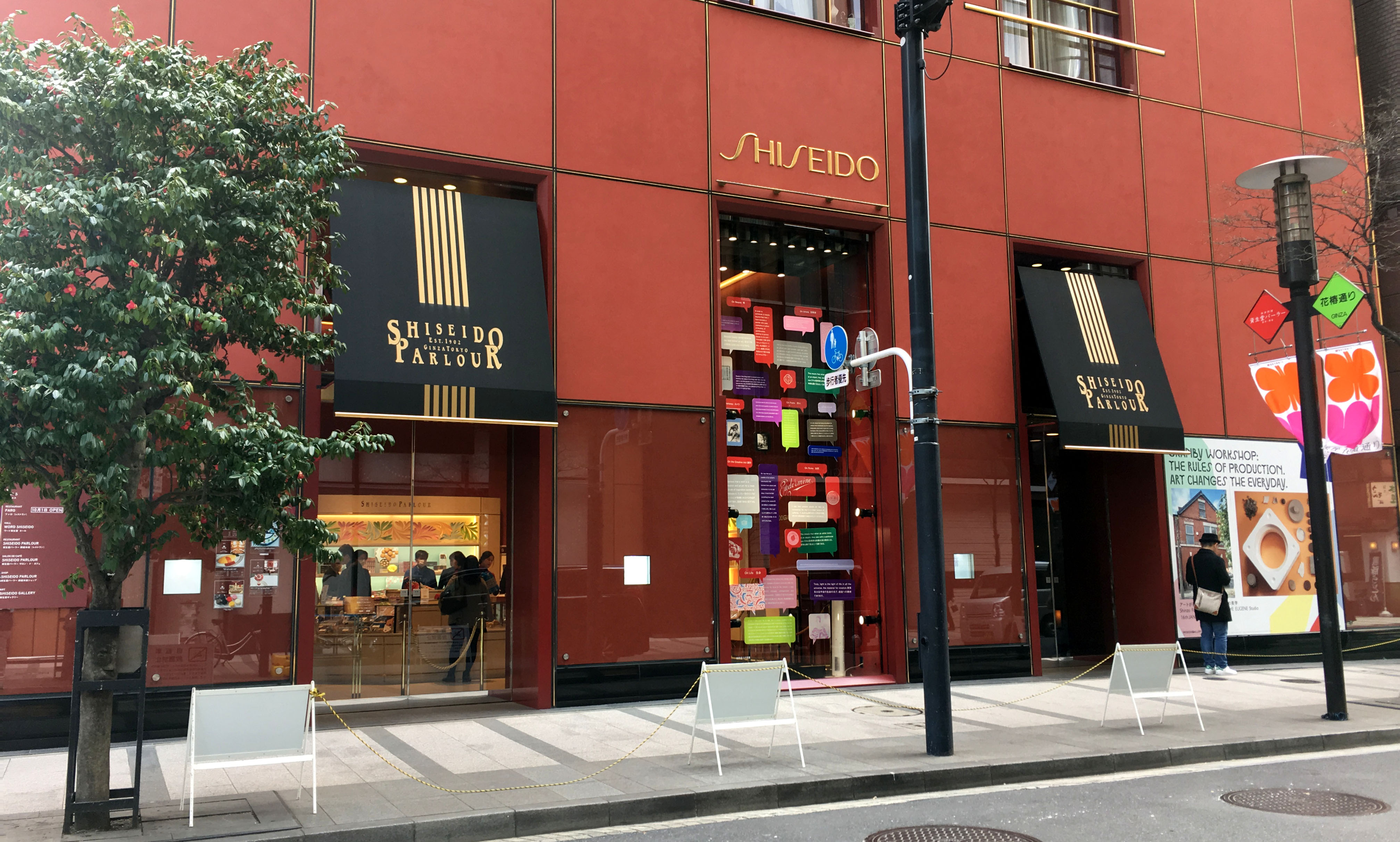
Photo: 毒島みるく / Wikimedia Commons · CC0 1.0. Shown without cropping.
The dish you wanted
Shiseido Parlour makes that continuity unusually legible. The street-level shop, third-floor café and fourth- and fifth-floor restaurant perform different jobs within the same building. Booking the restaurant is not a way of penetrating the shop’s public image. It is a way of getting a different meal. The floor matters more than an acquaintance’s assurance that they have been to “Shiseido”. Parfait, dinner and a box of biscuits are different propositions. [4]
Food writer Takeshi Kadokami had regularly used Shiseido Parlour’s now-closed Yodoyabashi restaurant in Osaka. Reading Sakiko Hirano’s Shortcake wa Senaka kara made him want its omurice again; in September 2024, he described going to Ginza for it. His visit was at lunch, not dinner. [8]
He described an egg wrapping approximately two millimetres thick, smooth but with a definite bite; concentrated chicken rice; and tomato sauce whose acidity mattered more than its sweetness. Fried parsley contributed aroma. The white tablecloths and formality did not, on his visit, make the room oppressive. His account places the attraction squarely on the plate. [8]
The restaurant’s published preparation explains why the rice merits such attention. Chicken thigh, onion and mushroom are cooked with tomato paste and ketchup into a concentrated mixture, then rested overnight. Rice is fried with that base to order, with Edam cheese added at the end. The omurice is therefore not merely a technically accomplished egg wrapped around a convenient filling. There is another preparation inside it. [9]

That division of labour is what makes familiar food interesting. An omelette can be photogenic while its contents remain negligible. A sharply defined outer shape can conceal a muddle. Here, the documented method gives a reason to expect the rice to hold its own, and Kadokami’s account supplies an instance in which it did. The appeal is not nostalgia alone. Someone with no childhood attachment to omurice can still be interested in the meeting of concentrated rice, restrained egg and an acidic sauce.
The croquette offers a related argument. In the company’s account, Einosuke Takaishi devised it in 1931; he would later serve as the third executive chef. Its continuity is in the preparation, not an untouched room. The current Tokyo Ginza Shiseido Building opened in 2001. The interesting achievement is making old preparations function within a renewed commercial operation. [1] [10]
Nor has the kitchen confined itself to preservation. Ryusuke Kurabayashi, who joined the company in 1990 and became its fourteenth executive chef in 2020, described his regional sourcing trips in a company-published interview in 2025. A visit to Akkeshi in Hokkaido had helped change how he sought ingredients; he wanted other chefs to visit producers themselves. The interesting proposition is not that travel automatically improves cooking. It is that the inherited repertoire remains available for use, rather than becoming the only permitted expression of the restaurant. [11]
The current anniversary menu puts that proposition on the table. Available until 29 November 2026, it marks the building’s twenty-fifth anniversary by revisiting the 2001 menu. Among its dishes are cornflake-fried sole with homemade tartare and Aomori pork with caramelised apple and a ginger-accented Madeira sauce. The pork is carved at the table. The sequence also includes the croquette and a rice course; the price is ¥16,500 including service, before drinks. [10]
On paper, this is a substantial dinner. The tartare and apple matter because they offer ways of arranging richness, not because they are impressive ingredients. There is also a fair question about accumulation: how much frying, sauce and ceremony does this particular evening need? An anniversary is an opportunity to choose abundance, not a reason to order beyond one’s appetite.
À la carte can make a more focused evening: meat croquettes followed by sole meunière with herb-scented brown butter, then one of the listed Japanese teas. At current prices, that combination is ¥8,140 including service. September also brings a pear-based nonalcoholic drink devised by the building’s BAR S team for the restaurant. A considered drink need not require relocation to a bar. [2]
There is no contradiction in dressing for dinner and ordering precisely what one wants. The pleasure of an impressive room need not be defended by an impressive order. Someone celebrating may want the carving, the anniversary and the successive courses. Someone else may have spent the afternoon thinking about one plate of fish. A restaurant with both formats gives those desires somewhere to coexist.
This is also why the supposedly minor preparations deserve scrutiny. In a dinner built around sauces, a spoonful left behind can say more than the ingredient announced at the table. One wants the tartare with the next piece of sole, or the tomato with the next piece of croquette; otherwise the kitchen has provided an explanation rather than a relationship between things worth eating. That is the standard the repertoire invites. Its age makes the expectation more exacting, not less.
What the chicken meal contains
Bird Land gives the evening a different centre of gravity. The business began in Asagaya in 1987 and moved to Ginza in 2001; the basement address is not the original premises. Its sustained commitment is to Okukuji shamo chicken from Ibaraki and to making a meal from more than the most immediately appealing pieces. [12]
The distinction matters when choosing the course. The current ¥9,800 menu lists an appetiser, liver pâté, eight skewers and sanshō-seasoned grilled chicken. The ¥11,800 menu adds chicken fillet with plum and shiso or basil, grilled cheese and a small oyakodon. The more expensive selection is worth considering not because it grants a superior level of admission, but because the bowl of chicken and egg changes the meal’s conclusion. [13]
In a 2024 interview with Tokyo Calendar, proprietor Toshihiro Wada explained that he first went to see the producers after reading about their chicken. His account of skewering emphasised not crushing the meat; over binchōtan, he preferred to turn it as little as possible. The work being described is controlled rather than demonstrative. A guest does not need to watch every movement for it to matter. [14]
The magazine described the pâté as smooth and rich, the result of carefully cleaning the liver. Its account of the oyakodon was equally specific: chicken stock, egg only lightly set, an idea that grew from egg-over-rice eaten at the production site. Those descriptions explain why the preparations around the skewers deserve attention. Firm meat, a spreadable liver preparation and softly set egg offer different ways of encountering the same principal ingredient. [14]
A chicken dinner loses interest when every serving makes the same argument about intensity. More concentrated is not always more pleasurable; neither is more tender. The useful question is how the kitchen makes one preparation lead to the next. Here, the pâté and rice bowl give the menu a vocabulary beyond the succession of grilled morsels. The small oyakodon is not an apologetic return to simplicity after something grand. It is one of the reasons to choose the grander meal.
Wada’s published comments about tomatoes are illuminating, too. Speaking to supplier OSMIC, he insisted on acidity as well as sweetness and described serving a grilled, peeled tomato with olive oil and no added salt. Giving it a plate of its own, rather than using it as an accessory, was important to him. This is a supplier interview, and the preparation is not promised on the current fixed menus. It nevertheless establishes a useful intention: supporting ingredients should be allowed to register. Ask about availability rather than treating an old photograph as a reservation entitlement. [15]
The drinks list offers a similarly concrete choice. Wine by the glass includes Grüner Veltliner and Saar Riesling, but there is no need to make wine appreciation an entrance examination. The published alternatives include unsweetened apple and mountain-grape juices, oolong tea, sparkling Darjeeling and alcohol-free beer. Someone who does not drink can decide what to accompany the chicken with, rather than merely what to refuse. [16]
The cost requires more care than the course headings suggest. Ikyu advertises the course with oyakodon at ¥12,980 including tax and service; its general restaurant terms separately specify a 10 percent service charge and no cover. The direct website’s headings do not make their inclusive status explicit. Keep the total attached to the actual reservation rather than adding charges twice or assuming different channels quote identically. Allow roughly ¥15,000–18,000 with drinks. This is a restaurant dinner, not a few skewers on the way elsewhere. [17]
Recent diners do not report an identical experience. One July 2026 account found the cooking ordinary and the portions slight after two courses and five beers produced a bill above ¥30,000. A returning guest writing in June praised both the food and the staff’s training. Neither short account can settle the restaurant’s present quality. Together they are a reason to avoid turning its history into an unconditional promise of value. [18]
The case for Bird Land rests on the complete chicken meal, particularly the variation offered by pâté, grilling and oyakodon. It is a more defensible reason to book than expecting a recognised address to make any bill feel justified. At this price, satisfaction cannot be delegated to the restaurant’s past.
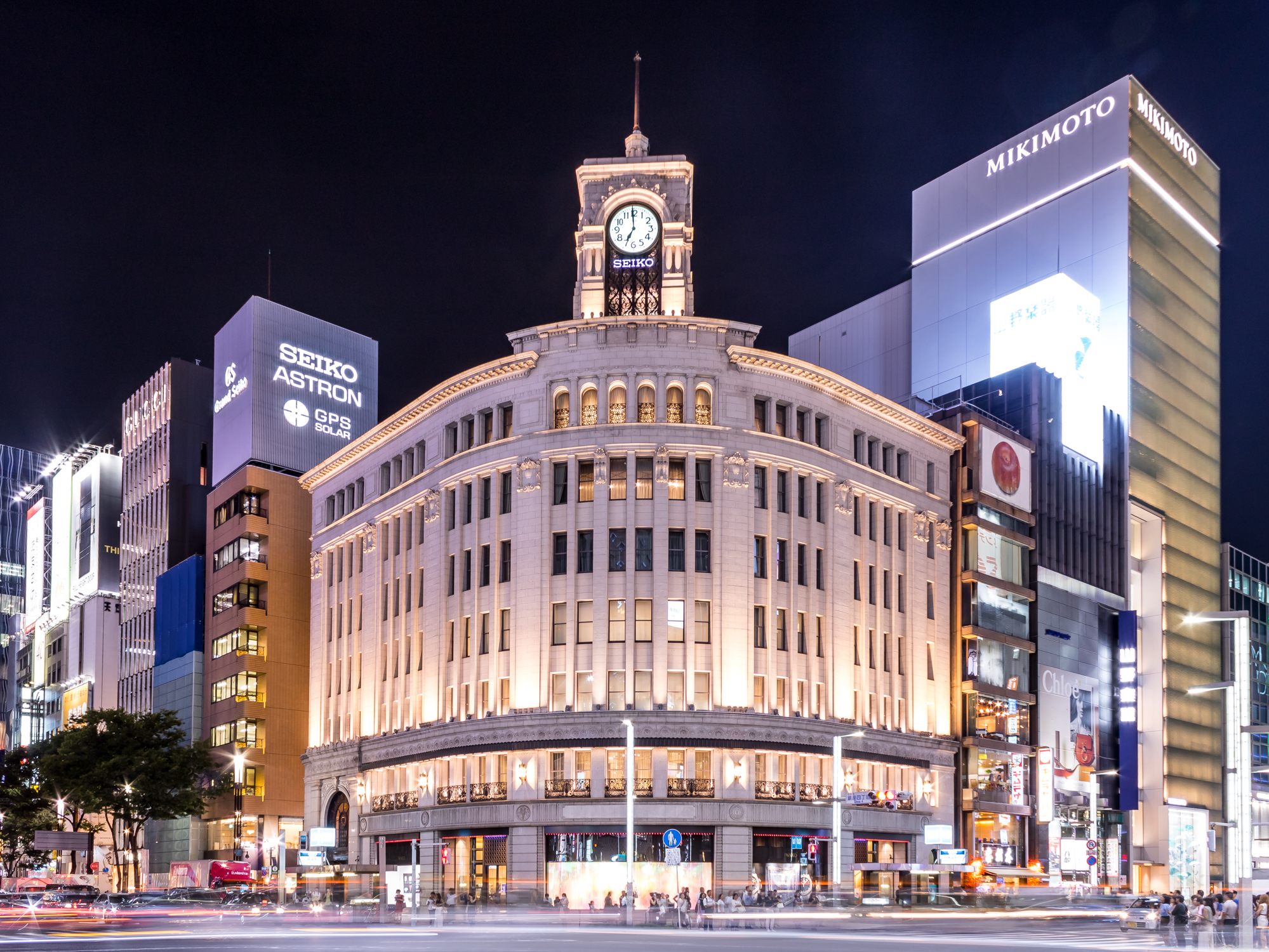
Photo © Kakidai / Wikimedia Commons · CC BY-SA 4.0. Shown without cropping.
Its current reservation notices are more helpful than the mythology of difficult bookings. The restaurant asks guests to telephone when online availability appears empty, and directs solo diners and parties of three or more to the phone. Table or counter preferences can be communicated. A screen showing no inventory is not, by itself, evidence that an introduction is required. [19]
There is another unusually plain notice for September: special opening on the twentieth and twenty-first, followed by closure from the twenty-second to the twenty-fourth because chicken deliveries stop. The supply arrangement has consequences for the diary. It is not merely a producer’s name on a menu. [19]
That notice gives the producer relationship practical force. The restaurant will alter its working week rather than promise the usual chicken dinner without the usual deliveries. It also spares a visitor a wasted journey. Such information is easily overlooked in an account of an important chef; for someone arranging a Tuesday dinner, it is indispensable.
A first-time guest has legitimate questions here: which course includes the rice, whether a table is available, what the complete bill is likely to be. Asking them need not imitate familiarity. Professional attention can be sincere while remaining professional. A carefully handled encounter does not become less valuable because neither party expects to recognise the other in five years.
The large room and the small interval
After that specialised chicken dinner, the most useful challenge comes from a room that initially seems to offer almost its opposite: the ground-floor Beer Hall Lion in Ginza 7-chome. It has 280 seats and belongs to Sapporo Lion. Its architecture is not incidental to the attraction. Neither is the fact that the principal drink is an extensively distributed lager. [20]
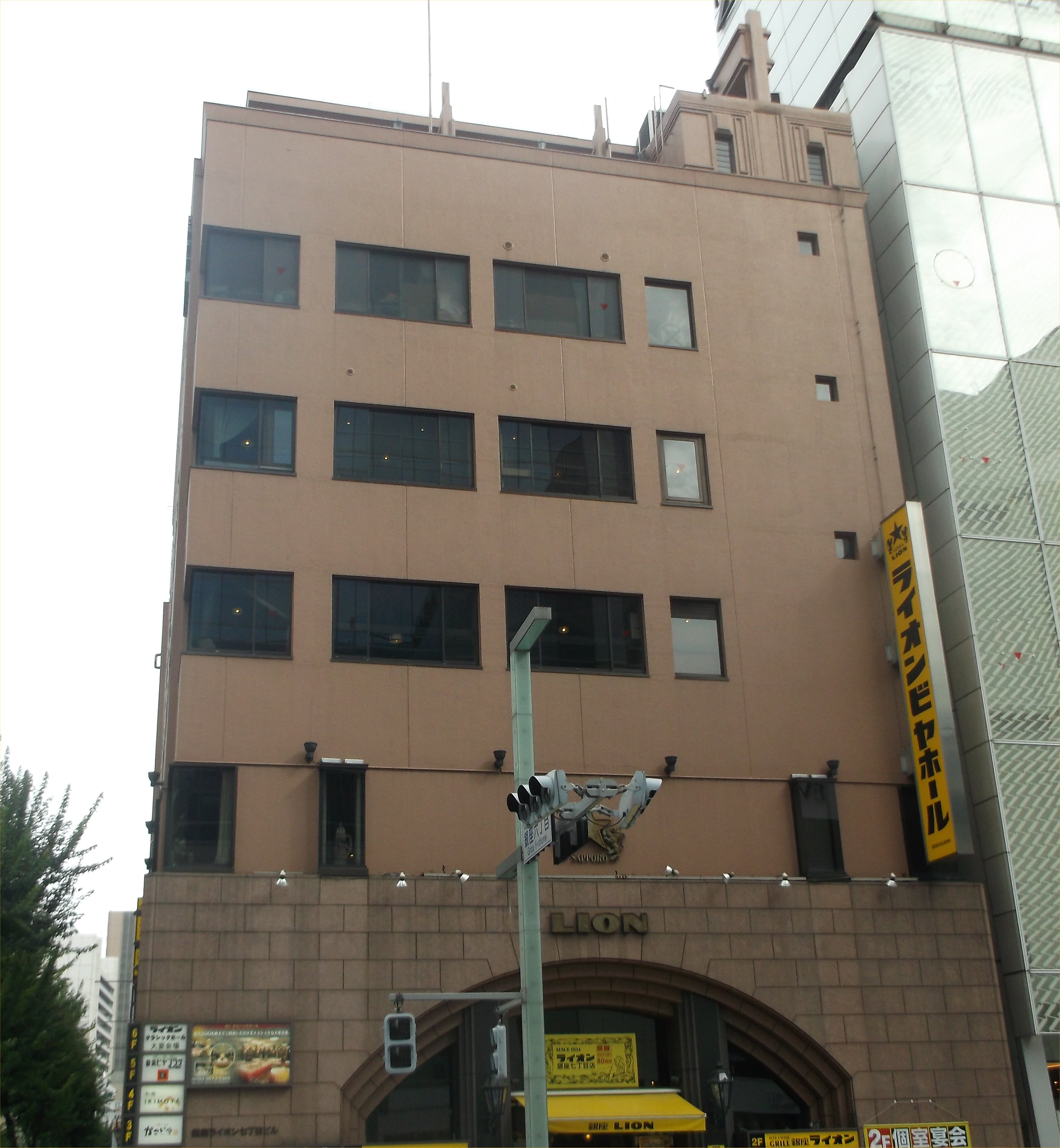
Eizō Sugawara designed the building, completed in 1934, as the headquarters of Dai Nippon Beer. Its ground-floor hall retains an extraordinary concentration of glass mosaic, tile and geometric ornament, although the building has undergone alterations and structural work. Chūō City’s heritage account distinguishes those changes from the survival of the hall. The distinction leaves ample room to admire what remains. Preservation does not require pretending that a working building has escaped maintenance. [3]
It is also unabashedly decorative. The brewery did not build a beautiful room to disguise commerce; it built one in which to conduct it. That seems a perfectly reasonable ambition. A drink does not become more sincere because the surroundings look as though nobody has spent money on them.
More surprising is the precision with which the operation describes the interval between pouring and drinking. In a December 2024 interview with Onajimi, then-general manager Katsuki Kumayama explained that experienced pourers could adjust their technique according to a table’s distance from the dispenser. The journey mattered because the foam changed while the beer was being carried. He also described teaching part-time staff about the decorations so they could answer questions, and making unobtrusive changes—such as replacing bulbs with LEDs—without destroying the appearance returning customers recognised. [20]
These are claims about training and organisation, not proof that every glass arrives perfectly. But they identify work worth examining. The impressive part is not a server performing an elaborate preparation at one guest’s table. It is the coordination required to deliver an ordinary-looking drink properly across a large room. The table at the far end is owed the same consideration as the one near the dispenser. That obligation is built into the job, rather than bestowed as a favour on a recognised customer.
The hall’s characteristic method is a single uninterrupted pour, producing liquid and foam together rather than adding a separate cap afterwards. Alku Tokyo documented the specially designed dispensing equipment and the trained staff responsible for using it. The stated aim is to release some carbonation and make the beer easier to drink. That is a particular texture to pursue, not a universal definition of the correct pint. [21]
The present menu makes the choice explicit. A small single-pour Sapporo Black Label is ¥700. A ¥760 Perfect Black Label emphasises fine, persistent foam. Start with the former to encounter the hall’s distinctive service, not because the latter must be wrong. There is no need to order an outsized vessel to demonstrate enthusiasm. The question is what happens to the beer, not how much of it one can carry. [7]
Food should earn the next mouthful rather than simply occupy the table. In its August 2024 visit, Rurubu & more described coarse-textured, moderately spicy chorizo and a tomato carpaccio made with peeled tomatoes, onion, prosciutto and chopped olives, lightly seasoned with olive oil. Both dishes remain listed. The attraction of that pairing is the alternation: seasoned meat, then tomato, rather than a procession in which every plate demands another fried accompaniment. [22] [23]
At current prices, the chorizo, tomato and one small Black Label total ¥2,570, with no service or cover charge. This is a light food-and-beer visit, not a claim that everyone will consider it dinner. A fuller order is possible. What should not be promised is an unlimited late supply of the roast beef: it is cooked in scheduled batches and sold in limited quantities. The hall’s final order does not make every dish available until that moment. [23]
The room does impose a practical limitation. The first floor cannot be reserved; the reservable restaurant upstairs is a different space. A queue is still a queue, however democratic its explanation. This is not the place to promise a particular table at a fixed minute. [7]
Yet the absence of a guaranteed seat is not the same as social uncertainty. The terms are ordinary: arrive, see whether there is room, decide whether to wait. The grand interior belongs to the offer, not to a class of guests one must resemble. Its visibility is part of its usefulness. Nobody needs to pretend to have discovered it.
Choosing the work, not the occasion
Kabukiza asks for a different kind of precision. “An evening at the kabuki” is still only an introductory explanation. Which play? Which view of the stage? How long does one actually wish to spend there?
.jpg)
Photo © dozodomo / Wikimedia Commons · CC BY-SA 2.0. Shown without cropping.
In the September 2026 programme, Numazu offers a substantial answer. A merchant encounters an elderly porter; an attempted act of help draws him into a household whose family relationships and conflicting loyalties make kindness painfully complicated. The work concerns ordinary people caught in a vendetta, rather than merely providing an occasion to admire costumes. Its published running time is 16:39–18:27. [24]
The attraction is dramatic: people who discover what they owe one another when other obligations make that knowledge dangerous. This is a reason to choose the work even before one knows how a particular cast will realise it. It is not a review of this month’s performances, which would require attendance. A synopsis can establish what is at stake, not whether an actor has made it devastating.
There is also room for a less grave preference. The same evening’s Kyō Ningyō, scheduled for 19:02–19:32, concerns a sculptor’s doll coming to life and includes a fight involving carpenters’ tools. A living doll and comic combat are entirely respectable reasons to go out. A longer tragedy is not automatically a more cultivated choice. [24]
The theatre’s single-act arrangements make those decisions possible, but not without trade-offs. Fourth-level seats are distant and relatively confined. Shochiku explicitly warns that the hanamichi runway is not visible and that part of the main stage may be obscured. Calling this simply a clever way to get the same experience for less would conceal the most important condition of the ticket. [25]
There are also upgraded single-act seats on the second level, a small group in the right-side seating area, closer to the stage. They do not require joining a private circle; reservations open at noon on the previous day. Their availability varies by date, and same-day sales for this category finish at 17:00. A remembered account of how kabuki tickets used to work is not enough. [26]
For Numazu, the September tariff is ¥2,800 on the fourth level or ¥9,400 for the second-level single-act seats. An English captioning device costs another ¥1,000 for a single act; online booking adds a ¥110 system fee. That makes ¥3,910 or ¥10,510 respectively. The higher price buys a different physical relationship to one work, not more theatre. [27]
Captioning supplies essential dialogue, lyrics and explanations. It is useful assistance, not an admission that one has arrived insufficiently prepared. Paying attention with help is more worthwhile than maintaining a dignified incomprehension. Equally, no device can decide whether tragedy or comedy is what this evening needs. [28]
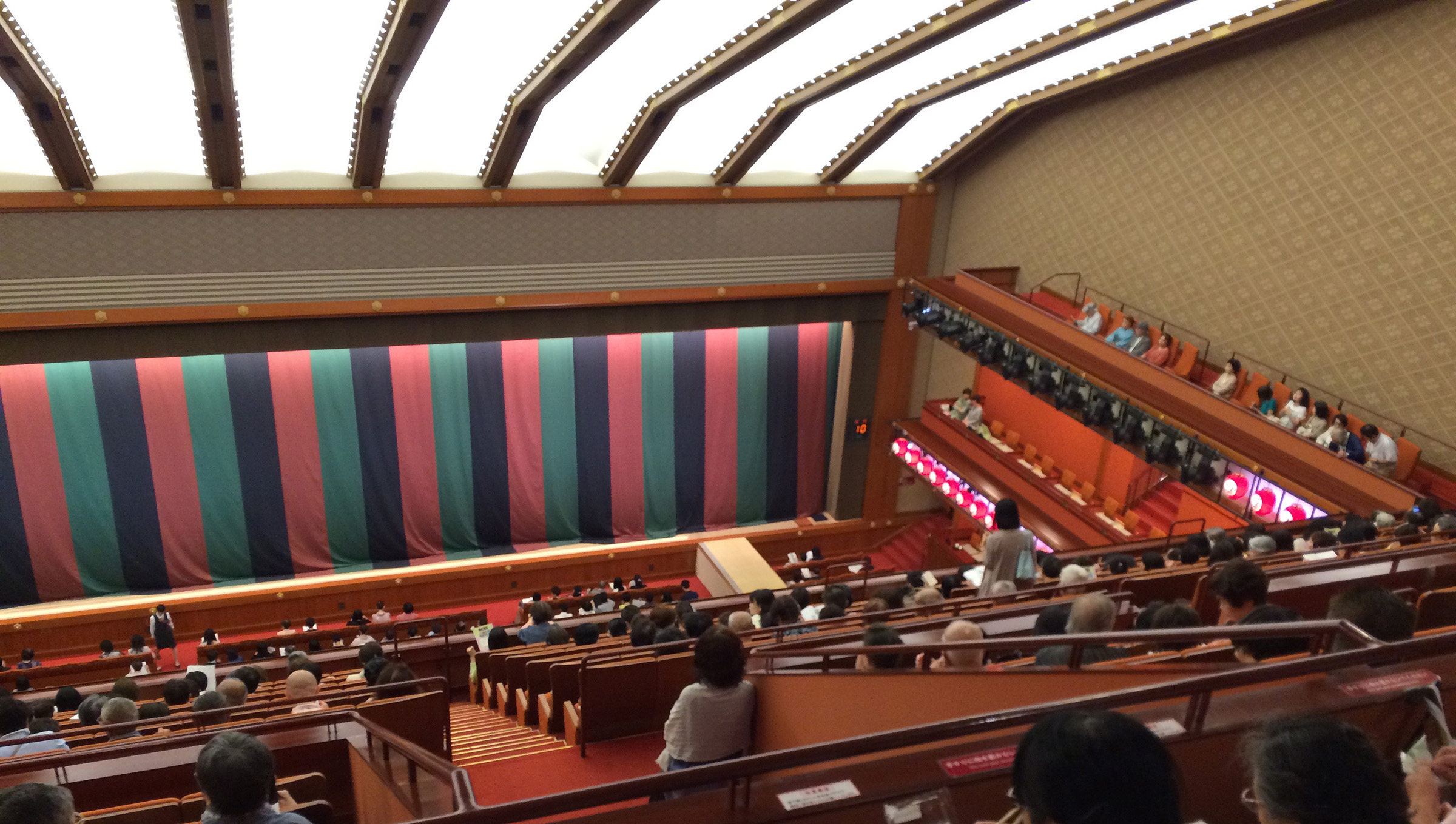
Photo © Marcinwiacek / Wikimedia Commons · CC BY-SA 4.0. Shown without cropping.
The clock then makes an editorial decision that a glossy itinerary might prefer to avoid. September’s complete evening programme is scheduled to finish at 20:49. Shiseido Parlour stops taking orders at 20:30. Those two experiences cannot be combined as a full performance followed by dinner at the restaurant, however attractive they look beside one another on a page. [27] [2]
Leaving after Numazu creates a different possibility: its 18:27 finish leaves room for a 19:15 restaurant reservation. Allow twenty minutes for the walk west along Harumi-dōri and south along Chūō-dōri, as well as time to leave the theatre. That is a planning allowance, not a promise about crowding or pace. The practical point is not to optimise the evening into two accomplishments. It is to avoid making dinner feel like an interruption of the play, or the play an obstacle to dinner. [27]
There is no obligation to combine them. Someone who wants the complete programme should take it seriously enough to give it the evening. Someone who wants the croquettes need not acquire a cultural preface. The choices become more interesting when neither has to justify the other.
The space between those choices is useful, too. A free hour need not immediately become a booking problem. It may be time to talk about the play, to decide whether dinner was enough, or to realise that the person across the table would rather stay where they are. None of these possibilities can be promised by an address. A good choice simply leaves enough room for them.
After his Ginza lunch, Kadokami wrote that he hoped Shiseido Parlour would return to Kansai. The Yodoyabashi restaurant had disappeared; the appetite had not. [8]
There is room in that wish for both attachment and change. A restaurant may outlast the room where someone first encountered it. A visitor may never return and still have chosen exactly the right dinner. There is no need to turn the first visit into a pledge. Returning is a pleasure when the desire comes back, not an obligation incurred by having praised the place.
For now, there is a restaurant in Ginza making the croquette with béchamel, finishing it in the oven and putting the tomato sauce underneath. It is possible to make a reservation for that, and leave the rest of the night unbooked.
Reporting note: This feature draws on Japanese- and English-language menus, reservation terms, published interviews and attributed criticism. The original draft identifies its reporting cut-off as 5 September 2026. No firsthand meals, drinks, performances or interviews were undertaken for this article. Sensory observations are attributed; the selection and analysis are editorial judgments. Photographs are independently sourced archival images, dated in their captions, not documentation of an EDIT27 visit.
Practical notes
September 2026 edition. These details are retained from the original draft and have not been rechecked as part of this photographic layout. September performances and seasonal offers have passed; consult current listings before booking.
Shiseido Parlour Restaurant, Ginza Main Store
資生堂パーラー 銀座本店レストラン
Location: Tokyo Ginza Shiseido Building, 4F–5F, 8-8-3 Ginza, Chūō-ku. The recommendation concerns this restaurant, not the third-floor café or FARO. Public reservations: +81 3 5537 6241. Open 11:30–21:30; last orders 20:30. Closed Mondays except public holidays, with additional year-end/New Year closures. [4]
Order and cost: Croquettes, sole meunière and Japanese tea total ¥8,140 including service in the original draft. The anniversary course is listed at ¥16,500 including service, drinks extra, through 29 November 2026; optional upgraded dishes cost more. Listed restaurant prices include tax; 10 percent service is additional. Main limitation: 20:30 is the published last-order time, not a verified latest arrival for every full course. Establish the arrival time when reserving. [2] [10]
Bird Land Ginza
銀座バードランド
Location: B1, Tsukamoto Sōzan Building, 4-2-15 Ginza, Chūō-ku, near Ginza Station C6. Reserve publicly online or at +81 3 5250 1081; solo diners and parties of three or more are directed to telephone. No introduction is required. [5] [19]
Order and cost: Choose the course including pâté and small oyakodon. Ikyu advertised ¥12,980 tax/service-inclusive at the original reporting cut-off; allow approximately ¥15,000–18,000 with drinks, depending on the order and booked terms. The general listing states 10 percent service, no cover. Confirm the inclusive total for direct reservations. [17]
Evening conditions: The official site listed 17:00–21:30, while Ikyu listed closing at 22:00 with 21:30 last orders. Book an explicit dinner seating rather than interpreting either as a late-arrival promise. Normally closed Sundays, Mondays and holidays; September exceptions described above are historical. The direct-booking notice cited in the draft specified ¥11,000 per person for same-day cancellation; agency bookings follow their own confirmed terms. Main limitation: differing published hours and price presentation require confirmation. [5] [19] [17]
Beer Hall Lion, Ginza 7-chome
ビヤホールライオン 銀座七丁目店
Location: 1F, Ginza Lion Building, 7-9-20 Ginza, Chūō-ku. This recommendation is specifically for the ground-floor hall. Walk-ins only; the reservable second-floor restaurant is different. Telephone: +81 3 3571 2590. [23] [7]
Hours: Monday–Thursday and Sunday 11:30–22:00, last orders 21:30; Friday, Saturday and holiday eves 11:30–22:30, last orders 22:00 in the original draft. Holiday combinations can alter the pattern. Cost: chorizo, tomato carpaccio and one small Black Label total ¥2,570, tax included, with no service or cover charge. Alcohol-free bottled beer is listed at ¥700. Main limitation: no guaranteed seat, and limited-batch dishes can sell out before final orders. [7] [23]
Kabukiza Theatre
歌舞伎座
Location: 4-12-15 Ginza, Chūō-ku, at Higashi-Ginza Station, exit 3. The September 2026 programme ran 2–26 September, with no performances on 9 or 18 September. Full evening shows on 5 and 21 September were privately booked; fourth-level single-act sales still operated. This programme has ended. [6] [24]
Programme discussed in this article: Numazu was scheduled 16:39–18:27; Kyō Ningyō, 19:02–19:32. Reserved single-act sales opened noon Japan time the previous day. Fourth-level unreserved tickets were sold from 10:00 on the performance day, subject to availability. Upgraded second-level single-act seats were date-dependent. [27]
Indicative historical cost and limitation: Numazu with online fee and single-act captioning totalled ¥3,910 on level four or ¥10,510 in upgraded level-two seating. Captioning rental required cash. Full-programme tickets ranged from ¥5,000–20,000, before optional ¥1,500 captioning and any applicable booking fee. Fourth-level sightlines are restricted; its entrance and facilities are separate from the main auditorium floors. Recheck the current monthly programme, seating conditions and prices rather than transferring September’s details to another visit. [27] [28] [25]
.png)


.png)


.jpg)
